TL;DR: The biggest minoxidil news in 2024-2025 centers on oral minoxidil's growing off-label use, FDA discussions about non-prescription oral access, stronger combination data with finasteride, and new compounding pharmacy restrictions. Topical minoxidil remains FDA-approved and unchanged. The science is getting sharper, the access landscape is shifting, and knowing the difference matters before you spend money.
What is the latest news on minoxidil in 2024 and 2025?
Minoxidil has been around since the 1980s, so calling anything about it "new" requires some honesty about what actually changed versus what just got more attention. Three developments matter right now.
First, oral minoxidil's off-label use went from a fringe dermatology practice to a mainstream option, with multiple academic medical centers publishing their protocols and the American Academy of Dermatology discussing it openly in 2023-2024 clinical guidance updates [1]. It isn't FDA-approved for hair loss in oral form, but it's legally prescribed off-label and the evidence base has grown fast.
Second, the FDA's Nonprescription Drug Advisory Committee has fielded renewed pressure to consider an OTC pathway for low-dose oral minoxidil. No approval has happened as of mid-2025, but the conversation is no longer hypothetical [2].
Third, the compounding pharmacy landscape shifted. The FDA's removal of minoxidil from the Category 1 bulks list in draft guidance (then partly revised) created real turbulence for telehealth companies that sell compounded topical minoxidil with additives like finasteride or tretinoin. If you're buying a compounded product, the regulatory ground under it is less stable than it was two years ago [2].
None of these developments changes whether topical minoxidil works. It does, for a large share of people with androgenetic alopecia. What's changing is the form, the dose, and who gets to sell it.
What is oral minoxidil and why is everyone suddenly talking about it?
Oral minoxidil was developed as a blood pressure drug in the 1970s. The doses used for hypertension run 10-40 mg daily. Dermatologists noticed that hair growth was a well-documented side effect, and they started experimenting with much smaller doses, typically 0.25 mg to 5 mg daily, specifically for hair loss [3].
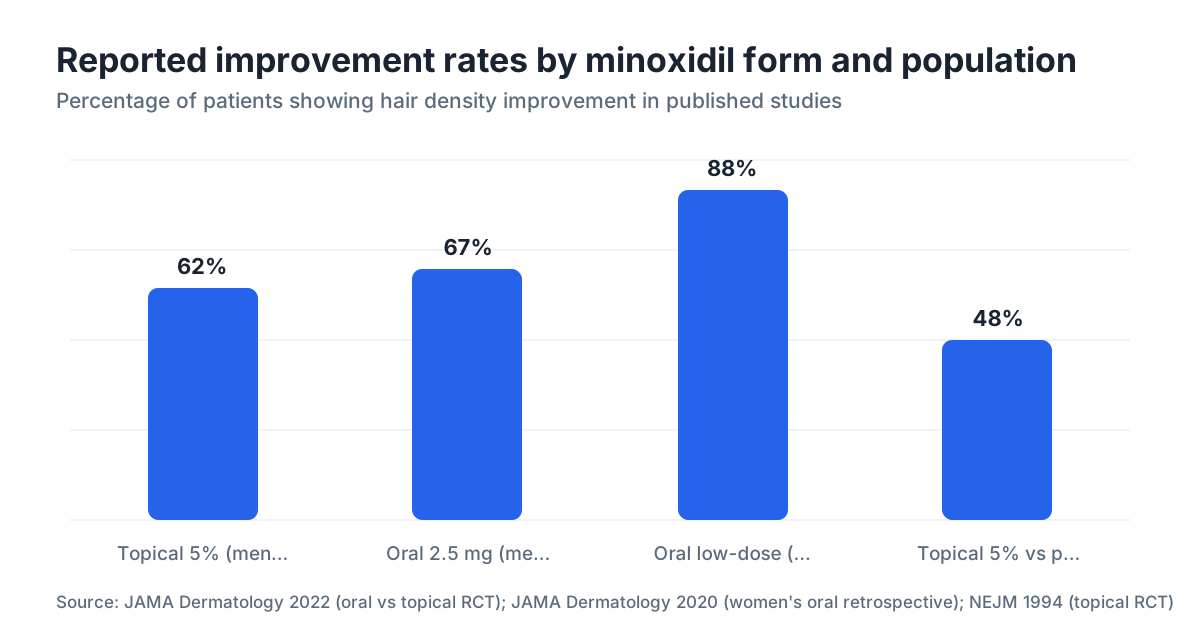
The study that moved this into mainstream dermatology was a randomized trial published in JAMA Dermatology in 2022, comparing low-dose oral minoxidil (0.5 mg in women, 2.5 mg in men) against topical 5% minoxidil over 24 weeks. The oral group saw comparable or slightly better hair density outcomes with side effects mostly limited to mild fluid retention and hypertrichosis (unwanted body hair) [3]. That paper got attention because it was well-controlled and the doses were low enough to suggest acceptable safety for otherwise healthy adults.
Since then, prescriptions for low-dose oral minoxidil have climbed sharply at major dermatology practices. Researchers at the Cleveland Clinic, University of Miami, and elsewhere have published retrospective reviews showing response rates in the 70-80% range for androgenetic alopecia across both sexes, though those are clinic populations, not general population trials, so take the numbers with appropriate caution [4].
The honest reason everyone is talking about it: it's a pill, it's cheap (generic minoxidil tablets can cost $10-30 per month at compounding pharmacies or with GoodRx), and the early data looks at least as good as the foam or solution most people struggle to apply consistently. Read more about the evidence and risks at oral minoxidil.
The downside is real. Even at low doses, some people get fluid retention, and cardiovascular screening is standard practice before prescribing. Anyone with a history of heart or kidney disease needs a more careful conversation with their doctor before starting.
Did the FDA change its position on minoxidil in 2024?
The FDA has not approved any new minoxidil indication or form as of mid-2025. What did happen is more procedural but still matters.
In 2023, the FDA released draft guidance proposing to remove minoxidil from the list of bulk drug substances that compounding pharmacies can freely use (the 503A and 503B lists). This would have significantly restricted compounded topical and oral minoxidil products, particularly the combination formulas (minoxidil plus finasteride, minoxidil plus tretinoin) that telehealth platforms have been selling [2].
After substantial public comment from dermatology societies and patient advocates, the agency revised parts of that position, but the situation remains unresolved. Minoxidil's regulatory status for compounding is still under active review, which means some compounded products you can buy today might not be available through the same channel next year.
For standard, brand-name or generic topical minoxidil (Rogaine, generic 2% and 5% solutions, minoxidil foam), nothing has changed. Those remain OTC drugs under existing FDA approval. Men's 5% topical is approved for androgenetic alopecia; women's 2% topical is approved for androgenetic alopecia; both have been since the late 1980s and early 1990s respectively [5].
The FDA's own label language states the product is "for use by men only" on the 5% version, and "not for use by people under 18 years of age." These restrictions haven't changed [5].
How does the new combination data for minoxidil plus finasteride change things?
This is probably the most clinically relevant development for men with androgenetic alopecia who are already using or considering treatment.
A 2023 meta-analysis published in the Journal of the American Academy of Dermatology synthesized data from multiple randomized controlled trials and found that the combination of oral finasteride plus topical minoxidil outperformed either drug alone on hair count endpoints after 12-24 months of treatment [6]. The effect sizes weren't dramatically larger, but they were consistent across studies, which is what makes a meta-analysis convincing.
For men at early-to-mid Norwood stages (II through IV), this data supports what many dermatologists have prescribed for years: finasteride to block DHT at the follicle level, minoxidil to extend the anagen (growth) phase and improve follicle blood supply. They work through different mechanisms, which is why stacking them makes biological sense.
Some telehealth companies have leaned hard on this combination data to sell compounded topical products that include both drugs in one solution. The convenience argument is real, but those products carry the compounding uncertainty described above. If you want both drugs, separate prescriptions give you more regulatory stability and clearer dosing.
For a thorough comparison of using both drugs together, see finasteride and minoxidil. And if you're new to finasteride itself, finasteride covers the mechanism and side effect profile in detail.
Women should note that finasteride is not FDA-approved for female pattern hair loss and carries teratogenicity risks. The combination approach described here applies primarily to men.
What are the compounding pharmacy changes and how do they affect you?
A significant share of people treating hair loss get their minoxidil from telehealth companies like Hims, Keeps, Ro, or direct compounding pharmacies. These services typically sell customized topical formulas, often with additives not found in OTC products.
The regulatory risk is this: compounding pharmacies can legally produce drugs for individual patients using bulk substances, but those substances must appear on the FDA's approved bulks lists (under 503A for patient-specific compounding and 503B for outsourcing facilities). When the FDA proposes removing a substance from those lists, compounders lose legal authority to use it in that context.
Minoxidil's proposed removal from the 503A/503B lists was contested and partially walked back, but the uncertainty itself has business consequences. Several telehealth platforms have reformulated products or added disclaimers. Some compounders operating in states with looser oversight have ignored the guidance, which creates product quality risk for the consumer.
If you're buying a compounded minoxidil product, ask your pharmacy which FDA list covers their minoxidil source. It's a reasonable question and any legitimate compounding pharmacy should be able to answer it [2].
OTC generic topical minoxidil from a major pharmacy chain is unaffected by all of this. It costs $20-40 for a 60 mL bottle and is manufactured under standard FDA drug manufacturing requirements. If your goal is basic topical minoxidil, there's no reason to use a compounding pharmacy.
Does topical minoxidil still work, or is oral minoxidil better?
Topical minoxidil still works. The evidence base for it is larger than for any other hair loss treatment, built over 35+ years and multiple well-controlled trials. In men with androgenetic alopecia, 5% topical applied twice daily produces statistically significant increases in hair count versus placebo at 48 weeks, a finding replicated across independent trials [7].
Whether oral is better is genuinely unsettled. The 2022 JAMA Dermatology trial found comparable results between low-dose oral and topical 5%, not a clear winner [3]. Other smaller studies lean slightly toward oral on patient adherence (people take a pill more consistently than they apply a topical) and some measures of hair density. But the long-term safety data for chronic low-dose oral minoxidil is thin next to 35 years of topical data.
Here's how to think about it practically. If you've been applying topical minoxidil consistently for 12 months and it's working, there's no compelling reason to switch. If you're struggling with the application routine, or if topical has produced modest results, discussing oral with a dermatologist is a reasonable next step.
If you want a full look at how minoxidil works for men specifically, minoxidil for men covers the dose, application, and realistic expectations.
Before starting either form, it helps to understand what's actually driving your hair loss, because minoxidil works best for androgenetic alopecia and not as well for telogen effluvium or other types. And if you're wondering about minoxidil side effects, the profile differs meaningfully between topical and oral.
What does the research say about minoxidil for women in 2024-2025?
Women's use of minoxidil has attracted more research attention in recent years, partly driven by the oral minoxidil wave and partly because female pattern hair loss is underdiagnosed and undertreated compared to male pattern loss.
The FDA-approved topical option for women is 2% solution, used twice daily. A 5% formulation is approved for men and sometimes prescribed off-label for women, though the labeling explicitly says "for use by men only." Dermatologists do use 5% in women, particularly postmenopausal women, but that's an off-label decision [5].
For oral minoxidil in women, doses of 0.25 mg to 1.25 mg daily have shown meaningful hair density improvements in small trials. A retrospective study from the Hospital de la Santa Creu i Sant Pau in Barcelona (published in JAMA Dermatology in 2020) followed 100 women on low-dose oral minoxidil and found 88% reported at least some improvement in hair density at 12 months, with the most common side effect being hypertrichosis affecting about 37% of patients [4]. Those numbers are from a clinic population on a voluntary questionnaire, so they're not a rigorous controlled trial, but the signal is consistent with other observational data.
Hypertrichosis (unwanted facial or body hair growth) is the side effect that stops many women from continuing oral minoxidil. It's dose-dependent, so staying at the lowest effective dose matters. It's also reversible when you stop the drug.
For any woman with hair loss before 50, ruling out causes like thyroid dysfunction, iron deficiency, and hormonal shifts is worth doing before starting minoxidil. Minoxidil isn't a diagnosis, it's a treatment, and it works better when you know what you're treating. What causes hair loss covers that diagnostic ground.
Are there new minoxidil formulations or delivery methods in development?
Yes, though most are in early or mid-stage trials and none have received FDA approval as of mid-2025.
Minoxidil sulfate (the active metabolite that minoxidil converts to in the scalp) has been explored as a topical alternative to minoxidil itself. The logic: some people are "non-responders" to topical minoxidil because they have low sulfotransferase activity in their scalp skin, which means they can't efficiently convert minoxidil to its active form. A topical minoxidil sulfate product would bypass that conversion step. Small studies have shown promise, particularly for the roughly 30% of people who respond poorly to standard topical minoxidil, but no product has cleared FDA review [8].
Nanoparticle and liposomal delivery systems for minoxidil have also been published in dermatology literature, with the goal of improving follicular penetration and reducing systemic absorption from topical application. Again, these are research formulations, not approved products.
Spray formulations and leave-in conditioner hybrids containing 2-5% minoxidil have proliferated in the cosmetics market, sold as "cosmetic" products rather than drugs to avoid the FDA approval process. These are not regulated as drugs, meaning the concentration and bioavailability claims are not independently verified. If you're using one, know what you're buying.
Platelet-rich plasma (PRP) combined with minoxidil has some trial data suggesting additive benefit, but it's expensive, not widely standardized, and the evidence doesn't yet support it as a first-line combination therapy.
The most likely near-term approval scenario is low-dose oral minoxidil getting formal FDA attention, given the volume of published off-label data. But there's no announced NDA submission as of this writing.
How does minoxidil compare to other hair loss treatments right now?
Minoxidil sits in a specific spot in the treatment landscape: it's the most widely used and longest-studied topical option, it's available without a prescription, and it works for most people with androgenetic alopecia if used consistently.
Finasteride (oral, 1 mg daily) has better long-term trial data for preserving hair in men with androgenetic alopecia, with a 5-year randomized trial showing 48% of men receiving finasteride had increased hair count versus 14% of placebo patients [9]. But finasteride requires a prescription, carries sexual side effect risks (affecting roughly 1.5-3.8% of users in clinical trials), and doesn't work for women with androgenetic alopecia in the same way.
Dutasteride, another DHT blocker, has shown slightly stronger effects than finasteride in some trials but also has stronger side effect potential and less long-term safety data [10].
Hair transplant surgery is the only option that moves existing follicles to create durable results in specific areas, but it works best as a complement to medical therapy, not a replacement, and it requires stopping loss before or during surgery to preserve results. Hair transplant covers what that process actually involves.
Below is a comparison of the main treatment options based on published data.
| Treatment | FDA-approved for AGA | Rx required | Evidence level | Common side effects |
|---|---|---|---|---|
| Topical minoxidil 5% (men) | Yes | No | Multiple RCTs | Scalp irritation, shedding at start |
| Topical minoxidil 2% (women) | Yes | No | Multiple RCTs | Scalp irritation, hypertrichosis |
| Oral minoxidil (low dose) | No (off-label) | Yes | Growing RCT data | Fluid retention, hypertrichosis |
| Oral finasteride 1 mg (men) | Yes | Yes | Multiple RCTs, 5-yr data | Sexual side effects (~2-4%) |
| Dutasteride 0.5 mg (men) | No (off-label in US) | Yes | RCT data | Similar to finasteride, longer half-life |
| Hair transplant | N/A | N/A | Established surgical outcomes | Surgical risks, donor depletion |
For men researching DHT blockers, understanding where minoxidil fits relative to finasteride is one of the first questions worth settling.
If you want a third-party look at where your hair loss stands before committing to any treatment, MyHairline's free AI scan (/scan) can assess your hairline pattern and Norwood stage from photos, which at least tells you what you're starting with.
What should you actually do right now given these developments?
Here's an honest take on applying the news to a real decision.
If you're not on any treatment and you have androgenetic alopecia, starting topical minoxidil is still the lowest-friction, lowest-risk first step. It's OTC, the evidence is solid, and the downside risk is minimal. Use it consistently for 12 months before deciding it doesn't work. Most people who "fail" minoxidil stop in month two or three because they shed (which is expected and temporary) or because they don't see dramatic early results (also normal for a drug that works by slowing loss and gradually improving density).
If you're a man already on topical minoxidil and want to do more, the combination data supports adding finasteride, and a dermatologist visit is the right way to start that conversation. Don't just add a pill from a telehealth platform without someone reviewing your health history.
If you're interested in oral minoxidil because you hate the topical application, that's a legitimate reason to ask your doctor. The evidence supports it. Ask specifically about dose, cardiovascular screening, and what to watch for in terms of fluid retention.
If you're buying a compounded combination product (minoxidil plus finasteride, minoxidil plus tretinoin), ask your telehealth provider directly what happens to your prescription if the compounding rules change. Have a backup plan.
For women, the conversation is more individualized. Get the diagnosis right first. A dermatologist visit to rule out other causes is worth more than starting minoxidil blindly.
For anyone at a receding hairline stage who hasn't done anything yet, the time you spend waiting is the time loss goes unchecked. Minoxidil won't regrow what's long gone, but it can slow what's happening now. That's the window.
MyHairline's AI scan (/scan) can give you a baseline assessment of your hairline stage for free, which at least frames the decision with some objectivity before you spend money on treatments.
Sources
- American Academy of Dermatology, Hair Loss: Diagnosis and Treatment
- JAMA Dermatology, 2022: Low-Dose Oral Minoxidil vs Topical Minoxidil for Androgenetic Alopecia
- JAMA Dermatology, 2020: Low-Dose Oral Minoxidil in 100 Women with Female Pattern Hair Loss
- FDA, Drug Label: Rogaine (Minoxidil) 5% Topical Solution
- Journal of the American Academy of Dermatology, 2023: Meta-analysis of Finasteride Plus Minoxidil vs Monotherapy
- New England Journal of Medicine, 1994: Topical Minoxidil for Male-Pattern Baldness
- Journal of the American Academy of Dermatology: Sulfotransferase Activity and Minoxidil Response
- Journal of the American Academy of Dermatology, 2002: Five-Year Finasteride Randomized Trial
- Journal of the American Academy of Dermatology: Dutasteride vs Finasteride for Androgenetic Alopecia
- FDA, Orange Book: Approved Drug Products with Therapeutic Equivalence Evaluations