
TL;DR: Minoxidil scalp irritation affects roughly 7% of topical users. The usual cause is propylene glycol, the solvent in most liquid formulas, not minoxidil itself. Switching to a propylene-glycol-free foam, dropping to once-daily application for a couple of weeks, or adding a gentle anti-dandruff shampoo clears most cases without stopping treatment.
Why does minoxidil make your scalp itch?
Minoxidil the molecule is rarely the culprit. The itch almost always traces back to propylene glycol, the solvent used in most liquid minoxidil formulas and some foams to help the drug soak into the scalp. Propylene glycol is a documented contact irritant, and in some people it triggers a true allergic contact dermatitis, which looks and feels much worse than plain irritation. [1]
The FDA-approved labeling for Rogaine (2% and 5% topical minoxidil) lists scalp irritation, itching, redness, and dryness as known adverse reactions, so this is not a fringe experience. [2] The label also notes that irritation can mean you're reacting to propylene glycol rather than minoxidil, and it points people toward a propylene-glycol-free formulation.
There's a second mechanism worth knowing. Minoxidil slightly speeds up cell turnover on the scalp. That can disrupt the skin barrier, make the scalp oilier (better-vascularized skin often means busier sebaceous glands), and set up conditions where Malassezia yeast, the organism behind dandruff, thrives. The result: some people develop or worsen dandruff-like flaking alongside real irritation, and the whole thing feels itchier. [3]
A minority of people do react to minoxidil itself. If you switch to a propylene-glycol-free formula and still get significant redness, swelling, or hives, that's the more likely scenario. Talk to a dermatologist before continuing.
How common is scalp irritation from minoxidil?
Roughly 7% of users. The number depends a lot on which formulation you use and how sensitive your scalp already is.
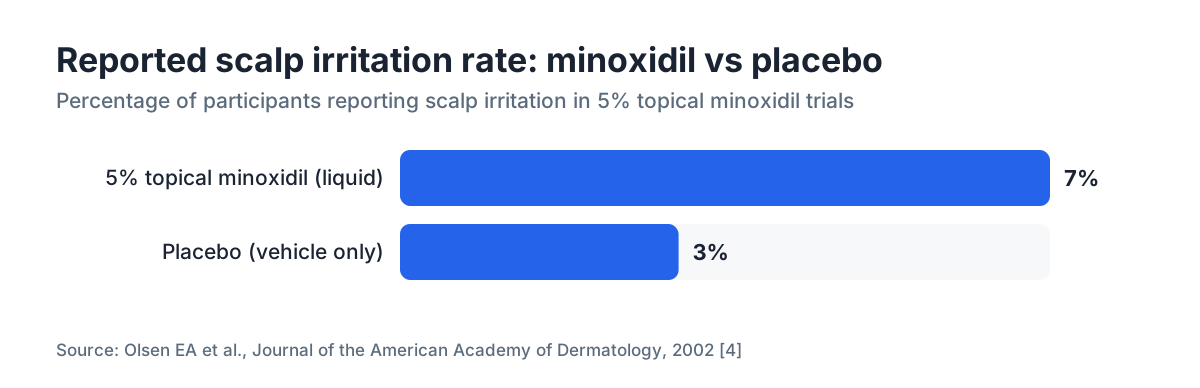
In the main trials for 5% topical minoxidil solution, scalp irritation and itching showed up in about 7% of users versus about 3% in the placebo group, which points to a real but not overwhelming risk from the product. [4] Foam formulations, built partly to cut propylene glycol exposure, show lower irritation rates in head-to-head comparisons, though the exact percentages move around between studies. [10]
For context: the far more common complaint is shedding in the first 4 to 8 weeks of use. That's normal (see the section below on shedding versus irritation). Irritation bad enough to make someone quit is less common than most people fear before they start.
What does minoxidil irritation actually look and feel like?
Not everything that itches is a reaction to minoxidil. Here's how to tell the types apart.
Typical propylene glycol irritation: mild to moderate itching that starts within an hour of application, some redness at the spots you treated, maybe a little flaking or dry skin. It stays where you put the product and fades after you rinse.
Contact dermatitis (allergic reaction): more intense itching, visible redness, small bumps or pustules, and sometimes spreading past the application zone to your forehead, ears, or neck. It can take a few days to show up after you start a new product. A true allergic contact dermatitis will not calm down on its own; it usually gets worse with each application. [1]
Dandruff-related itch: flaky white or yellowish scale, itching that's diffuse rather than spot-specific, often worse in cold or dry weather. You can manage this without stopping minoxidil.
Seborrheic dermatitis flare: like dandruff but angrier, sometimes with oily orange-tinted crust at the hairline. If you've had seborrheic dermatitis before, minoxidil can kick it up a notch.
If you develop facial swelling, a rash spreading down your neck, chest tightness, or trouble breathing after applying minoxidil, stop and get emergency care. Those are signs of a systemic allergic reaction, which is rare but real. [2]
Which minoxidil formulas are worse for irritation: liquid or foam?
Liquid is worse for most people. Liquid minoxidil (both 2% and 5%) almost always contains propylene glycol. Foam minoxidil (5%) was built specifically to cut that exposure: most foams use ethanol and other excipients instead. The FDA approved 5% minoxidil foam partly because it gives an alternative to patients who couldn't tolerate the liquid. [2]
Foam isn't irritation-free for everyone, though. Ethanol, the main carrier in foam, dries the skin. Some people find the alcohol dries their scalp enough to cause its own low-grade itch, especially in winter or dry climates.
Generic liquid minoxidil (2% or 5%) without propylene glycol exists, but you have to read labels carefully or buy from a compounding pharmacy. The AAD points to propylene-glycol-free formulations as a reasonable first move for anyone with a sensitive scalp. [5]
Oral minoxidil is a different animal. Because it skips your scalp entirely, it causes no topical irritation at all. The tradeoffs are systemic side effects (fluid retention, extra body hair, faster heart rate at higher doses) and the fact that it's used off-label for hair loss. [6] If topical minoxidil keeps irritating you no matter what you try, oral minoxidil is a legitimate conversation to have with a dermatologist. More at oral minoxidil.
| Formula | Contains propylene glycol? | Typical irritation rate | Best for |
|---|---|---|---|
| 2% liquid | Yes (most brands) | Higher | Budget-focused, lower-dose users |
| 5% liquid | Yes (most brands) | Higher | Men comfortable with liquid |
| 5% foam | No (most brands) | Lower | Sensitive scalps, easier styling |
| PG-free liquid | No | Lower | Sensitive scalps wanting liquid |
| Oral minoxidil | N/A | None (topical) | Topical-intolerant users, by prescription |
How do you stop minoxidil scalp itch without quitting treatment?
Most people can stay on minoxidil and fix the irritation. Here's what actually works, roughly in the order I'd try it.
Switch formulas first. If you're on liquid, move to a propylene-glycol-free foam. This clears irritation for a large share of users because it removes the most common irritant. Give it two to three weeks after switching to see if things settle.
Let the product dry completely before contact. Minoxidil should be fully dry before you lie down on a pillow or touch your scalp. Wet minoxidil sitting on skin for hours is more irritating than a quick dry application.
Wash your scalp on a regular schedule. A gentle, fragrance-free shampoo every one to two days clears the product buildup that collects under your hair and worsens irritation. Don't use it right before applying minoxidil.
Add an anti-dandruff shampoo if you have flaking. Ketoconazole 1% (over the counter, brands like Nizoral A-D) or selenium sulfide 1% shampoo two to three times a week handles Malassezia-driven itch well. A review in the Journal of the American Academy of Dermatology noted that ketoconazole may also have weak anti-androgenic effects that could modestly support hair retention, though that's not the reason to reach for it here. [7]
Apply to a dry scalp only, not right after showering. Wet skin soaks up more solvent and more irritant. Wait at least 30 minutes after washing.
Drop to once-daily application for a while. The label says twice daily, and that's best for results, but once daily still does real work. If your scalp needs a break while it adjusts, dropping to once daily for two to four weeks, then going back to twice daily, gives the skin barrier time to recover. [5]
Hydrocortisone 1% cream, used sparingly. If the itch is sharp, a small dab of OTC hydrocortisone on the irritated skin around the hairline (not on the follicles you're treating) can calm things for a day or two. Short-term fix only. Regular steroid cream on the scalp is not something to do without medical guidance.
See a dermatologist for patch testing if it keeps coming back. If you've switched formulas and you're still getting a significant reaction, a patch test can tell whether you're reacting to minoxidil itself, propylene glycol, or something else in the product. That changes what you do next.
Can you use minoxidil if you already have a sensitive or inflamed scalp?
You can, but you have to be careful about it.
If you have active seborrheic dermatitis, psoriasis, or eczema on your scalp, putting minoxidil on top of an already-broken skin barrier will almost certainly raise absorption of the vehicle (propylene glycol or ethanol) and the drug itself, which lifts the risk of both irritation and, in principle, systemic absorption. The FDA label for topical minoxidil specifically warns against use on an irritated, reddened, or broken scalp for exactly this reason. [2]
The practical approach: get the underlying scalp condition under control first, even if it takes a few weeks, then bring in minoxidil in its least-irritating form (propylene-glycol-free foam, once daily to start). Plenty of people with seborrheic dermatitis stay on minoxidil for years; they just keep the seborrheic dermatitis managed at the same time.
Psoriasis is trickier. Some topical psoriasis treatments interact with minoxidil vehicles, and psoriatic plaques are a genuinely broken barrier. That's a conversation for a dermatologist, not something to self-manage.
Is scalp irritation making you shed more hair? How to tell it apart from normal minoxidil shedding
This is one of the biggest panic points for new users. Shedding in the first 4 to 8 weeks is normal and well-documented: minoxidil pushes hair follicles out of the resting (telogen) phase and into the growing (anagen) phase, and the telogen hairs shed first before new growth comes in. [8] This is telogen effluvium, and it does not mean the treatment is failing. More on the mechanism at telogen effluvium.
Scalp irritation can also drive extra shedding, but the pattern looks different. Irritation-driven shedding comes with visible redness or flaking, tends to spread across the whole scalp, and doesn't settle the way normal minoxidil shedding does (which usually peaks around weeks 6 to 8 and then eases off).
If your shedding is still climbing past the 12-week mark AND you have visible irritation, book a dermatologist visit. Sustained scalp inflammation can disrupt follicles on its own, separate from minoxidil's mechanism.
If your shedding is heavy but your scalp feels fine, that's almost certainly the normal telogen effluvium response. Uncomfortable, yes, but it's a signal the drug is doing something. For a wider look at what else drives shedding, see what causes hair loss.
What if you're allergic to minoxidil itself, more than propylene glycol?
A true minoxidil allergy is less common than propylene glycol intolerance, but it happens. The tell: you've switched to a propylene-glycol-free formulation and still get a significant inflammatory reaction within 24 to 48 hours of application.
Patch testing is the way to confirm it. A dermatologist applies a small amount of diluted minoxidil to your back or forearm under an occlusive patch for 48 hours, then reads the reaction at 48 and 96 hours. A positive reaction means a genuine minoxidil allergy.
In that case, topical minoxidil is probably off the table for you. Your options shift to:
- Finasteride (oral or topical, no scalp application involved), which works through a different mechanism by blocking DHT. See finasteride or the combined approach at finasteride and minoxidil.
- Oral minoxidil, which skips topical exposure. Off-label, prescription only, with its own side effect profile.
- Low-level laser therapy or platelet-rich plasma, which have weaker evidence but no allergen exposure.
- For heavier loss, a consultation about hair transplant options.
If you're using minoxidil for a receding hairline and it keeps inflaming your scalp, finasteride might be a cleaner primary treatment for you anyway, especially for androgenetic alopecia, since it goes after the hormonal root cause directly. The role of DHT is laid out at dht blocker.
Does stopping minoxidil because of irritation cause more hair loss?
Yes, eventually. This is one of the less pleasant facts about minoxidil.
Minoxidil does not cure androgenetic alopecia. It manages it. When you stop, hair the drug was holding onto tends to shed over a few months, usually landing you back where your hair loss would have been without treatment. The FDA label puts it plainly: "Hair growth is expected to be completely reversible 3 to 4 months after withdrawal of treatment." [2]
So stopping because of irritation is a real tradeoff, not a free move. That's why it pays to try every formulation swap and add-on before giving up on topical minoxidil.
If you do need to stop, the shedding that follows feels alarming but isn't extra damage to your follicles. You're just returning to your natural trajectory. And if you can pin down and fix the irritant (usually propylene glycol) and restart, you don't lose much ground.
Myhairline.ai offers a free AI hair analysis at /scan if you want a baseline picture of your hairline before making a change, so you have something to compare against in three to six months.
Practical routine for using minoxidil with a sensitive scalp
Here's a real-world protocol pulled from current dermatology guidance and the evidence base. This isn't a prescription; it's a framework to talk through with your doctor.
Week 1 to 2 (starting fresh or restarting after a break): Use a propylene-glycol-free 5% foam once daily in the evening. Apply to a scalp that's been dry for at least 30 minutes. Wash your hair every other day with a fragrance-free shampoo. Skip any obviously irritated or red patches.
If you're tolerating it well by week 3: Move to twice daily as labeled. Morning and evening, each application fully dried before it touches pillows or hands.
Add ketoconazole 1% shampoo (Nizoral A-D or equivalent) twice a week if you flake at all. Leave it on for 3 to 5 minutes before rinsing.
Avoid: fragranced shampoos, dry shampoo buildup under the application site, heat styling right after applying, and sunscreen on the scalp before minoxidil has dried (it can trap the product and worsen irritation).
Watch your scalp: mild, occasional itching within an hour of application that fades is usually leftover propylene glycol irritation from your previous formula. Persistent redness, scaling, or worsening itch over two weeks means it's time for a dermatologist.
For the full picture of what minoxidil does and doesn't do, including efficacy data, see minoxidil for men and the broader minoxidil side effects guide.
When should you see a dermatologist about minoxidil scalp irritation?
Not every itch needs a doctor. Some situations do.
See a dermatologist if: you've switched to a propylene-glycol-free formula and the reaction runs longer than two weeks; you have visible pustules, crusting, or swelling at the application site; the rash spreads to your face or neck; you've reacted to other skincare products too (a sign of a broader contact allergy pattern worth mapping); or your shedding keeps accelerating past three months on treatment instead of slowing.
Ask specifically about patch testing for propylene glycol and minoxidil as separate allergens. Ask whether your scalp condition (seborrheic dermatitis, eczema, psoriasis) should be treated first before you restart minoxidil. And ask whether oral minoxidil or finasteride is a better fit given your reaction history.
Dermatologists who focus on hair loss (trichologists and hair-specialist dermatologists) are better set up for this than a general practitioner, though a good GP can handle straightforward irritation cases.
Sources
- National Institutes of Health, National Library of Medicine (StatPearls): Allergic Contact Dermatitis
- DailyMed (NIH/NLM), Minoxidil topical solution and foam labeling
- American Academy of Dermatology, seborrheic dermatitis overview
- Olsen EA et al., Journal of the American Academy of Dermatology 2002: 5% minoxidil topical solution in men
- Randolph M, Tosti A, Journal of the American Academy of Dermatology 2021: Oral minoxidil for hair loss
- Ramos PM, Miot HA, Anais Brasileiros de Dermatologia 2015: Female pattern hair loss review (ketoconazole and androgenetic alopecia)
- Sinclair R, International Journal of Dermatology 1998: Male pattern androgenetic alopecia and minoxidil-related shedding
- U.S. Food and Drug Administration, Drugs section
- Blume-Peytavi U et al., Journal of the American Academy of Dermatology 2011: Minoxidil foam vs solution comparison