TL;DR: Minoxidil serum is a topical solution (usually 2% or 5% minoxidil in a liquid base) applied directly to the scalp to slow hair loss and regrow hair. Clinical trials show roughly 40% of men and women see moderate regrowth after 16 weeks. It works best started early, requires daily use forever, and takes 3-6 months before you'll judge real results.
What exactly is minoxidil serum?
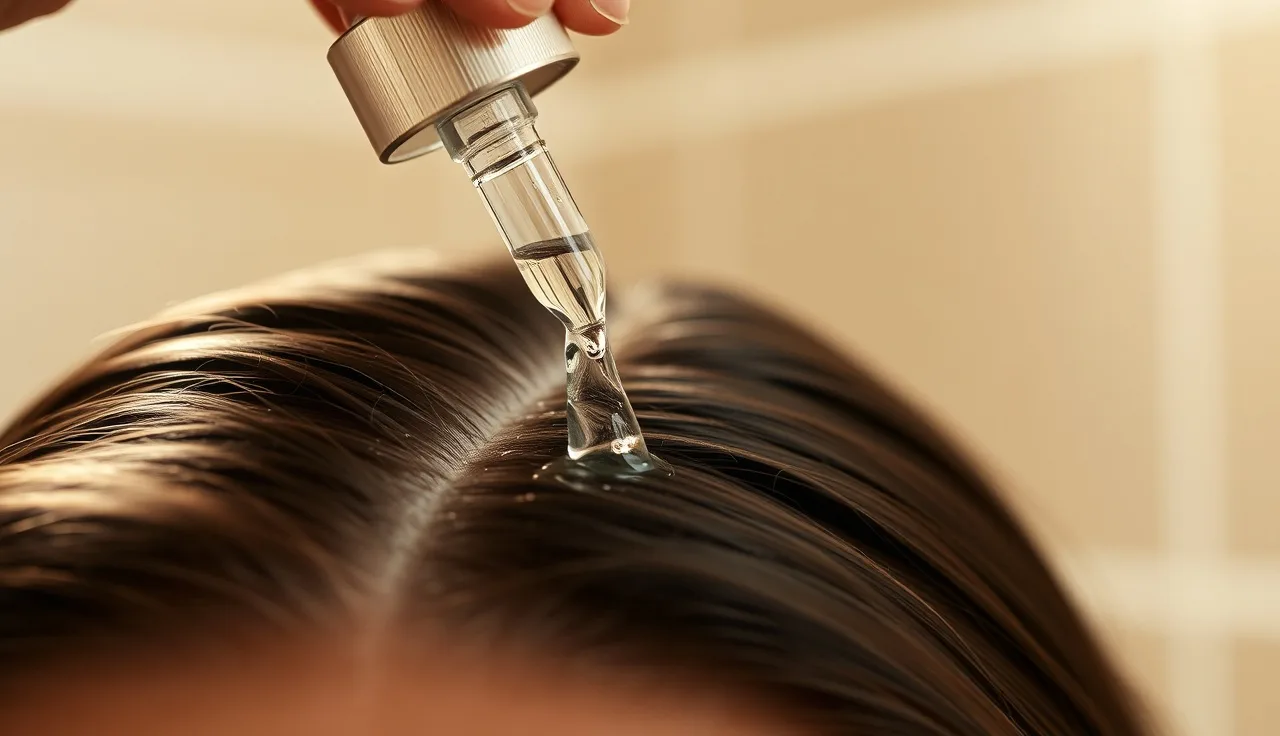
Minoxidil serum is the original topical form of minoxidil: a clear or slightly alcohol-tinged liquid you drop or squirt onto thinning scalp areas and massage in. The FDA approved topical minoxidil for androgenetic alopecia in 1988, first at 2% for women, then at 5% for men [1]. "Serum" is largely a marketing term the industry landed on to distinguish the liquid solution from the foam version launched in the mid-2000s. They contain the same active ingredient. The vehicle (what carries the minoxidil to your scalp) is different, and that difference matters more than most people realize.
The classic liquid formula uses propylene glycol as a penetration enhancer, water, and usually ethanol. Propylene glycol is effective but it's also the main reason some people get scalp irritation or find the serum feels greasy and takes longer to dry. The foam skips propylene glycol and tends to feel lighter and dry faster, but some dermatologists argue the serum's propylene glycol actually improves minoxidil absorption into the follicle.
You'll see minoxidil serum sold under the original brand name Rogaine, dozens of generics (Kirkland, Equate, and store brands from most major pharmacy chains), and a growing wave of "enhanced" formulas that add ingredients like azelaic acid, caffeine, or biotin. Those additions are mostly unproven extras. The minoxidil does the actual work.
To understand what causes hair loss in the first place, and why minoxidil is one of the few things that genuinely helps, it's worth reading that separately. The short version: androgenetic alopecia (male and female pattern hair loss) shrinks follicles over time, and minoxidil is one of only two FDA-approved topical treatments that can partially reverse that.
How does minoxidil serum actually work on hair follicles?
Minoxidil is a potassium channel opener. It was originally developed as an oral blood pressure drug in the 1970s, and hypertrichosis (unexpected hair growth) was a noticed side effect that led researchers to test it on the scalp [2]. The precise mechanism at the follicle level is still not fully pinned down, which is an honest admission you'll find in the literature.
What researchers do know: minoxidil dilates small blood vessels around the follicle, which likely increases oxygen and nutrient delivery. It also seems to open ATP-sensitive potassium channels in smooth muscle cells of the dermal papilla, which may extend the anagen (active growth) phase of the hair cycle and shorten the telogen (resting) phase [2]. Follicles that have miniaturized due to DHT-related damage can partly recover, producing thicker terminal hairs again. Partly. Minoxidil does not block DHT, which is the hormone driving follicle miniaturization in the first place. That's a real limitation.
This is also why minoxidil and finasteride (a DHT blocker) are often used together. Minoxidil stimulates the follicle; finasteride removes the hormonal attack. You can read more about that combination at finasteride and minoxidil.
One thing the mechanism explains well: when you stop minoxidil, the hair it maintained typically sheds within 3-6 months. There's no lasting change to the follicle's underlying hormonal environment. That's not a scare tactic. It's just how the drug works. You're renting the result, not buying it.
What do clinical trials show about minoxidil serum's effectiveness?
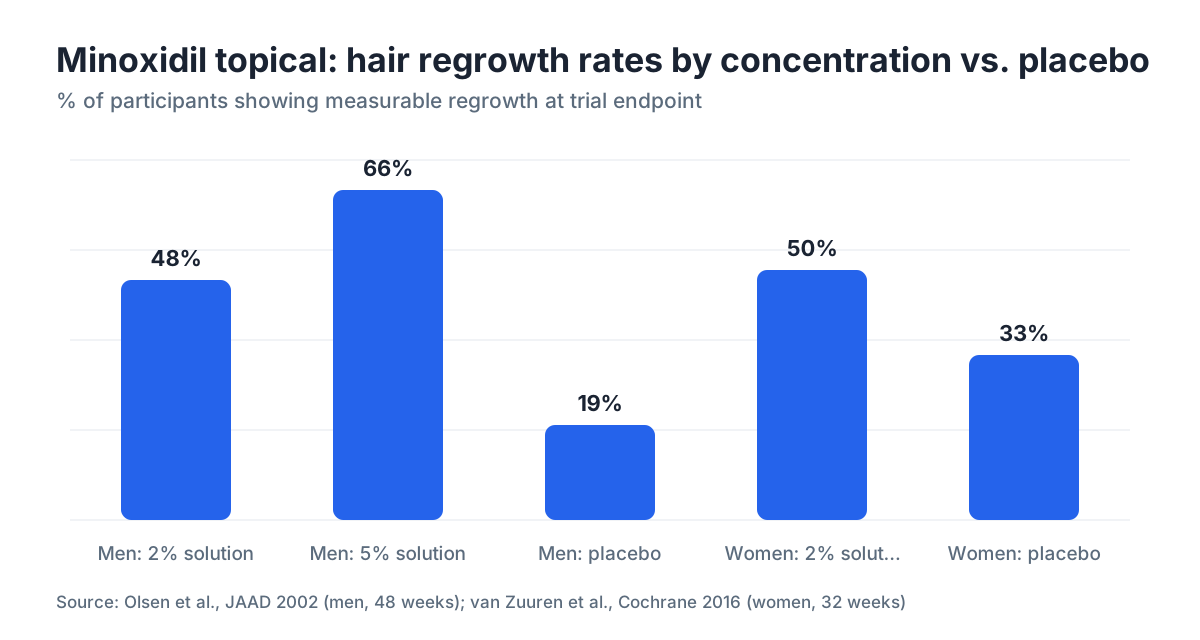
The big multicenter trial published in the Journal of the American Academy of Dermatology (Olsen et al., 2002) compared 5% minoxidil solution to 2% solution and placebo in men with androgenetic alopecia over 48 weeks [3]. The 5% solution produced 45% more hair regrowth than the 2% solution by nonvascular hair count, and both beat placebo. The study's stated conclusion was that "5% topical minoxidil was clearly superior to 2% topical minoxidil and placebo in stimulating hair growth and slowing hair loss in men with androgenetic alopecia" [3].
For women, the FDA-approved concentration is 2% (though off-label use of 5% is increasingly common and studied). A Cochrane review found that roughly 50% of women using 2% minoxidil reported minimal-to-moderate regrowth after 32 weeks, compared to about 33% on placebo [4]. Those numbers sound modest, and they are. Minoxidil is not a miracle. It keeps more hair than you'd have otherwise, and for some people it meaningfully reverses thinning, but it doesn't restore a full head of hair once follicles are gone.
The data on foam vs. serum is thinner. A 2011 head-to-head study found 5% foam as effective as 5% solution for hair regrowth in men, meaning they performed similarly [5]. If you're choosing purely on efficacy, the evidence doesn't clearly favor one form. If you're choosing on tolerability (scalp irritation, dryness), most dermatologists lean toward foam for sensitive scalps and serum for people who don't react to it.
Here's the honest ceiling: if your follicles are completely gone (slick-bald, scar tissue), minoxidil does nothing. It works on miniaturized follicles that still have some function, not dead ones. Earlier treatment consistently produces better outcomes across every trial.
| Concentration | Approved for | Avg. regrowth vs. placebo | Primary trial population |
|---|---|---|---|
| 2% solution | Women (FDA) | ~17% increase in nonvascular hair | Women, 32-week trials [4] |
| 5% solution | Men (FDA) | ~45% more than 2%, clear placebo beat | Men, 48-week trial [3] |
| 5% foam | Men (FDA) | As effective as 5% solution | Men, 52-week trial [5] |
| 5% solution (off-label women) | Off-label | Similar or better than 2% in small trials | Women, limited data |
Minoxidil serum vs foam: which one should you pick?
For most people, the choice won't matter much clinically. Both deliver the same active molecule to the same follicles. The real differences are in the experience of using them.
Serum dries slower, especially with higher alcohol or propylene glycol content. If you apply it and then immediately style your hair or lie down, you may get product on your pillow or clothing. It also tends to feel wetter on the scalp. For people with curly or coily hair textures, a liquid serum can sometimes distribute more evenly through dense hair than a foam that dissipates quickly on contact.
Foam is quicker to apply for many people, leaves less residue, and is less likely to cause the contact dermatitis that propylene glycol triggers in sensitive skin. The AAD notes that propylene glycol-containing formulas are a common cause of scalp irritation with minoxidil use [6]. If you've tried the serum and your scalp got red, itchy, or flaky, switching to foam is a reasonable first move before concluding minoxidil doesn't work for you.
Price is another factor. Kirkland Signature 5% minoxidil solution (a widely used generic, sold in 6-month supplies at Costco) often runs around $25-$30 for six months. Foam generics tend to be slightly more expensive, and branded Rogaine foam is typically $40-$60 for a 3-month supply. Neither requires a prescription in the United States.
If you have a receding hairline specifically, foam can be awkward to target at the hairline without spreading to the forehead (where hair growth is decidedly unwanted). A dropper-tip serum bottle gives you more precision. That's a real practical difference.
Bottom line: try the form that fits your lifestyle. If you get irritation, switch. If you don't see results after 6 months of consistent use, the form you chose probably wasn't the issue.
How do you use minoxidil serum correctly?
The labeled dose for 5% minoxidil solution is 1 mL applied to the affected scalp area twice daily [1]. Most dropper bottles are calibrated so that filling to the 1 mL line is one dose. You apply it directly to the scalp, not to the hair shaft, and spread it with your fingertips across the thinning area. Then wash your hands. Minoxidil absorbed through your hands isn't doing anything useful and can cause minor blood pressure effects in large amounts.
Scalp should be dry or mostly dry before applying. Applying to a wet scalp dilutes the formula and reduces absorption. Wait at least 4 hours before washing your hair after application, and ideally longer.
Once daily use is where most real-world people land, and there's some data suggesting once daily at 5% is roughly comparable to twice daily at 2%, though the twice-daily 5% protocol used in trials produced the strongest results [3]. If you're going to use it once daily, morning is generally better than night: you avoid transferring it to pillowcases and you won't sleep with a wet scalp, which some people find uncomfortable.
One thing almost nobody mentions upfront: expect a shedding phase in the first 2-8 weeks. Minoxidil pushes resting (telogen) hairs out prematurely to make way for new anagen growth. This initial shed terrifies people into stopping. Don't stop. It's a sign the drug is doing something. If shedding is heavy and persists past 8 weeks, or if it started before you used minoxidil, read about telogen effluvium because they can look very similar and the causes and responses are different.
How long does minoxidil serum take to work?
Four months is the earliest point where most users see meaningful change, and six months is the more honest benchmark. The 48-week Olsen trial showed that hair counts kept improving from week 16 to week 48, so patience past the 4-month mark pays off [3].
The timeline roughly goes like this:
Weeks 1-8: possibly a shedding phase (normal, don't panic), no visible improvement.
Weeks 8-16: hair shedding stabilizes, some people notice early fuzz or baby hairs at thinning areas.
Months 4-6: the realistic point to take a comparison photo against your baseline. Some people see clear improvement; others see stabilization (no further loss) without obvious regrowth. Stabilization is a valid and undervalued outcome.
Months 6-12: continued improvement is possible and documented in trials running to 48 weeks. A small percentage of non-responders exist at every time point.
If you hit 12 months of consistent use with no change, most dermatologists would consider you a non-responder and discuss alternatives, which might include finasteride, a DHT blocker, or eventually a hair transplant.
Photography matters here. The scalp is notoriously hard to self-assess in a mirror. Take a photo in the same lighting, same angle, same distance every four weeks from day one. It's the only way to see gradual change reliably.
What are the side effects of minoxidil serum?
The most common side effect is scalp irritation: redness, itching, flaking, or dryness. The FDA label for topical minoxidil lists these as the primary local reactions [1]. As mentioned above, propylene glycol in the solution is often the culprit, not the minoxidil itself. Switching to foam often resolves this.
Unwanted facial or body hair growth is real, and more commonly reported by women. Minoxidil absorbed systemically (especially if you're applying a lot, applying to broken skin, or using high concentrations) can stimulate hair in areas you didn't intend. The FDA label notes this as a known effect [1]. Keeping doses precise and not over-applying reduces the risk.
Cardiovascular effects (fast heartbeat, dizziness, fluid retention) are rare with topical use at labeled doses but are documented with higher-dose off-label application and with oral minoxidil. If you experience chest pain, rapid or irregular heartbeat, or sudden weight gain, stop use and see a doctor.
For a full breakdown of all the side effects organized by frequency and severity, the dedicated minoxidil side effects article covers it in detail. That's worth reading before you start, not after something surprises you.
Pregnancy is a hard stop. Minoxidil is Category C in pregnancy, meaning animal studies showed adverse fetal effects [1]. Women who are pregnant or planning pregnancy should not use topical minoxidil without explicit guidance from their physician.
Can women use minoxidil serum, and is 5% safe for them?
Yes, women can use minoxidil serum. The FDA approved 2% topical minoxidil for women specifically, with the indication for female pattern hair loss [1]. The 5% concentration is not FDA-approved for women, but it's widely used off-label, and several studies have compared the two.
A randomized controlled trial published in Dermatology (Blume-Peytavi et al., 2011) found that once-daily 5% foam was as effective as twice-daily 2% solution in women with female pattern hair loss, with a slightly better tolerability profile for the foam [7]. Some dermatologists do recommend 5% for women who don't respond adequately to 2%, accepting the higher facial hair risk in exchange for potentially better efficacy.
Women should be aware that the facial hypertrichosis risk (forehead, sideburn, and cheek hair) is higher with 5% than 2%. Keeping application away from the hairline edge, washing hands immediately, and not touching the face after application reduces but doesn't eliminate this.
For women experiencing diffuse thinning rather than a defined bald spot, the serum dropper may actually be easier to use across a wider area than foam. The minoxidil for men article focuses on male-specific dosing protocols, but the mechanistic information there applies to both sexes.
Women with hair loss that came on suddenly, is associated with shedding in large clumps, or coincides with hormonal changes (postpartum, menopause, thyroid issues) should get bloodwork done before assuming androgenetic alopecia is the cause. Minoxidil won't help if the root issue is nutritional deficiency, thyroid dysfunction, or a different kind of hair loss entirely.
Is minoxidil serum worth it if you're already losing a lot of hair?
This is the question that actually matters for most people reading this. The answer depends almost entirely on how much follicle function you still have.
Minoxidil is most effective in the earlier Norwood stages (Norwood II-IV for men, Ludwig I-II for women). At those stages, follicles are miniaturized but alive. Minoxidil can partly reverse miniaturization and extend the growth phase, producing meaningful visible improvement for a real subset of users.
At Norwood V-VII (extensive hair loss, large bald areas), minoxidil has much less to work with. Some follicles in those areas may still be functional, and minoxidil can help maintain them, but you're unlikely to regrow a full crown from an advanced Norwood stage. Manage expectations here: stabilization, not restoration, is the realistic goal.
If you're assessing your own stage and wondering whether you're still in the window where minoxidil makes sense, a proper evaluation (by a dermatologist or via a tool like the free AI hair analysis at MyHairline) can help you understand what you're actually looking at before you commit to a years-long regimen.
Cost over time is real. At $25-$60 for a 2-3 month supply, you're looking at $100-$240 per year, indefinitely. If you stop, the hair you maintained will shed. That's a lifetime commitment worth consciously accepting before you start, not discovering after 18 months.
What ingredients are added to "enhanced" minoxidil serums, and do they help?
Walk the hair care aisle or browse any direct-to-consumer brand and you'll see minoxidil serums with added retinol, caffeine, azelaic acid, biotin, saw palmetto, peptides, and various botanical extracts. The marketing on these is aggressive. The evidence is not.
Retinol (retinoic acid) is the most studied additive. A small but real study showed that 0.025% tretinoin combined with 0.5% minoxidil produced regrowth comparable to 5% minoxidil alone, suggesting retinoids may improve minoxidil's skin penetration [8]. This is probably the only additive with meaningful supporting evidence. Some compounding pharmacies offer minoxidil plus tretinoin formulas on prescription.
Caffeine has a follicle-stimulation mechanism in vitro (in lab dishes) but the human trial evidence is weak. One industry-funded trial showed modest benefit, but independent replication is lacking. It's not going to hurt you, but don't pay a premium for it.
Azelaic acid is a DHT blocker at the follicle level in theory, and some formulas pair it with minoxidil hoping for complementary effects. There's no large controlled trial confirming the combination outperforms minoxidil alone on meaningful hair count endpoints.
Biotin added to a topical serum is essentially inert for hair growth unless you have a genuine biotin deficiency, which is rare. Topical biotin doesn't absorb into the hair follicle in any meaningful way. The hair loss supplements article goes into oral biotin and other supplement evidence if you're curious about that angle.
Saw palmetto is another one that sounds reasonable (DHT blocking mechanism) but lacks the trial depth to recommend confidently. If you want DHT inhibition, finasteride has the actual clinical record.
The practical advice: don't pay extra for enhanced serums unless you're specifically getting the tretinoin combination under medical supervision. The minoxidil is doing the work.
Do you need a prescription for minoxidil serum in the US?
No. In the United States, 2% and 5% topical minoxidil are available over the counter without a prescription [1]. You can buy them at CVS, Walgreens, Costco, Target, Amazon, and most grocery store pharmacy sections.
This is different from finasteride (oral, prescription-required) and oral minoxidil (off-label, also prescription-required in practice). Topical minoxidil is genuinely accessible without a doctor visit, which is one reason it's often the first treatment people try.
In the UK, 5% minoxidil became available without prescription in 2022, a significant regulatory change. In Canada, 2% has been OTC for years; 5% status varies by province. If you're outside the US, check your local regulatory body's current status because it changes.
Custom-compounded minoxidil formulas (higher concentrations, combination formulas with tretinoin or finasteride) do require a prescription and are made by compounding pharmacies. Some telehealth companies now offer compounded minoxidil with finasteride in a single topical formula. That's a distinct product from what you buy off the shelf.
One thing worth knowing: OTC doesn't mean right for every person. If you have cardiovascular conditions, are on blood pressure medications, or have any scalp condition (psoriasis, severe seborrheic dermatitis), talking to a dermatologist before starting makes sense.
What happens if you stop using minoxidil serum?
The hair you maintained or regrew with minoxidil will shed, typically over 3-6 months after stopping. This is expected and consistent with the mechanism: minoxidil keeps follicles in the growth phase; remove it, and they return to their hormonally determined trajectory.
This is the part that catches people off guard. They see good results at month 6, feel like they've fixed the problem, stop using the serum, and then watch their hair thin back out by month 12. The drug didn't fail. The underlying cause (androgenetic alopecia) continued the moment the treatment stopped.
If you're planning to stop because of side effects, switch formulas first rather than quitting entirely. Irritation from the serum may resolve with the foam. If you're stopping because you genuinely don't want a permanent commitment, that's a reasonable personal choice, but go in knowing what to expect.
For people who want more permanent results, a hair transplant moves donor follicles that are genetically resistant to DHT into thinning areas. Those grafts don't require maintenance with minoxidil, though many surgeons recommend continuing topical minoxidil on non-transplanted areas to preserve native hair. At MyHairline, the free AI scan can help you understand your current loss pattern before deciding whether ongoing topical treatment or a surgical option makes more sense for your situation.
The stopping decision is yours. Make it with full information about the shed that follows.
Sources
- FDA, Rogaine (minoxidil topical solution) prescribing information and OTC label
- Randomski A et al., "The Mechanism of Action of Minoxidil in Hair Loss," International Journal of Molecular Sciences, 2022
- Olsen EA et al., "A randomized clinical trial of 5% topical minoxidil versus 2% topical minoxidil and placebo in the treatment of androgenetic alopecia in men," Journal of the American Academy of Dermatology, 2002
- van Zuuren EJ et al., "Interventions for female pattern hair loss," Cochrane Database of Systematic Reviews, 2016
- Blume-Peytavi U et al., "A randomized, single-blind trial of 5% minoxidil foam once daily versus 2% minoxidil solution twice daily in the treatment of androgenetic alopecia in women," Journal of the American Academy of Dermatology, 2011
- American Academy of Dermatology, Hair Loss: Diagnosis and Treatment
- Blume-Peytavi U et al., "Efficacy and safety of 5% minoxidil foam vs 2% minoxidil solution for women with female pattern hair loss," Dermatology, 2011
- Ferry JJ et al., "Retinoids and minoxidil in androgenetic alopecia," Journal of Clinical Pharmacology, 1990