TL;DR: Minoxidil shampoo delivers minoxidil to the scalp in a wash-out or leave-on form. The FDA has approved topical minoxidil 2% for women with androgenetic alopecia, but most shampoos rinse off before enough drug absorbs. Leave-on lotions and foams have far stronger evidence. A shampoo can help as an add-on, not a replacement.
What is minoxidil shampoo and how is it different from regular minoxidil?
Regular topical minoxidil, the kind with decades of FDA trial data behind it, comes as a liquid solution or a foam. You apply it to a dry scalp and leave it there. Contact time is the whole point. The drug has to stay put long enough to reach the hair follicle and do its work.
Minoxidil shampoo is a cleanser, either wash-out or leave-on, that contains minoxidil alongside the usual shampoo ingredients. The pitch is convenience. One step in the shower and you're treating your scalp while you wash your hair. That convenience is real. So is the problem. Most shampoo formulas rinse off in two or three minutes, which may not leave enough time for the drug to absorb.
Two product types are worth separating:
-
Rinse-off shampoos that carry minoxidil as an incidental ingredient. These probably deliver very little active drug to the follicle. Short contact time, heavy dilution in water, and no strong clinical trial behind them.
-
Leave-in scalp treatments or serums marketed with minoxidil that stay on the scalp after you apply them. These act much more like standard topical minoxidil and have a plausible mechanism.
If a product tells you to rinse it out, set your expectations low. If it tells you to massage it in and leave it, read the label for the minoxidil concentration and compare that to what the trials actually tested.
For how standard topical minoxidil works, see our full guide on minoxidil for men. The pharmacology covered there is identical in women.
Is minoxidil shampoo FDA-approved for women?
No minoxidil shampoo has its own FDA approval for treating female hair loss. What the FDA approved is topical minoxidil 2% solution for women with androgenetic alopecia (female pattern hair loss), plus topical minoxidil 5% foam, which was first approved for men and later studied in women [1].
The approval language is specific to those vehicles. The agency cleared minoxidil for use in females based on trials of the solution and foam, not shampoo [1]. A shampoo containing minoxidil is not the same product, even when the active ingredient matches.
That difference matters at the checkout. A rinse-off minoxidil shampoo is often sold as a cosmetic or a non-prescription drug without its own clinical package proving the shampoo vehicle behaves the same way. You're trusting the name minoxidil, not the vehicle that was studied.
The American Academy of Dermatology guidelines for female hair loss recommend topical minoxidil as a first-line treatment and cite the solution and foam formulations [2]. The AAD does not list minoxidil shampoo as a proven therapy for female pattern hair loss.
So if a seller says their minoxidil shampoo is "FDA-approved for women," ask which product, which formulation, and which clinical package. The honest answer is that the ingredient is approved in other formats, not that the shampoo itself went through trials.
What does the evidence actually say about minoxidil shampoo for hair regrowth?
Not much, specifically for the shampoo vehicle. The clinical database for minoxidil is huge, but nearly all of it rests on the solution and foam.
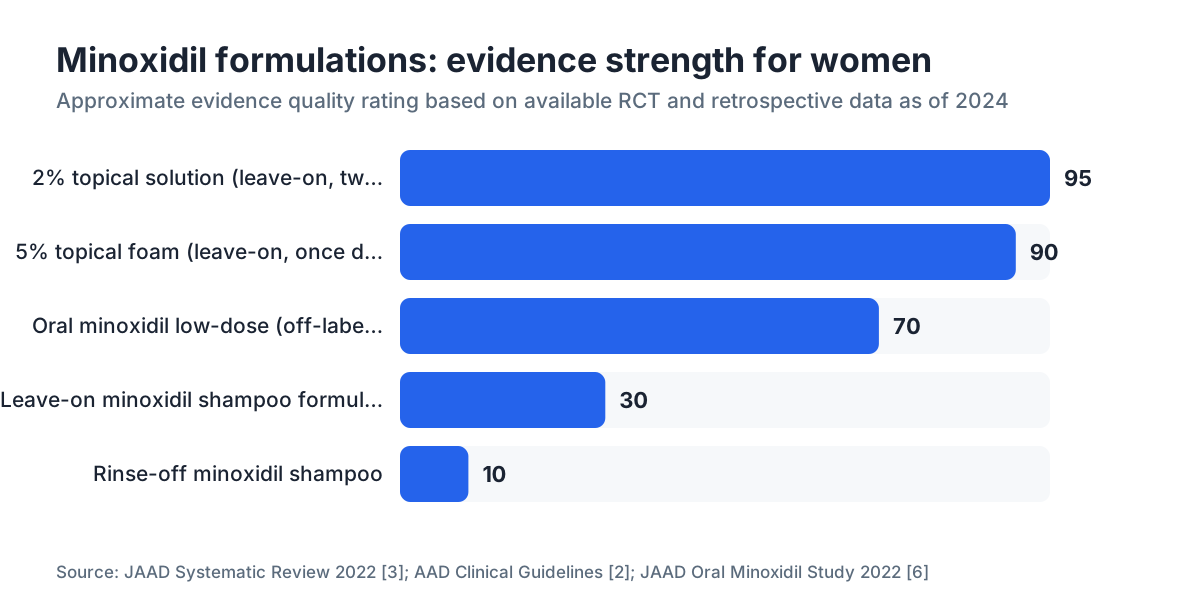
A 2022 systematic review in the Journal of the American Academy of Dermatology looked at topical minoxidil in female androgenetic alopecia and confirmed that 2% solution used twice daily raises hair count and hair weight versus placebo, with effects measurable at 32 weeks [3]. That review covered solution and foam studies. No shampoos.
For the shampoo format itself, the data is thin. A 2021 review in Dermatology and Therapy noted that new delivery vehicles for minoxidil, including shampoo-like formulations, are under investigation, but concluded that "bioavailability data for rinse-off minoxidil preparations remain limited" [4].
Bioavailability is the whole question. Minoxidil works when it reaches the dermal papilla cells around the follicle. A product you rinse off in the shower probably delivers a fraction of the dose a leave-on product does. Nobody has good numbers on exactly how large that fraction is for shampoo. The closest signal comes from topical drug delivery research generally, which shows rinse-off vehicles consistently underperform leave-on vehicles for follicular penetration.
Here's the practical read. If you're spending money on a minoxidil product, the evidence sits firmly behind approved leave-on formulations. A shampoo can be a reasonable add-on. It's not a substitute.
Before you start anything, read our guide on minoxidil side effects so you know what you're signing up for.
What concentration of minoxidil in shampoo should women use?
For approved leave-on topical minoxidil, the studied doses in women are 2% solution twice daily and 5% foam once daily [1]. A well-cited 2014 trial found 5% foam once daily broadly comparable to 2% solution twice daily, which is a real point in the foam's favor for anyone who forgets a midday dose [5].
Minoxidil shampoos on the market usually run from 1% to 5% minoxidil. But the concentration on a shampoo label means little on its own. It tells you nothing about how long the product stays on the scalp, how much water dilutes it, or whether any penetration enhancers are in the mix.
If you pick a leave-on minoxidil treatment instead of a rinse-off shampoo, 2% twice daily or 5% once daily are the doses with human data behind them in women. Going above 5% is not FDA-approved, and higher strengths don't come with proportionally better evidence.
For rinse-off shampoos, there's no evidence-based concentration to recommend, because the format hasn't been rigorously tested in women. A 5% rinse-off shampoo isn't clearly better than a 2% one when most of the drug goes down the drain.
Who is minoxidil shampoo most likely to help (and who it won't)?
Topical minoxidil, in its proven forms, works best for women with female pattern hair loss, meaning diffuse thinning at the crown and a widening part, graded on the Ludwig scale [2]. It works by stretching out the anagen (growth) phase of the hair cycle and enlarging the follicle. It does not build new follicles from nothing.
Women most likely to respond to any minoxidil product:
- Those in earlier Ludwig stages (I or II), where miniaturized follicles are still present and alive
- Women who've been thinning for less than five years
- Those without complete follicle loss (slick-bald patches usually don't respond)
Women less likely to respond:
- Those with scarring alopecia, where follicles are permanently destroyed
- Women whose loss is driven entirely by nutritional deficiency, thyroid disease, or telogen effluvium that hasn't resolved. Fix the cause first
- Women who've lost hair for decades with no treatment along the way
A dermatologist can look at your scalp with a dermoscope and tell you in a few minutes whether your follicles are miniaturized (potentially minoxidil-responsive) or truly gone. That exam is worth doing before you commit six months to any product.
Not sure what type of loss you have? Our overview of what causes hair loss is a good place to start before you choose a treatment.
How do minoxidil shampoos compare to other minoxidil formulations for women?
| Formulation | FDA-approved for women | Evidence strength | Typical application | Approximate monthly cost (US) |
|---|---|---|---|---|
| 2% solution (topical) | Yes (androgenetic alopecia) | Strong (multiple RCTs) | Twice daily, leave-on | $10-$25 (generic) |
| 5% foam (topical) | Studied in women, originally approved for men | Strong | Once daily, leave-on | $20-$40 |
| Oral minoxidil (low-dose, 0.25-1.25 mg) | Off-label | Growing (multiple 2020-2024 studies) | Once daily pill | $15-$50 (compounded) |
| Minoxidil shampoo (rinse-off) | No | Minimal | During shower, rinsed | $15-$45 |
| Minoxidil shampoo (leave-on) | No | Limited | Leave-on after wash | $20-$50 |
Low-dose oral minoxidil (0.25 mg to 1.25 mg daily) has become a real option for women who can't tolerate topical application or who want a systemic effect [6]. A 2022 retrospective study in JAAD found meaningful hair density improvement in women on low-dose oral minoxidil, though dermatologists prescribe it off-label. More on that in our article on oral minoxidil.
Shampoos rank last here on evidence. That doesn't make them harmful. It makes them unproven as a standalone treatment. Some women run a minoxidil shampoo on wash days alongside their standard leave-on minoxidil, buying a little extra contact time. That's not a bad instinct. No controlled trial has tested it either.
What are the real side effects of minoxidil shampoo women should know about?
Minoxidil's side effect profile is well-documented for the leave-on formulations. Shampoos absorb less and more variably, so they may carry a lighter side effect load, but they share the same risks wherever the drug does get in.
The effects women report most with topical minoxidil:
Initial shedding. This is the one that scares people. In the first four to eight weeks, many women see more hair fall. That's minoxidil pushing resting hairs into the shed phase early so new growth can follow. It's temporary. It does not mean the drug is failing. It's still real, still alarming, and women deserve a heads-up that it's coming [2].
Scalp irritation. The propylene glycol in liquid minoxidil solutions irritates some scalps. Foams and shampoos often contain less of it or none, which is one genuine advantage of those vehicles.
Unwanted facial hair. More common in women than the packaging lets on. Fine hair can show up along the hairline, temples, and cheeks. It usually fades if you stop, and it's less common at 2% than at 5% [2].
Systemic effects like headache, fluid retention, and heart palpitations are rare with standard topical use and more likely with oral minoxidil. With a rinse-off shampoo, systemic absorption is probably low. With a leave-on scalp product, it's similar to standard topical minoxidil.
For the full breakdown with frequency data, see our guide on minoxidil side effects.
Pregnancy note: the FDA label lists topical minoxidil as Pregnancy Category C, meaning animal studies show fetal risk and there are no adequate human studies. If you're pregnant or trying to conceive, don't use minoxidil without talking to your OB or dermatologist first [1].
How should women use minoxidil shampoo correctly to get the most out of it?
If you've decided to use a minoxidil shampoo, here's how to squeeze the most out of it given the absorption limits.
For rinse-off minoxidil shampoos:
- Massage it into a wet scalp and leave it on at least five minutes before rinsing. Some brands say ten. Longer dwell time improves the odds of real drug contact.
- Don't make it your only minoxidil treatment if your loss is significant. Use it on wash days as a complement to a leave-on product.
- Rinse with cool or lukewarm water. Hot water can raise irritation and may strip the product faster.
For leave-on minoxidil scalp treatments in shampoo-like vehicles:
- Apply to a dry or towel-dried scalp, not soaking wet hair. Water dilutes the dose before it can penetrate.
- Part your hair to expose the scalp and apply to the skin, not the hair shaft. The follicle lives in the scalp.
- Let it dry fully before bed. Minoxidil on a pillow transfers to facial skin and can grow hair where you don't want it.
Consistency beats everything. Minoxidil works only as long as you use it. Stop, and the new hair usually sheds within three to six months, dropping density back to baseline [2].
One more thing worth knowing. Pairing minoxidil with a DHT blocker or another evidence-based treatment often beats either one alone, especially in androgenetic alopecia, where dihydrotestosterone is driving the follicles to shrink.
Are there other hair loss treatments women should use alongside or instead of minoxidil shampoo?
Minoxidil, whatever the vehicle, handles one half of the problem. It stimulates the follicle to grow. In women with androgenetic alopecia, the hormonal driver keeps working underneath, with DHT miniaturizing follicles over time, unless something addresses that too.
Treatments with evidence in women:
Low-level laser therapy (LLLT). FDA-cleared combs and caps have shown modest benefit in randomized trials for female pattern hair loss [7]. They don't replace minoxidil, but you can add one without interaction worries.
Spironolactone. An off-label anti-androgen that US dermatologists commonly prescribe for women with androgenetic alopecia. A retrospective study found it effective in a majority of women treated [8]. It needs a prescription and monitoring.
Finasteride. Approved for men, used off-label in some post-menopausal women. Not for pre-menopausal women because of teratogenicity risk. More in our article on finasteride.
Nutrition. Iron deficiency and low ferritin track with hair loss in women. If you haven't checked ferritin, vitamin D, and thyroid function, do that before spending on topicals. Our article on hair loss supplements sorts what's worth taking from what isn't.
Hair transplant surgery. A last resort for most, but effective when donor areas are healthy. It fails when the whole scalp is thinning diffusely. More in our guide to hair transplant.
Want to map your pattern of loss before committing to a plan? The free AI hair analysis tool at MyHairline (myhairline.ai/scan) reads your thinning pattern from photos and points you toward the treatments that fit.
For most women with androgenetic alopecia, a combination beats a single agent, usually minoxidil plus a DHT-targeting treatment. A shampoo alone is almost never enough.
How long does it take to see results from minoxidil shampoo?
For the proven leave-on formulations, the trials give a clear timeline. Hair count and density gains become measurable around 16 weeks (four months), with more substantial results at 32 to 48 weeks [3].
The first four to eight weeks may look worse thanks to the initial shed. Quit at week six because the extra fall spooks you, and you'll miss the benefit and blame the product for something that was actually the drug working.
For minoxidil shampoos specifically, there's no clinical timeline. A leave-on shampoo-format product with contact time close to standard topical minoxidil might follow a similar curve. A rinse-off product may deliver later, or not at all.
Photos in consistent lighting every four weeks beat your daily mirror check. Density changes are subtle and slow. Most people genuinely can't see the difference week to week, but the three-month versus baseline side-by-side is clear.
Patience is the most underrated part of treating hair loss. The women who quit at two months never find out whether it would have worked.
What should women look for when buying a minoxidil shampoo?
If you're going to buy one, here's what separates a product worth trying from a marketing exercise.
Check rinse-off versus leave-on. This is the single most important question. Rinse-off products have far less evidence. If the directions say to rinse, the concentration on the label tells you almost nothing about what reaches your follicles.
Find the minoxidil concentration on the Drug Facts panel. In the US, if minoxidil is an active drug ingredient, the product needs a Drug Facts panel under FDA OTC drug rules [1]. No panel means the product may be mislabeled or sold as a cosmetic, which means less oversight of what's actually inside.
Avoid proprietary blends that hide ingredient amounts. "Minoxidil complex" or "hair growth blend" with no stated concentrations is a red flag.
Look for adjuncts that earn their place. Some shampoos pair minoxidil with ketoconazole (which has some evidence for cutting scalp DHT and inflammation) or biotin (useful only if you're deficient). Those combinations can be genuinely helpful or just window dressing.
Price does not track efficacy here. Generic 2% minoxidil solution runs about $10 to $20 a month and has the strongest evidence. A $60 minoxidil shampoo has no comparable trial behind it.
When you're unsure, a board-certified dermatologist can examine your scalp, grade your Ludwig stage, and tell you which treatment fits. That appointment is worth more than hours of reading product pages.
Is minoxidil shampoo safe to use long-term?
Topical minoxidil has been studied for over 40 years, since the FDA first approved it in 1988 [1]. The leave-on formulations have a well-established long-term safety record. Systemic side effects from topical use stay uncommon because absorption through intact scalp skin is limited.
For minoxidil shampoos specifically, long-term safety data isn't independently established. That said, rinse-off products probably deliver a lower systemic dose than leave-on products, so they're unlikely to carry greater systemic risk. Scalp irritation from repeated shampooing is a possible issue, depending on the other ingredients.
The main long-term catch isn't safety. It's dependence. Minoxidil is a maintenance treatment, not a cure. Stop, and the hair you've kept or regrown sheds over the next three to six months [2]. That's a standing commitment. Weigh it before you start.
Women who've used topical minoxidil for years and want to taper or move to a lower-maintenance routine should talk it through with a dermatologist. Some switch to low-dose oral minoxidil for easier compliance. Others stay on topical indefinitely. There's no single right answer, and the myhairline.ai/scan tool can track your pattern over time if you want a visual baseline before you change anything.
Sources
- FDA, Minoxidil Topical Solution 2% Drug Label
- American Academy of Dermatology, Hair Loss in Women Clinical Guidelines
- Journal of the American Academy of Dermatology, Systematic Review of Topical Minoxidil in Female AGA, 2022
- Dermatology and Therapy, Novel Delivery Vehicles for Minoxidil Review, 2021
- Journal of the American Academy of Dermatology, 5% Minoxidil Foam vs 2% Solution in Women, 2014
- Journal of the American Academy of Dermatology, Low-dose Oral Minoxidil in Women Retrospective Study, 2022
- Lasers in Surgery and Medicine, Low-Level Laser Therapy for Female Pattern Hair Loss RCT
- JAMA Dermatology, Spironolactone for Female Pattern Hair Loss Retrospective Study
- FDA, Minoxidil 5% Foam Approval History
- National Library of Medicine, StatPearls: Minoxidil