
TL;DR: A hair transplant at Norwood 6 is medically possible but almost never delivers the full, dense result clinics advertise. The average donor area yields 6,000 to 8,000 grafts lifetime. A Norwood 6 scalp needs 8,000 to 12,000 grafts for convincing coverage. That gap is where marketing hype lives. Realistic outcomes mean lower density, careful zone prioritization, and permanent medication to protect remaining hair.
What is Norwood 6 hair loss, exactly?
The Norwood-Hamilton scale runs from 1 to 7, and it is the standard classification doctors and surgeons use when they plan treatment [1]. Stage 6 means the top of the scalp, the frontal zone, and the crown have merged into one continuous bald area. A thin bridge of hair that separates front from crown at Norwood 5 is completely gone by stage 6. What remains is a horseshoe-shaped band of hair running from ear to ear across the back and sides.
That remaining band is called the permanent zone, or the safe donor area. It is permanent in the sense that follicles there carry less sensitivity to dihydrotestosterone (DHT), the androgen that drives pattern baldness [2]. The rest of the scalp has already lost that protection. At Norwood 6, roughly 60 to 70% of the scalp surface is bald, depending on the individual's head size.
Head size matters more than most clinics advertise. An average adult male scalp covers about 600 to 650 square centimeters. A Norwood 6 bald zone typically spans 350 to 400 cm². If you want even modest coverage at 30 grafts per cm², you are looking at 10,500 to 12,000 grafts just for that zone. That number comes up again and again in this article because it is the central tension in every Norwood 6 consultation.
Learning what causes hair loss at a genetic and hormonal level is worth doing before any transplant conversation. Norwood 6 is not a random event. It reflects a strong androgenetic history that does not stop after surgery.
How many grafts does a Norwood 6 transplant actually require?
Surgeons talk in grafts. One graft is one follicular unit, which holds one to four hairs. The average graft has roughly 2.2 hairs, so 1,000 grafts deliver about 2,200 hairs. Density in a non-balding scalp runs 80 to 100 follicular units per cm². A transplant that achieves 40 to 50 FU/cm² looks acceptably thick in photographs. At 25 to 30 FU/cm² it reads as real hair when styled carefully, but not under strong light [3].
For Norwood 6, here is what the math produces:
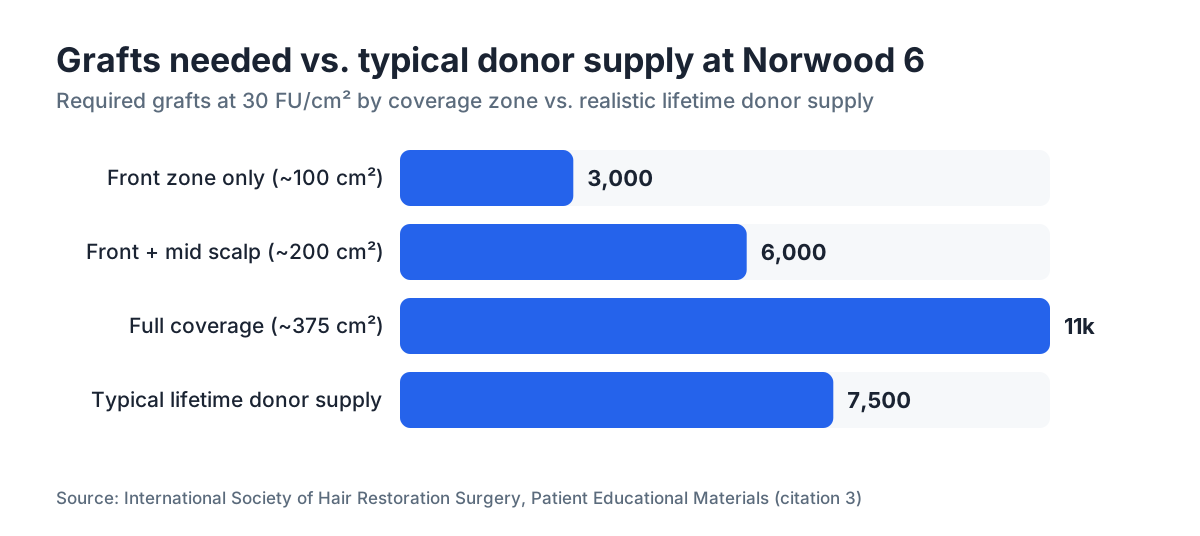
| Coverage target | Bald area (cm²) | Grafts at 30 FU/cm² | Grafts at 40 FU/cm² |
|---|---|---|---|
| Front zone only (~100 cm²) | 100 | 3,000 | 4,000 |
| Front + mid scalp (~200 cm²) | 200 | 6,000 | 8,000 |
| Full coverage (~350 to 400 cm²) | 375 | 11,250 | 15,000 |
Full coverage at photographic density is simply not achievable for most people, because it needs more grafts than the donor area can safely give. Harvest too aggressively from the permanent zone and you thin it visibly and permanently, trading a bald top for a see-through back [3].
The clinics that quote 10,000+ grafts in a single session are almost always either counting individual hairs rather than follicular units (which inflates the number) or planning to harvest beyond the true permanent zone, putting future donor hair at risk. Some Turkish and Southeast Asian clinics advertise 5,000-graft megasessions. Those graft counts are real but often delivered at lower per-graft survival, because blood supply to the recipient site gets overwhelmed at very high densities.
How much donor hair does a Norwood 6 patient actually have?
The permanent zone in a typical male scalp holds between 6,000 and 10,000 viable grafts across a lifetime, with most people sitting closer to 7,000 to 8,000 [3]. That is the total budget. Spend it once and it is gone.
A meaningful minority of Norwood 6 patients have lower donor density from the start, either because their pattern baldness has diffused into areas that look permanent but are not, or because the permanent zone is simply narrower on their skull. This is why a good surgeon measures donor density with a dermoscope or trichoscope before quoting any numbers. A density below 65 FU/cm² in the permanent zone is a warning sign that aggressive extraction will leave visible thinning.
Body hair FUE (taking grafts from beard, chest, or torso) is sometimes offered as a way to supplement donor supply. The evidence here is limited. A 2020 review in the Journal of Cutaneous and Aesthetic Surgery noted that beard grafts can survive scalp transplantation, but growth cycles differ from scalp hair, caliber is often coarser, and long-term survival data beyond five years is thin [4]. Beard grafts can fill gaps in a low-visibility zone like the crown, but they look noticeably different in high-visibility frontal areas.
Body hair is a supplement, not a solution. Anyone telling you it doubles your available grafts and produces flawless, natural-looking coverage is overselling the current evidence.
What realistic results can a Norwood 6 patient expect from a transplant?
An honest answer: you can expect a real improvement in appearance, but you cannot expect to look like a Norwood 2. The goal at Norwood 6 is coverage and framing, not the native density you had at 25.
Most experienced surgeons who work with Norwood 6 patients prioritize the frontal third and the hairline, because that zone has the highest visual impact per graft. A defined hairline combined with coverage across the front 10 to 15 cm of scalp changes how a face looks at conversational distance. The mid-scalp gets secondary priority. The crown is often left last or treated conservatively because it is a large area with limited aesthetic return per graft.
A realistic two-session plan for Norwood 6 might look like this: 3,500 to 4,500 grafts to the frontal zone in session one, then 2,000 to 3,000 grafts to mid-scalp in session two 12 to 18 months later. That leaves 0 to 2,000 grafts for any future crown work, if donor supply allows. Final density across the treated area might land at 25 to 35 FU/cm², noticeably lower than natural hair but convincing with the right cut and styling.
Clinic photos showing dense, even coverage after Norwood 6 transplants are almost always shot under controlled lighting, with styling product, or at a time point (12 to 18 months) when post-transplant shock loss has resolved but future progressive loss has not yet appeared. Ask any clinic for five-year follow-up photos. Most do not have them.
Myhairline.ai's free AI scan can help you document your current Norwood stage and track changes over time, which gives you a baseline before any surgical consultation.
Is a Norwood 6 transplant worth the money?
Cost varies enormously. In the United States, FUE transplants typically run $4,000 to $15,000 per session depending on graft count and clinic [5]. A Norwood 6 patient needing two sessions could easily spend $15,000 to $25,000 in the US. Turkey-based clinics commonly advertise all-inclusive packages at $2,000 to $4,000, which is why medical tourism is now a major factor in transplant decisions.
The value question depends on what you are buying. Go in expecting 50 to 60% coverage of the bald zone with acceptable density for photos and everyday life, commit to finasteride or another DHT-blocking treatment to stop further loss, and many Norwood 6 patients report high satisfaction. A 2019 patient satisfaction survey in Dermatologic Surgery found overall satisfaction rates for hair transplant surgery above 80% when patient expectations were managed before surgery [6].
Go in expecting the hairline you had at 22, and you will spend that money and be disappointed.
The risks deserve plain language too. Scarring (both FUE dot scars and FUT linear scars) is permanent. Infection is uncommon but real. Shock loss, where existing hair temporarily falls out after surgery, hits a significant minority of patients and can look alarming for three to six months. Overharvesting the donor zone is an irreversible mistake that some patients discover only years later, when the safe zone thins out.
Compare the cost against long-term medication. Generic finasteride costs roughly $10 to $30 per month [see finasteride], and finasteride and minoxidil together might run $40 to $60 monthly. Over ten years that is $4,800 to $7,200, with ongoing efficacy and reversibility. At Norwood 6 the comparison is not either-or, because surgery without medication tends to leave you with continued loss around the transplanted zone.
Does medication need to accompany a Norwood 6 transplant?
Yes, and any surgeon who does not raise this point in your consultation is a yellow flag.
Transplanted grafts come from the permanent donor zone, and they keep their DHT resistance after relocation. They will not fall out due to pattern baldness. But the surrounding native hairs in the recipient zone, any remaining hairs at Norwood 6, and hairs at the edges of the transplanted area do not have that protection. Without DHT suppression, those hairs keep miniaturizing, and the transplanted islands of density end up ringed by expanding bald patches over the following years.
Finasteride is the most studied oral treatment for this. A 1998 New England Journal of Medicine trial found that finasteride 1 mg/day produced a statistically significant increase in hair count versus placebo over two years, and follow-up work has shown maintenance effects at five years [7]. The FDA approved finasteride 1 mg for androgenetic alopecia in men. It does not work on bald areas, only on miniaturizing ones, so at Norwood 6 its main value is protecting the transplant margins and any remaining hair.
Topical or oral minoxidil can work alongside finasteride. Minoxidil for men is not a DHT blocker but a vasodilator that extends the anagen phase. Check minoxidil side effects before starting. DHT blockers beyond finasteride include dutasteride, which is not FDA-approved for hair loss but is used off-label with stronger DHT suppression.
Surgery and medication together produce more durable outcomes than surgery alone. That is not marketing language. It is the logical consequence of how the biology works.
FUE vs FUT: which technique makes more sense at Norwood 6?
Both techniques harvest follicular units from the donor zone. FUT (follicular unit transplantation) removes a strip of scalp, which is then dissected under microscopes. FUE (follicular unit extraction) punches out individual grafts one at a time. The techniques differ mainly in how they treat the donor area.
For Norwood 6 patients, FUT can yield a higher graft count per session because strip harvesting is efficient and causes less transection (accidentally cutting the follicle) in skilled hands. A well-executed FUT strip from a typical donor zone can yield 3,000 to 4,000 grafts in one session. The tradeoff is a linear scar across the back of the scalp, which matters most to people who prefer very short hair at the sides.
FUE leaves small circular scars, each 0.8 to 1.0 mm, spread across the donor area. It is less visible at very short haircuts and gets marketed as scarless, which is not accurate but close enough to be fair. FUE has slightly higher transection rates and can deplete the permanent zone faster if done aggressively, which matters a lot at Norwood 6 where every graft counts.
A reasonable position: many Norwood 6 patients who need maximum graft yield across two sessions do well with a combined approach, FUT first to preserve scattered FUE grafts for later fine-tuning. But surgeon skill matters more than technique. A mediocre FUT surgeon and an excellent FUE surgeon will produce opposite quality rankings.
For a broader overview of how both techniques work, read our guide to hair transplant surgery before making any decisions.
How do you spot a clinic that is overpromising on Norwood 6?
A few patterns show up again and again in overpromising clinics.
First, they quote graft numbers without measuring your donor density. Promising 6,000 FUE grafts before putting a trichoscope to your scalp is guessing. Any reputable clinic measures donor density in follicular units per cm², total permanent zone size, and estimated extraction yield before quoting a plan.
Second, they show you before-and-after photos without disclosing the follow-up period or the photography conditions. Photos taken at 12 months under studio lighting look dramatically better than the same head at five years under natural light, after surrounding native hair has continued to recede.
Third, they push you toward the crown rather than the hairline. This sounds backwards, but filling the crown uses enormous numbers of grafts for moderate visual impact and makes the clinic's results photograph dramatically in close-up. The hairline and frontal zone are harder to restore but do more for everyday appearance.
Fourth, they do not mention medication at all. No serious Norwood 6 surgical plan skips a conversation about finasteride, dutasteride, or at minimum topical minoxidil.
Fifth, they use price as the main selling point without discussing donor math. Cheap only counts if the result is honest. A $2,500 all-inclusive package that overharvests your donor zone leaves you with permanent scarring and nothing left for future repair.
Are there non-surgical alternatives worth considering at Norwood 6?
At Norwood 6, medications alone will not restore significant hair to bald areas. That is a hard biological limit. Finasteride and minoxidil work on miniaturizing follicles, not on follicles that have been fully lost for years. If you have been at Norwood 6 for a decade, no pill or topical is going to reverse that.
Medication still has a real place in managing Norwood 6. If you recently progressed to stage 6 and you still have some miniaturizing hairs in the transition zone, finasteride can slow or stall further loss, which preserves donor hair and reduces the graft burden on any future surgery. This is not a minor point. Slowing progression by three to five years gives you options you would not otherwise have.
Low-level laser therapy (LLLT) has FDA clearance for hair growth, but the mechanism is poorly understood and the evidence base is thin. A 2014 randomized controlled trial in the American Journal of Clinical Dermatology found a statistically significant increase in hair density with LLLT versus a sham device [9], but the effect size is modest and most trials used patients with early-stage loss, not Norwood 6. Do not spend serious money on laser caps expecting reversal at this stage.
Scalp micropigmentation (SMP) deserves a separate mention. It is not a hair restoration treatment but a cosmetic tattoo that simulates a close-cropped appearance. For people who want to look like they have chosen to shave their head, SMP can produce a convincing result at lower cost and risk than surgery. It is a legitimate option, not a consolation prize, just a different goal.
To understand the full pharmacological toolkit, oral minoxidil and hair loss supplements are worth reading before your next clinic appointment.
What questions should you ask a surgeon before booking a Norwood 6 transplant?
Walk into any consultation with these questions written down. A surgeon's answers will tell you more than any before-and-after gallery.
How many viable grafts do I have in my permanent zone? Ask them to show you the measurement. If they cannot give you a number derived from actual density measurement, they are guessing.
What is your recommended zone prioritization for my case, and why? The answer should be front-heavy with a specific rationale, not a generic promise of full coverage.
Can I see your five-year follow-up results from Norwood 6 patients? Two-year results look much better than five-year results when surrounding native hair keeps miniaturizing without medication compliance.
What is your graft survival rate? Industry estimates for graft survival with skilled technique run 85 to 95%. Clinics that cannot cite their own survival data have not measured it.
What medication plan do you recommend alongside surgery? If they do not have an answer, leave.
What happens if I need a repair or additional session in three years? Who covers the cost of correcting donor overharvesting or poor graft placement?
Are the before-and-after photos your own patients, or from a shared industry library? Some clinics use stock or licensed photos not from their own work.
These questions are not adversarial. Reputable surgeons welcome them. The ones who get defensive when you ask about donor density numbers are showing you exactly why you should ask harder.
What does the evidence say about long-term outcomes at Norwood 6?
The honest answer is that long-term controlled data specific to Norwood 6 transplantation is sparse. Most published hair transplant studies use mixed Norwood stages, and many measure outcomes at 12 to 18 months rather than five or ten years.
The International Society of Hair Restoration Surgery (ISHRS) conducts periodic practice censuses. Their 2022 practice census reported that hair transplant surgery has grown substantially in volume globally, with FUE now representing the majority of procedures, but stage-specific long-term outcome data remains limited in published literature [10].
What exists in the literature generally supports cautious optimism for higher Norwood stages when expectations are calibrated. A 2016 retrospective study in the Journal of Cutaneous and Aesthetic Surgery, while focused on mixed Norwood stages, found that patient-reported satisfaction tracked pre-operative counseling quality rather than the absolute graft count or density achieved [11]. Patients who had been told realistic expectations before surgery reported high satisfaction even with modest density improvements. Patients given aggressive coverage promises reported dissatisfaction despite objectively acceptable outcomes.
That pattern should inform how you read every clinic consultation. The surgeon who tells you the harder truth upfront is almost certainly a better choice than the one who shows you glossy photos of Norwood 3 results while you sit in the consultation chair as a Norwood 6.
Receding hairline dynamics feed into the progression toward Norwood 6. Reading about receding hairline patterns may help you understand your own history better.
Sources
- American Academy of Dermatology, Hair loss types: Androgenetic alopecia
- National Library of Medicine / NCBI, Androgenetic Alopecia (StatPearls)
- International Society of Hair Restoration Surgery, Patient Educational Materials
- Journal of Cutaneous and Aesthetic Surgery, Body hair transplantation using follicular unit extraction (2020)
- American Society of Plastic Surgeons, 2023 Plastic Surgery Statistics Report
- Dermatologic Surgery, Patient satisfaction after follicular unit hair transplantation (2019)
- New England Journal of Medicine, Finasteride in the treatment of men with androgenetic alopecia (1998, Kaufman et al.)
- American Journal of Clinical Dermatology, Randomized controlled trial of low-level laser therapy for androgenetic alopecia (2014)
- International Society of Hair Restoration Surgery, Practice Census results
- Journal of Cutaneous and Aesthetic Surgery, Patient satisfaction in hair transplant surgery: a retrospective study (2016)