

TL;DR: The Norwood scale (formally the Hamilton-Norwood scale) classifies male pattern baldness across 7 stages, from a full hairline at Stage 1 to a bare crown at Stage 7. Doctors use it to track progression and pick treatments. Finasteride and minoxidil work best at Stages 2-4. Hair transplants become an option at Stage 3 and up, if donor supply allows.
What is the Norwood scale?
The Norwood scale is a seven-stage system for classifying male pattern hair loss (androgenetic alopecia). Dermatologists, hair transplant surgeons, and researchers use it as a shared language. Say you're a Norwood 3, and every specialist in the room knows what your hairline looks like and roughly how much donor hair you have to work with.
The system goes back decades. James Hamilton, an anatomist, first published a classification of male pattern baldness in 1951 after studying hair loss in hundreds of men [1]. O'Tar Norwood revised and expanded that work in 1975, creating the version clinics use today [2]. That's why you'll see it called the Hamilton-Norwood scale, the Norwood-Hamilton scale, or just the Norwood scale. Same thing.
The scale runs from Stage 1 (no meaningful loss, baseline) to Stage 7 (a narrow horseshoe of hair around the back and sides, top of the scalp bare). There's also a Type A variant for men whose loss advances front to back in a straight line instead of leaving an island of hair on the crown. That distinction matters clinically, because Type A loss tends to leave less donor hair for a transplant.
One thing to be clear about. The scale describes pattern, not speed. Two men can both be Norwood 3 and have reached it at completely different ages and rates.
What does each Norwood stage look like?
Here's what you'd actually see at each stage, in plain terms.
Stage 1 is the control. No recession, no thinning, a hairline sitting where it did in your early twenties. Doctors include it so there's a baseline to compare against.
Stage 2 is the first sign of change. The hairline pulls back slightly at the temples, forming small triangles of recession. Most men here don't notice until someone points it out or they dig up an old photo. This is sometimes called a "mature hairline" rather than true hair loss, though the line between the two is genuinely blurry.
Stage 3 is where most dermatologists say male pattern baldness formally begins. Temple recession is now deeper and clearly visible. Stage 3 Vertex is a variant where recession starts at the crown (vertex) instead of, or on top of, the temples. This is the earliest stage where transplant surgery gets seriously discussed, though surgeons often prefer to wait and watch how far the loss goes before operating.
Stage 4 shows heavy temple recession plus a distinct bald spot on the crown. A band of hair still separates the two areas across the top of the head, but it's thinning.
Stage 5 is where that bridge between temples and crown narrows a lot. The two areas of loss are marching toward each other. Hair on top is sparse, and the head reads as clearly bald on top.
Stage 6 means the temple and crown areas have merged. The top of the scalp is largely bare. Hair on the sides and back holds on.
Stage 7 is the most advanced stage. Only a horseshoe of hair remains around the back and sides. That hair is genetically resistant to DHT (dihydrotestosterone), which is why it survives while everything else goes. It's also the donor hair for a transplant, and at Stage 7 there may not be enough of it to restore real coverage.
Androgenetic alopecia affects roughly 50 million men in the United States, according to the American Academy of Dermatology [3].
How common is each Norwood stage?
Prevalence data comes mostly from Hamilton's original work and from a frequently cited 1998 analysis by Norwood himself in the Journal of the American Academy of Dermatology [2]. Numbers shift by age group, but the overall shape is consistent: the older you get, the more likely you are to show pattern loss.
By age 50, roughly half of white men have Norwood Stage 3 or higher. By age 70, that climbs to about two-thirds. Prevalence runs somewhat lower in men of East Asian descent and differs again in men of African descent, who are less likely to develop the classic Norwood pattern.
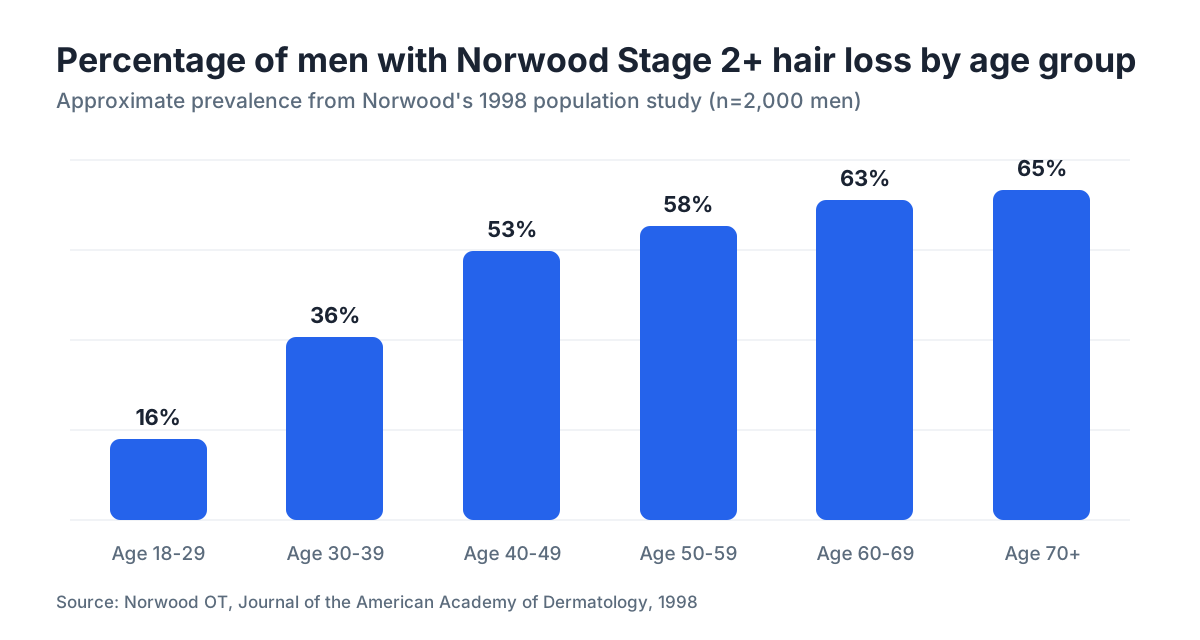
Norwood's 1998 data (2,000 men, ages 18-80) found about 16% of men aged 18-29 showed Stage 2 or higher loss. That figure rose to 53% in the 40-49 group and 65% in men over 70 [2].
Here's the approximate breakdown by age group, from Norwood's 1998 dataset.
| Age range | % with Stage 2+ hair loss |
|---|---|
| 18-29 | ~16% |
| 30-39 | ~36% |
| 40-49 | ~53% |
| 50-59 | ~58% |
| 60-69 | ~63% |
| 70+ | ~65% |
These are estimates from one population sample, not precise predictions. Genetics, ethnicity, and individual variation all move the numbers.
What causes hair loss to progress through the Norwood stages?
The main driver is dihydrotestosterone, or DHT, a hormone converted from testosterone by an enzyme called 5-alpha reductase. Follicles on the top and front of the scalp carry androgen receptors that are genetically sensitive to DHT. When DHT binds those receptors, it shortens the hair growth cycle over time. Follicles produce finer, shorter hairs with each cycle until they stop producing visible hair at all. That process is called follicular miniaturization.
Follicles at the back and sides don't share that sensitivity, which is why the Norwood horseshoe survives even at Stage 7. That's the whole biological basis for transplant surgery: you move DHT-resistant follicles into the zones where the sensitive ones have died.
Genetics is the biggest risk factor. If your father and maternal grandfather both went bald, your odds are high. But the inheritance is polygenic (controlled by many genes), so predicting your personal trajectory from family history alone is rough. Age is the other major factor. The longer you live, the more cumulative DHT exposure your follicles rack up.
For the underlying mechanisms, the what causes hair loss and DHT blocker articles cover the biology in detail.
Which treatments work at each Norwood stage?
Treatment choice depends heavily on stage. Getting it right before you spend money matters, so here's the stage-by-stage breakdown.
Stages 1-2: Evidence for treating Stage 1 is basically zero, since there's nothing to treat. Stage 2 is where prevention logic kicks in. Finasteride (1 mg/day oral) is FDA-approved for male pattern hair loss and works by blocking 5-alpha reductase, cutting scalp DHT by roughly 60-70% [4]. A five-year placebo-controlled trial in the Journal of the American Academy of Dermatology found men on finasteride maintained or gained hair count, while the placebo group lost about 100 hairs per target area over five years [5]. Starting at Stage 2 makes sense if you have a strong family history of advanced loss.
Topical minoxidil (2% or 5%) is FDA-approved for male pattern baldness and works differently, mainly by extending the growth phase of hair follicles and increasing follicular size [6]. It won't touch DHT, but it can slow visible progression and, in some men, regrow hair in partly thinned areas.
Stages 3-4: This is the sweet spot for medical treatment. Both finasteride and minoxidil have their strongest evidence here. Used together, the combination beats either drug alone, per a randomized controlled trial in Dermatologic Therapy (2015) that found the pairing produced better hair count and patient satisfaction than monotherapy [7]. The finasteride article covers dosing and side effects, the minoxidil for men guide is a practical starting point, and the finasteride and minoxidil article covers the combination.
Transplant surgery is also viable here, especially at Stage 3 Vertex and Stage 4. Many surgeons want patients on stabilizing medication first so they aren't operating on a moving target.
Stages 5-6: Medication can still slow progression but won't restore real density to large bald areas. A transplant becomes the primary option. Donor supply needs careful assessment, though. Moving from Stage 5 toward a possible Stage 7 over the next decade means grafts placed now have to be planned around the final expected pattern, not the current one. A good surgeon plans for that.
Stage 7: Options are genuinely limited. Donor supply is stuck at the horseshoe band, and the grafts available may not cover the whole top. Scalp micropigmentation (SMP), a tattooing technique that mimics a shaved head, is a realistic cosmetic option at this stage. So is shaving down entirely.
For side-effect details on the two most-used medications, the minoxidil side effects article covers the known risks honestly.
How do doctors actually use the Norwood scale in clinical practice?
When you sit down with a dermatologist or transplant surgeon, they assess your Norwood stage visually, sometimes with trichoscopy (dermoscopy of the scalp) or a hair pull test to back it up. That stage then feeds a few practical decisions.
First, it anchors a conversation about likely progression. A 28-year-old at Stage 3 has a very different risk profile than a 55-year-old at Stage 3. Age of onset is a rough proxy for how aggressive the alopecia is likely to be.
Second, it informs transplant candidacy. Surgeons weigh the ratio of available donor grafts to the area needing coverage. At Stage 4, that math usually works. At Stage 6 or 7, it gets hard. The hair transplant article goes into graft counts and realistic outcomes.
Third, it drives research. Every clinical trial on a hair loss treatment uses Norwood staging to define its population, which is why you'll see eligibility lines like "Norwood Stage 2-5" in trial descriptions.
The scale is imperfect. It was developed on white men, and research has noted it captures the classic pattern less reliably in men of other ethnicities [8]. It also ignores hair caliber, density, and rate of progression, all of which matter. Some clinicians now add the Basic and Specific (BASP) classification, which is more detailed, but Norwood remains the most widely used and cited system.
Can you tell which Norwood stage you're at yourself?
Roughly, yes. A good photo in bright overhead light, hair wet and slicked back, shows your hairline and crown clearly enough to pin down your approximate stage. Compare it against validated Norwood diagrams, which appear in most dermatology textbooks.
The honest limit of self-assessment is the transitions. The gap between Stage 2 and Stage 3, or between Stage 4 and Stage 5, can be subtle, especially when you're staring at your own scalp. A rear-view mirror shot, or a photo a friend takes from behind, helps with the crown.
If you want a structured starting point before booking a dermatology appointment, MyHairline's free AI scan (/scan) lets you upload photos and get a Norwood stage estimate to bring to a consultation. It's not a diagnosis. It gives you a baseline and flags whether your situation warrants a closer look.
Self-assessment also misses miniaturization. Hairs that are thinning but still present don't look the same in a phone photo as they do under a trichoscope. So if you're making treatment decisions, a dermatologist's read is worth having.
What is Stage 2 on the Norwood scale, and should you start treating it?
Stage 2 is the first stage where visible change shows up. The hairline moves back slightly at the temples, forming shallow triangles. The front hairline overall is still mostly intact. Plenty of men in their late twenties and early thirties are Stage 2 without knowing it.
Whether to treat at Stage 2 is genuinely contested. Some dermatologists push finasteride early precisely because you have the most hair left to protect. Others point out that not every Stage 2 man progresses fast, and finasteride carries real side effects in a minority of users. Sexual side effects show up in roughly 2-4% of users in clinical trials, though post-market reports suggest some cases persist after stopping [4].
The practical answer. If you have a strong family history of Norwood 5-7 baldness and you're still in your twenties or early thirties, a conversation with a dermatologist about starting finasteride at Stage 2 is reasonable. If your family history is mild and your recession is minimal, watchful waiting with annual photos to track change is equally defensible.
Minoxidil at Stage 2 carries lower side-effect stakes, but its evidence base is strongest for men with clearly thinning hair rather than early recession. The receding hairline article covers the Stage 2-3 territory in more depth.
How is the Norwood scale different from hair loss in women?
The Norwood scale was built for male pattern baldness and doesn't apply to women. Female pattern hair loss follows a different distribution. Instead of receding at the temples or hollowing out the crown, women usually get diffuse thinning across the top of the scalp while the frontal hairline stays largely intact.
The standard tool for female pattern loss is the Ludwig scale, running from Grade I (mild crown thinning) to Grade III (near-total loss on top). Some clinicians use the Sinclair scale instead.
The distinction matters for treatment. Finasteride at standard doses is not FDA-approved for female pattern hair loss, and it's contraindicated in women who are or may become pregnant because of the risk of birth defects [4]. Minoxidil 2% is FDA-approved for women; the 5% concentration is used off-label.
If a woman is losing significant hair, the Norwood scale is the wrong tool. That said, telogen effluvium is a common cause of diffuse shedding in women (and men) that gets mistaken for pattern loss, and it's worth ruling out before assuming androgenetic alopecia.
What are the limitations of the Norwood scale?
The scale is useful but not flawless. Knowing its limits helps you use it better.
It was built from studies of mostly white men. Several papers have noted the classic Norwood pattern is less representative in men of Asian or African descent, who may show different distributions and progression [8]. That doesn't make the scale useless for those men. It means clinical judgment has to fill the gaps.
It captures pattern, not density. A man at Norwood 3 with fine, miniaturized hairs throughout the thinning zone is in a very different spot than a man at Norwood 3 with thick, dense hairs. The first man has less effective hair to work with than his stage number suggests.
It doesn't predict rate of change. Two men both classed as Norwood 3 at 30 can look completely different at 45. One barely moves, the other hits Stage 6. The scale is a snapshot, not a forecast.
Staging disagreements between clinicians also happen, especially at the transition points. A 2021 study in Dermatology and Therapy on inter-rater reliability found moderate agreement among dermatologists using the Norwood scale, with the most disagreement at Stages 3 and 4 [9]. Keep that in mind if two doctors hand you two different stage readings.
Is there anything beyond Norwood Stage 7?
No. Stage 7 is the terminal classification in the Norwood system. But "terminal" describes the pattern, not the biology. Some men at Stage 7 still have diffuse thinning across their remaining horseshoe, which can keep miniaturizing slowly.
Some clinicians add descriptors alongside the number. The density and caliber of the remaining donor hair at Stage 7 varies a lot between men. A surgeon might call a Stage 7 patient "good donor density" or "poor donor density," and that changes what a transplant can achieve far more than the Norwood number alone.
If you're at Stage 7 and thinking about a transplant, the realistic conversation with a qualified surgeon is about what coverage is achievable with the grafts you have, not about rebuilding the hairline you had at 20. That honesty upfront saves a lot of disappointment later.
For men wondering whether supplements like saw palmetto or other DHT-adjacent compounds do anything at advanced stages, the evidence is weak. The hair loss supplements article summarizes what data exists.
How do hair transplant surgeons use the Norwood scale?
For a transplant surgeon, the Norwood scale is one input in a bigger calculation. The core question is simple: how many grafts do I have to work with, and how much area needs covering?
A rule of thumb used in the field: covering the frontal third of the scalp takes roughly 1,500 to 2,500 grafts for most men, while restoring the whole top from Stage 5-6 can need 4,000 to 5,000 or more. The average donor area holds about 6,000 to 8,000 transplantable follicular units, though that varies a lot by individual [10].
So at Norwood 4 or 5, there's usually enough donor supply for meaningful, natural-looking results. At Norwood 6-7, the surgeon has to choose: prioritize the frontal zone for maximum visual impact, or spread grafts thin for broader but weaker coverage.
Norwood staging also helps surgeons plan for future loss. If a 30-year-old walks in as Norwood 3, the surgeon has to design a hairline that still looks natural if the patient hits Norwood 5 or 6 in ten years. That's why most surgeons want patients on finasteride for at least a year before operating, to show the loss has stabilized.
If you're weighing surgery, the hair transplant article covers FUE vs. FUT, graft counts, and realistic cost ranges in detail.
Sources
- Hamilton JB, American Journal of Anatomy, 1951, original classification of male pattern baldness
- Norwood OT, Journal of the American Academy of Dermatology, 1975 and 1998, Norwood scale revision and prevalence data
- American Academy of Dermatology, hair loss overview
- U.S. National Library of Medicine, MedlinePlus, finasteride drug information
- Kaufman KD et al., Journal of the American Academy of Dermatology, 1998, five-year finasteride trial
- U.S. National Library of Medicine, MedlinePlus, minoxidil topical drug information
- Hu R et al., Dermatologic Therapy, 2015, combination finasteride and minoxidil RCT
- Birch MP et al., Dermatology, 2001, Norwood scale applicability across ethnicities
- Dhurat R et al., Dermatology and Therapy, 2021, inter-rater reliability of Norwood scale
- International Society of Hair Restoration Surgery, practice census and graft guidelines