

TL;DR: The Norwood scale runs from Stage 1 (no loss) to Stage 7 (only a horseshoe rim of hair remains). Most men with male pattern baldness fall somewhere between Stage 2 and Stage 5. Real-life examples show more variation than the classic diagrams suggest. Treatment works best at Stages 2 through 4, before follicles permanently miniaturize.
What is the Norwood scale and why do doctors still use it?
The Norwood scale, formally the Hamilton-Norwood scale, is the most widely used classification system for male pattern hair loss. James Hamilton first published a version in 1951, and O'Tar Norwood revised and expanded it in 1975 into the seven-stage system doctors use today [1]. It maps the typical progression of androgenetic alopecia from a full head of hair to the characteristic horseshoe of remaining hair at the back and sides.
Doctors use it because it gives a shared language. When a dermatologist says "he's a Norwood 4," every hair restoration surgeon in the room knows roughly what they're looking at. That matters for planning transplant sessions, dosing conversations, and tracking whether a treatment is working.
That said, the scale has real limits. It was designed around a mostly white male population. It doesn't capture diffuse thinning well, and it ignores density loss at the crown until that loss is fairly advanced. The Ludwig scale covers female pattern hair loss separately. Some clinics now layer in additional measurements like hair caliber and miniaturization percentage, which the original scale never addressed.
For a man sitting in front of a mirror wondering whether he's losing hair, the Norwood scale is still the fastest orienting tool available. Match your current hairline and crown to the descriptions below, note where the thinning is most active, and you'll have a much clearer conversation with any clinician or when researching your options online.
What does each Norwood stage actually look like in real life?
The diagrams you find in textbooks show clean, symmetrical hairlines. Real hairlines are messier. One temple recedes faster than the other. The crown thins in a patch that's off-center. Some men have a Norwood 3 hairline but Norwood 5 crown density. Keep that in mind as you read through the stages.
Stage 1 There is no visible hair loss. The hairline sits at or just above the upper forehead crease. This is the baseline. Most men in their late teens and early 20s start here.
Stage 2 A slight recession at the temples forms two small triangular areas. The hairline still looks roughly straight across, but the corners have softened. In real life this can look like a "mature hairline" rather than active balding, and many men stay here permanently. The line between normal maturation and early androgenetic alopecia is genuinely blurry at Stage 2, and researchers have acknowledged the difficulty of drawing it [1].
Stage 2A This is a variant where recession moves across the front hairline uniformly rather than at the temples first. The whole frontal line shifts back. It's less common but worth knowing because it looks different from the classic Stage 2 recession.
Stage 3 This is the stage where most men first say "I'm going bald." The temple recessions deepen significantly, leaving two bare or nearly bare triangles that extend back toward the crown. By the textbook definition, the recession at Stage 3 is deep enough that if you drew a line across the top of the head from ear to ear, the hairline sits noticeably behind it [1]. In real photos, Stage 3 men often still look like they have a lot of hair when viewed from the front, but dramatic from above.
Stage 3 Vertex This is Stage 3 recession at the temples plus early thinning at the crown (vertex). It's one of the most common real-life patterns. Frontal hair still present but crown shows a visible bald spot, often coin-sized to palm-sized.
Stage 4 Deeper recession at the front than Stage 3, and more obvious thinning or balding at the crown. A band of hair still connects the two sides across the top, but it may be thin. From above, you can see two distinct bald zones that haven't merged yet.
Stage 5 The band of hair connecting the front and crown zones has narrowed substantially. In real pictures, Stage 5 men often have a thin strip of hair across the top that looks sparse. The two bald areas are now large and nearly merging.
Stage 5A The variant where recession comes straight back from the front without a split zone. Less common. The top of the head looks like a smooth continuation of the forehead.
Stage 6 The bridge of hair is gone. Front and crown bald areas have merged into one large bald zone. Only the horseshoe remains at the back and sides, but it extends relatively high up the sides of the head.
Stage 7 The most advanced stage. The horseshoe is present but the hair is confined to a narrow band at the back and sides, sitting relatively low. The hair within that band may also be finer than it was. In real-life photos, Stage 7 men show very little hair on anything above ear level.
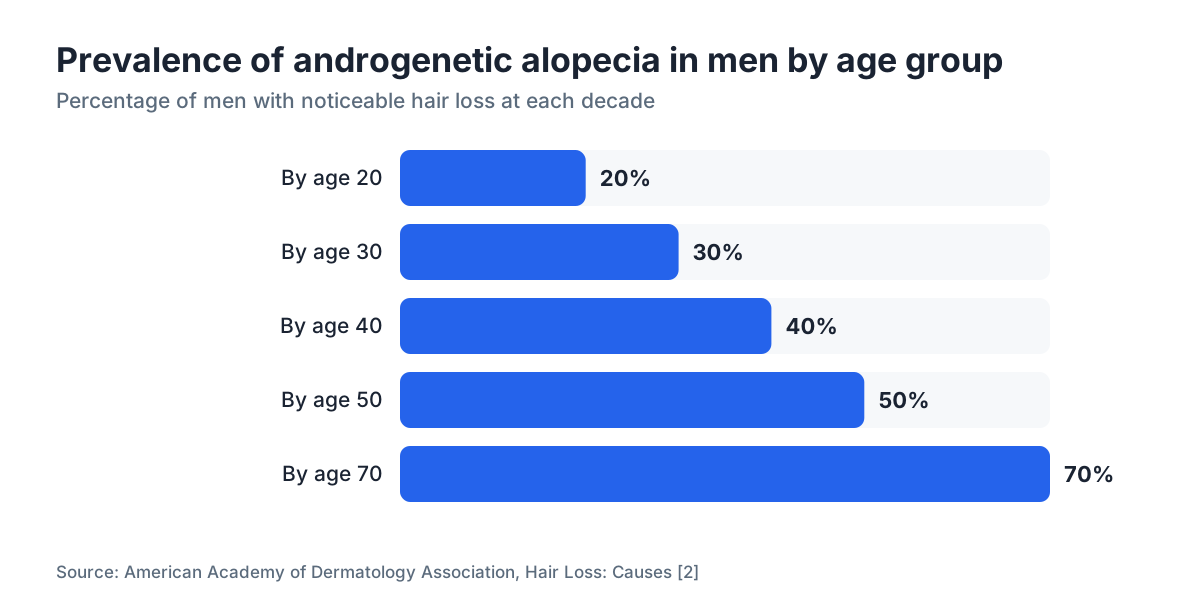
An estimated 50 percent of men will have noticeable androgenetic alopecia by age 50 [2]. Progression speed varies enormously. Some men reach Stage 4 by 25. Others take 30 years to move from Stage 2 to Stage 3.
How do real Norwood stage photos differ from the textbook diagrams?
The original Hamilton-Norwood diagrams are line drawings. They show idealized, symmetric patterns. Real scalps don't cooperate.
The most common mismatch is asymmetry. The left temple almost always differs from the right, sometimes by a full stage. A man might have Stage 3 recession on the left and Stage 2 on the right. Most grading protocols assign the more advanced side when asymmetry exists, but different clinics handle this differently.
The second common difference is density. Two men can have the exact same hairline shape, placing them both at Stage 4, but one has dense hair behind that line and the other has significantly diffuse thinning that the scale doesn't capture. This is why some researchers and surgeons have pushed for density-adjusted scoring, but no single replacement has taken over.
Lighting matters enormously in real photos. Harsh overhead lighting makes any thinning look far more advanced than it is. Wet hair collapses and dramatically reveals scalp. Dry, styled hair under soft lighting can conceal two full stages of loss. This is why tracking your own hair loss with photos requires consistent conditions: same lighting, same time of day, same hairstyle, ideally wet hair photographed from directly above.
If you want a more objective read on your current stage, MyHairline's free AI scan analyzes photos against a structured database to estimate your Norwood stage, which removes some of the subjectivity of comparing yourself to diagrams.
Which Norwood stages respond best to minoxidil and finasteride?
Treatment timing is probably the single most important piece of information this article can give you. Both minoxidil and finasteride work best on follicles that are alive but miniaturizing, not on follicles that are already dead and replaced by scar tissue.
Minoxidil has the most evidence at Stages 2 through 4. The 5% topical formula was approved by the FDA for men specifically for vertex (crown) hair loss, and the clinical trials supporting that approval showed meaningful regrowth in men with "moderate" loss, roughly Stages 3 to 4 [3]. Men at Stage 6 or 7 can still try it, but the realistic expectation shifts from "regrowth" to "slow further loss."
Finasteride works by blocking the conversion of testosterone to dihydrotestosterone (DHT), which is the androgen that miniaturizes hair follicles in genetically susceptible men [4]. The main registration trials showed that finasteride 1 mg daily stopped loss or produced regrowth in the majority of men with Stages 2 through 4 loss over two years. Stage 5 and beyond showed less benefit on average, though individual responses vary. You can read more about how the drug works and its side effect profile at our finasteride and DHT blocker pages.
Using both together is a recognized clinical approach. A 2002 study in the Journal of Dermatology found that finasteride plus minoxidil produced more hair count improvement than either agent alone [5]. The American Academy of Dermatology (AAD) lists both as first-line recommended treatments for androgenetic alopecia [6].
The short version: if you're at Stage 2 or 3, you have the most to gain and the least to lose by starting treatment now. At Stage 5 or 6, medication may still slow progression but transplant surgery starts becoming a serious conversation. At Stage 7, the donor supply has to be carefully evaluated before anyone promises you results.
For a deeper look at minoxidil for men including dosing and application, or to understand minoxidil side effects before you start, those guides cover the details this article doesn't.
At what Norwood stage should you consider a hair transplant?
Hair transplants are surgical procedures that move follicles from the permanent donor zone (back and sides) to bald or thinning areas. They don't create new hair. They redistribute what you have.
The practical implication: you need enough donor hair to fill the recipient area, and the recipient area can't still be aggressively losing hair without a plan for medication to hold the native hair.
Most hair restoration surgeons prefer to operate on patients who are at least Stage 3 or 4 and who have stabilized their loss, either through medication or by reaching an age (often mid-to-late 30s or beyond) where progression has slowed. Operating on a 21-year-old at Stage 3 carries real risk: transplanted hair in the front looks good at 25, but if the native hair behind it continues to fall out, you end up with an island of transplanted hair surrounded by bald scalp.
At Stages 4 and 5, a single well-planned FUE or FUT session can produce dramatic results. At Stage 6 and 7, donor supply becomes the limiting factor. The horseshoe zone is finite, and a Stage 7 scalp may not have enough donor follicles to cover a large bald area at natural density. Some Stage 7 patients are good candidates for partial coverage at lower density; others aren't realistic candidates at all.
If you're considering surgery, our hair transplant guide covers what FUE vs FUT actually involves, what realistic costs look like (typically $4,000 to $15,000 in the US depending on graft count and technique [7]), and how to evaluate a surgeon.
Finasteride after a transplant is standard practice at most reputable clinics. Without it, native hair outside the transplanted zone often continues to fall out.
How is the Norwood scale different for women and is there an equivalent?
The Norwood scale was built on male pattern loss. Female pattern hair loss has a different distribution, and the Ludwig scale (1977) is the standard classification for it [8].
Women lose hair diffusely across the top of the scalp, with the frontal hairline often staying relatively intact [11]. The Ludwig scale has three grades: Grade I is mild thinning at the crown, Grade II is wider spread thinning, and Grade III is extensive thinning with near-complete loss at the crown.
A small percentage of women do show the temple recession characteristic of the Norwood scale, but it's less common. Women who notice patchy loss rather than diffuse thinning should also consider telogen effluvium, a different condition triggered by stress, illness, or hormonal change that doesn't follow either scale's pattern.
The AAD recommends that women with hair loss be evaluated for underlying causes including thyroid disease, iron deficiency, and hormonal factors before assuming the loss is androgenetic [6]. Understanding what causes hair loss in your specific case matters before picking a treatment.
Can you accurately self-diagnose your Norwood stage at home?
Yes, with reasonable accuracy, if you're systematic about it. The main problem with self-assessment is that we see our own hair in mirrors under consistent but often flattering conditions.
The most reliable self-assessment approach: take three photos in the same session. Stand under a bright overhead light (or outside in daylight). Use a second mirror or a selfie stick to get a true top-down shot. Take the first photo with hair dry and styled normally, the second with hair wet and combed flat, and the third from the front at eye level. Compare all three to the stage descriptions above.
Wet hair from directly above is the most diagnostic single view. It removes volume, which is the main thing that masks early loss.
The honest limitation of self-staging is that the boundary between adjacent stages is blurry. Distinguishing Stage 3 from Stage 4 on yourself is genuinely hard. A dermatologist or board-certified hair restoration surgeon can do a trichoscopy exam, which looks at hair caliber and the ratio of terminal to vellus hairs, giving information the naked eye misses.
For an intermediate option between mirror and dermatologist, MyHairline's free AI scan can estimate your Norwood stage from photos and flag patterns worth discussing with a clinician.
Does Norwood stage predict how fast you'll lose hair?
No. Current stage and rate of progression are separate variables.
A man at Stage 2 could be there for the rest of his life. A man at Stage 2 could also be at Stage 5 within five years. The Norwood scale describes where you are, not how fast you're moving.
The factors associated with faster progression include a young age at onset (losing hair before 25 tends to predict more aggressive eventual loss), a strong family history on both the maternal and paternal sides, and high baseline DHT sensitivity of the follicles [2]. None of these predict individual trajectories reliably enough to stake treatment decisions on.
The practical implication is that serial photography over time tells you more than a single stage assessment. If you're Stage 3 today, take dated overhead photos every three months. If you're Stage 3 twelve months from now, your loss is relatively slow. If you're Stage 4, that's information that changes the urgency of your treatment decision.
Some men ask whether lifestyle factors like stress, diet, or creatine accelerate Norwood progression. Stress can trigger temporary shedding through telogen effluvium, which looks like worsening loss but is often reversible. Permanent androgenetic progression is primarily driven by genetics and DHT, not by lifestyle choices, though maintaining overall health doesn't hurt.
What is the Norwood Class A variant and does it show up in real pictures?
Class A is a less common variant pattern that Norwood described alongside the main scale. In Class A, the hairline recedes straight back from front to crown without the two-zone pattern (frontal recession plus separate crown thinning) seen in the standard scale.
In real-life pictures, Class A looks like someone is erasing the hairline from front to back in a single continuous wave. There's no island of hair at the vertex that persists while the front recedes. Men with Class A patterns often report that their hair "just keeps going back" without a bald spot forming separately at the crown.
Class A variants exist for Stages 2 through 5. A man with Class A Stage 4 loss has a hairline that has moved far back but still has relatively uniform remaining hair behind it, rather than a front zone and a crown zone joined by a thin bridge.
This matters for transplant planning. The donor zone and recipient pattern look different, and experienced surgeons adjust their hairline design accordingly.
Are there Norwood scale photos and resources from medical sources?
The American Academy of Dermatology has patient-facing information on androgenetic alopecia at their public website, including descriptions of the stages and general guidance on treatment [6]. Their site doesn't host a full photo library, but it's the most reliable non-commercial source for understanding what the stages mean clinically.
The National Institutes of Health's National Library of Medicine (PubMed) has the original Norwood 1975 paper and later studies with figure sets [1]. Access to full text varies by journal, but abstracts with key descriptions are free.
For real-life photo examples, the most honest sources are peer-reviewed clinical trials that include before-and-after photographs of participants, published in journals like the Journal of the American Academy of Dermatology or Dermatologic Surgery. These use standardized photography conditions. The before photos give you a cleaner sense of what each stage looks like than most commercial sites.
Be cautious with before-and-after photos on hair clinic websites. Lighting manipulation, styling, and selective case presentation can make results look far more dramatic than average outcomes. The AAD and the International Society of Hair Restoration Surgery (ISHRS) both recommend seeking multiple independent opinions before any surgical procedure [9].
What treatments are available at each Norwood stage, and what should you skip?
Here's a practical breakdown by stage. This isn't a prescription, it's a framework for the conversation you should have with a dermatologist.
| Norwood Stage | Minoxidil | Finasteride | Transplant | Notes |
|---|---|---|---|---|
| 1 | Not indicated | Preventive only (off-label) | Not applicable | No treatment needed |
| 2 | Can slow loss | First-line option | Not appropriate yet | Early intervention has most impact |
| 3 | First-line | First-line | Sometimes, with caution re: young patients | Combination therapy often recommended [5] |
| 3 Vertex | First-line | First-line | Possible for vertex if stable | Crown responds well to minoxidil [3] |
| 4 | Yes | Yes | Good candidate range if stable | Most transplant consultations happen here |
| 5 | Slows loss | Slows loss | Possible, donor supply permitting | Expectations should be calibrated carefully |
| 6 | Slows loss | Slows loss | Limited by donor supply | Plan around coverage, not density |
| 7 | Slows loss | Less benefit | Restricted; donor hair is scarce | Some patients not surgical candidates |
Things worth skipping: most over-the-counter "DHT-blocking shampoos" have very limited evidence. Low-level laser therapy (LLLT) has FDA clearance as a device but the effect size in trials is modest at best [10]. Hair fibers and concealers are cosmetic, not treatment. Hair loss supplements like biotin are widely sold but evidence for androgenetic alopecia specifically is weak unless you have a documented deficiency.
For men considering combining medications, finasteride and minoxidil together is the topic our dedicated guide covers in full detail, including how to start, what to expect, and how long you need to use both before assessing results.
For those interested in oral minoxidil as an alternative to topical application, oral minoxidil has a different side effect profile and is now being prescribed off-label at low doses with growing evidence.
Sources
- Norwood OT. Male pattern baldness: classification and incidence. Southern Medical Journal, 1975.
- American Academy of Dermatology Association, Hair Loss: Causes
- FDA, Minoxidil Topical Solution 5% label (NDA 019501)
- FDA, Propecia (finasteride 1mg) label (NDA 020788)
- Khandpur S et al. Comparative efficacy of various treatment regimens for androgenetic alopecia. Journal of Dermatology, 2002.
- American Academy of Dermatology Association, Hair Loss Diagnosis and Treatment
- International Society of Hair Restoration Surgery, Practice Census Survey 2022
- Ludwig E. Classification of the types of androgenetic alopecia (common baldness) occurring in the female sex. British Journal of Dermatology, 1977.
- International Society of Hair Restoration Surgery, Patient Resources
- Avci P et al. Low-level laser (light) therapy (LLLT) for treatment of hair loss. Lasers in Surgery and Medicine, 2014.
- Shapiro J. Hair loss in women. New England Journal of Medicine, 2007.