

TL;DR: The Norwood scale (officially the Hamilton-Norwood scale) classifies male pattern baldness into 7 stages, from a full hairline at Stage 1 to near-total crown and frontal loss at Stage 7. About 50% of men show meaningful hair loss by age 50. Knowing your stage matters because treatments that work at Stage 2 often can't reverse Stage 6 or 7.
What is the Norwood scale and why does it matter?
The Norwood scale, formally called the Hamilton-Norwood scale, is the standard classification system doctors and researchers use to measure male pattern baldness. Dr. James Hamilton published the original version in 1951, and Dr. O'Tar Norwood revised and expanded it in 1975 into the seven-stage system used today [1]. Every clinical trial on finasteride, minoxidil, and hair transplants uses this scale to define who qualifies and what counts as improvement. So if you don't know your stage, you can't really evaluate whether a treatment is likely to help you.
The scale runs from Stage 1 (no visible loss, full juvenile hairline) to Stage 7 (a narrow band of hair on the sides and back of the scalp, with everything on top gone). A few intermediate stages, labeled with the letter A, describe a pattern where hair recedes straight back across the front rather than leaving an island of hair on top.
Why does staging matter practically? Because androgenetic alopecia, the medical name for male pattern baldness, is driven by DHT (dihydrotestosterone) slowly miniaturizing hair follicles over years. Medications like finasteride and minoxidil for men can slow or partially reverse early-stage loss. They generally cannot regrow hair on a scalp that's been bald for years. Hair transplants can restore coverage, but surgeons need a healthy donor area, which shrinks at higher stages. Your stage, in other words, shapes every decision that follows.
What does each Norwood stage actually look like?
Here's a plain-language description of every stage, including the A variants.
Stage 1: No hair loss. The hairline sits where it was in your teens or early twenties. Most 18-year-olds are Stage 1, and some men stay here their entire lives.
Stage 2: Slight recession at the temples, forming a small symmetrical triangle of thinning. This is the classic "mature hairline" that many men develop in their twenties. It looks like a very minor retreat and is often mistaken for a natural adult hairline rather than early loss. Stage 2A describes recession that moves back evenly across the entire front rather than just at the temples.
Stage 3: The temporal recession deepens into clearly visible triangular patches. If you draw a line from the outer corner of your eye straight up, Stage 3 recession typically passes behind that line. Stage 3 Vertex (3V) means you're also developing thinning or a bald spot at the crown, even if the front still looks okay. Stage 3A shows the same straight-back recession pattern across the entire hairline.
Stage 4: The frontal hairline has receded significantly and the crown bald spot has grown. A band of hair still separates the two areas, but it's thinning. This is where many men first seriously consider treatment. Stage 4A has a broad hairline retreat with less crown involvement.
Stage 5: The bridge of hair between the front and crown is now very narrow or nearly gone. The two areas of loss are starting to merge. Stage 5 is a turning point. From here, non-surgical treatments are less likely to meaningfully restore density, though they can still slow progression.
Stage 6: The frontal and crown areas have merged into one large bald zone. The sides and back still have hair but the top of the scalp is largely bare. Some hair may remain at the very center front in Stage 6A.
Stage 7: The most advanced stage. Hair loss covers the entire top of the scalp. Only a narrow horseshoe-shaped fringe of hair remains along the sides and back of the head. This is what most people picture when they think "bald." The donor area for transplants is at its smallest here, which sharply limits surgical options [2].
How common is each Norwood stage, and how many men go bald?
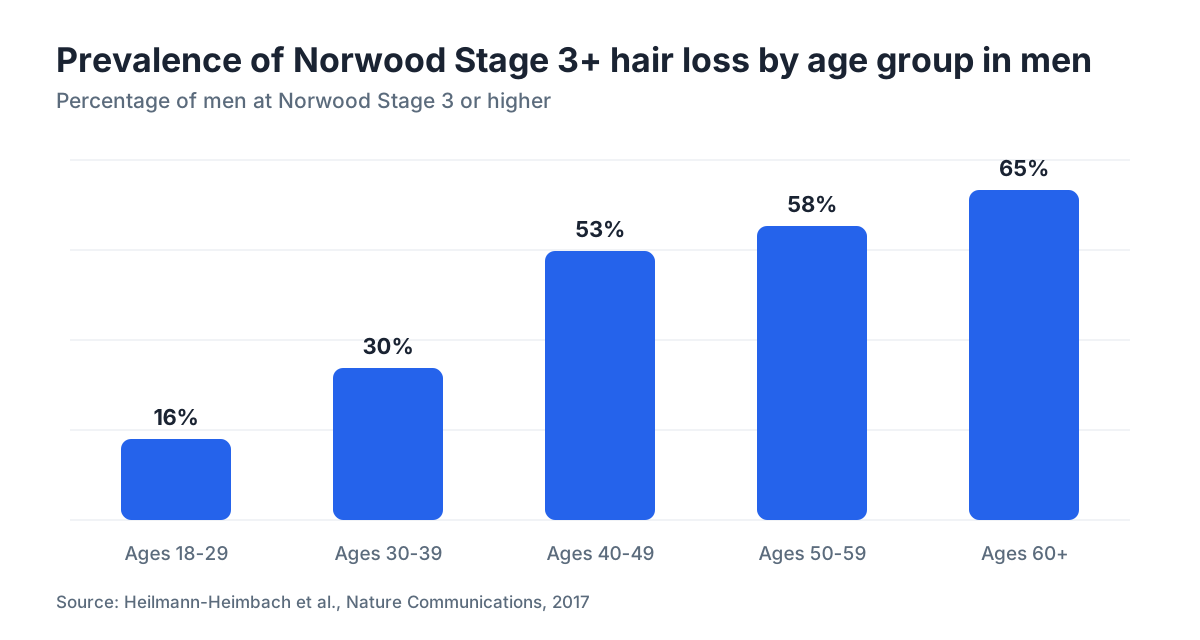
Male pattern baldness is far more common than most men realize until it's happening to them. A large study published in the Journal of Investigative Dermatology found that about 16% of men aged 18-29 show Stage 3 or higher on the Norwood scale [3]. By the 40s, that number climbs to roughly 53%. By the 60s, about 65% of men have reached Stage 3 or beyond [3].
The often-cited "50% of men by age 50" figure is real, though it refers to any clinically meaningful hair loss, not specifically Stage 5 or higher. The data are consistent enough across multiple populations that this rule of thumb holds up.
Genetics determine most of your risk. The androgen receptor gene on the X chromosome (inherited from your mother) is the strongest known genetic predictor, which is why the old advice to "look at your maternal grandfather" has some truth to it, though it's an oversimplification. Dozens of other gene variants contribute, and nobody has good enough data yet to predict with certainty which stage any individual will reach [4].
Progression speed varies enormously. Some men go from Stage 2 to Stage 5 in five years. Others spend twenty years at Stage 3. There's no reliable way to predict your personal rate from a single observation, which is why dermatologists often recommend documenting your hairline with photographs every six months.
Which Norwood stages respond best to minoxidil and finasteride?
The short answer: Stages 2 through 4 get the most benefit. Stages 5 through 7 can still see slowed progression, but real regrowth is unlikely.
Finasteride (1 mg/day, brand name Propecia) was FDA-approved in 1997 for male pattern baldness. The main registration trials enrolled men aged 18-41 at Norwood Stages 2 Vertex through 4 [5]. After one year, 83% of finasteride users maintained or increased hair count while 72% of the placebo group lost hair. After five years, 66% of men on finasteride maintained or gained hair. These numbers apply to that specific population, not to men at Stage 6 or 7.
Minoxidil 5% topical solution was FDA-approved for men's hair loss and is available over the counter [6]. The label studies focused on vertex (crown) thinning in men with Norwood Stage 3 Vertex through Stage 4. Regrowth is most reliably seen at the crown; hairline recession responds more modestly. Oral minoxidil at low doses (0.625-5 mg/day) is increasingly used off-label and shows similar or slightly better efficacy in small studies, though the FDA has not approved it for hair loss.
Using both together is worth considering for moderate stages. A randomized controlled trial published in Dermatology and Therapy found that the combination of oral minoxidil 0.25 mg plus finasteride outperformed either drug alone at 24 weeks [7]. The finasteride and minoxidil combination is the most evidence-backed two-drug approach for Stages 2-4.
For a receding hairline specifically (Stages 2-3), finasteride has better evidence than minoxidil alone, because finasteride addresses the hormonal cause (DHT) rather than just stimulating growth cycles.
At Stage 5 and beyond, medication is better thought of as preservation than restoration. Keeping what's left while planning for a transplant later is a legitimate strategy.
If you're unsure what stage you're at, MyHairline's free AI scan (/scan) can give you a visual stage estimate from a photo in under a minute. It's not a medical diagnosis, but it's a reasonable starting point before talking to a dermatologist.
At what Norwood stage should you consider a hair transplant?
Most surgeons prefer to operate on men who have reached a stable Stage 3 through 5. "Stable" means the loss pattern has not changed significantly in at least a year, ideally two.
Operating too early (Stage 2) risks designing a hairline around a scalp that will keep receding behind the transplanted hair, leaving an unnatural result. Operating at Stage 7 is technically possible but the donor zone is small and the bald area is very large, so full coverage usually isn't achievable without multiple sessions [2].
The two main transplant techniques, FUT (follicular unit transplantation) and FUE (follicular unit extraction), draw grafts from the occipital and parietal scalp. Those follicles are genetically resistant to DHT, which is why transplanted hair tends to survive. But if you're at Stage 6 or 7, the math gets difficult: you may need 3,000-6,000 grafts for adequate coverage, and the donor area may not safely supply that many in one procedure.
A board-certified hair restoration surgeon (look for ISHRS membership as a quality signal) will assess your donor density, scalp laxity, miniaturization percentage via dermoscopy, and your projected final Norwood stage before recommending surgery [8]. Anyone who'll transplant you without doing that assessment is cutting corners.
Cost scales with graft count. In the United States, FUE typically runs $5,000-$15,000 per session depending on graft count and clinic [9]. A Stage 4 requiring 1,500-2,500 grafts costs far less than a Stage 6 needing 4,000+ grafts, and the results are usually more satisfying.
One more thing: continuing finasteride after a transplant is standard practice. The transplanted hairs are DHT-resistant, but your native hairs behind and around them aren't. Without medication, you can end up with transplanted islands surrounded by new recession.
How do doctors actually determine your Norwood stage?
In a clinical setting, a dermatologist or hair loss specialist diagnoses your stage by direct visual and tactile examination. They part the hair in multiple directions, assess the density at the vertex, temples, and frontal scalp, and often use a dermatoscope (a lighted magnifying device) to measure follicle miniaturization, which shows thinning before it's visible to the naked eye [10].
Dermoscopy can detect miniaturized follicles (vellus-like hairs) in areas that still look full, which is why a doctor might tell you you're trending toward Stage 4 even when you think you look like a Stage 2. A ratio of more than 20% miniaturized hairs in an area is generally considered clinically significant.
Photographic standardization matters for tracking. The Norwood system was designed for visual classification against a reference chart, not algorithmic measurement, so agreement between different clinicians isn't perfect. Two dermatologists might classify the same scalp as Stage 3 vs. Stage 4 in a borderline case. That's a known limitation of the system [1].
Some clinics also use trichoscopy software that counts individual hairs per square centimeter and tracks changes over time with comparative photos. This gives a more objective measure than staging alone.
For self-assessment, the most useful approach is good lighting, a hand mirror, and a phone camera. Take a photo from the top (bird's eye view), the front, and each temple. Compare those photos to the Hamilton-Norwood reference chart, which is freely available in the dermatology literature. Then compare again in six months. The trend over time tells you far more than a single snapshot.
Does the Norwood scale work for women too?
No. The Norwood scale was designed for male pattern baldness and doesn't map well to female hair loss. Women with androgenetic alopecia typically lose density diffusely across the top of the scalp while keeping their frontal hairline, a pattern that doesn't fit any Norwood stage cleanly.
For women, the standard classification is the Ludwig scale (three stages of central thinning) or the Sinclair scale, which some researchers prefer for its finer gradations. The Savin scale is another option used in research settings.
If a woman appears to be following a Norwood-like pattern with significant hairline recession, that warrants investigation beyond standard androgenetic alopecia. Conditions like telogen effluvium, traction alopecia, or hormonal disorders can cause patterns that look superficially similar.
Finasteride is not FDA-approved for women and is contraindicated in women who are pregnant or may become pregnant due to risk of fetal harm [5]. Minoxidil 2% is FDA-approved for women; 5% is also used off-label in women but the FDA has only approved it for men.
Can you slow or stop Norwood progression without drugs?
Honestly, the evidence for non-pharmaceutical approaches is thin. Low-level laser therapy (LLLT) devices, such as laser combs and laser caps, have FDA clearance (not approval, which is a meaningful difference) for hair growth, meaning they passed a safety review. Some small trials show modest effects on hair density at Stages 2-4, but the data are nowhere near as strong as for finasteride or minoxidil [11].
Hair loss supplements like biotin, saw palmetto, and various vitamin blends are heavily marketed but underresearched. Saw palmetto has a theoretical DHT-blocking mechanism and a few small studies suggest mild benefit, but no large randomized controlled trial has established that it works. Biotin deficiency can cause hair loss, but most people aren't deficient, and supplementing beyond normal levels doesn't grow hair.
Diet, stress, and sleep quality affect hair loss indirectly by influencing overall follicle health and inflammation. Severe nutritional deficiencies, crash dieting, and chronic high stress can all speed up shedding. But these are contributing factors, not primary drivers of Norwood progression. Fixing them won't reverse androgenetic alopecia on its own.
DHT blockers like finasteride and dutasteride work at the hormonal level and have the strongest evidence for slowing progression. Natural DHT blockers (pumpkin seed oil, for example) have very limited data. One small Korean trial showed pumpkin seed oil increased hair count vs. placebo, but the sample was tiny and the study hasn't been replicated at scale.
The honest summary: if you want to slow Norwood progression, FDA-approved medications are the only options with consistent evidence. Everything else is adjunctive at best.
What does progression look like over time, and can you predict your final stage?
Predicting a man's final Norwood stage is genuinely hard. The clearest warning signs are early onset, a strongly affected family history on both sides (more than just the maternal line), and rapid early progression.
Men who show Stage 3 or higher loss before age 25 are statistically more likely to reach Stage 5 or higher by their 40s than men who first notice recession after 35. But this is population-level data, not a personal forecast.
Long-term tracking of hair loss shows that, without treatment, most men with any measurable loss at baseline keep progressing, though the rate varies widely [3]. Treatment with finasteride meaningfully slowed that trajectory in the FDA trial population: after five years, men on finasteride had about 277 more hairs per square centimeter than men on placebo at the vertex, a statistically and visually significant difference [5].
One real-world complication: men often don't start treatment until Stage 4 or 5, by which point the follicles in the affected areas are largely miniaturized or gone. The hair cycle has a long memory. Follicles that have been dormant for more than a few years have a much lower probability of responding to any treatment. This is why dermatologists consistently say earlier treatment means better outcomes, not because they're trying to sell you drugs, but because follicle miniaturization is largely irreversible past a threshold.
The most useful thing you can do right now, whatever stage you think you're at, is document it. A photo today is worth more than a vague memory of "my hair looked thicker last year."
If you want a quick objective read on where you stand, MyHairline's free AI scan (/scan) analyzes photos against the Norwood scale and gives you a stage estimate plus personalized information about treatment options.
Is creatine linked to faster Norwood progression?
This question comes up constantly in gyms and fitness forums, and the data are thinner than the conversation suggests.
The worry traces back to a single 2009 study of college rugby players in which three weeks of creatine supplementation raised DHT levels by about 56% and the DHT-to-testosterone ratio by 36% [12]. DHT drives androgenetic alopecia, so the theoretical pathway is plausible.
But that study measured DHT in blood, not hair follicle androgen activity, and it has never been replicated. No study has directly measured Norwood stage progression in creatine users vs. non-users. The 2009 finding remains a single data point from a small study.
So the honest answer is this: creatine might speed up Norwood progression in men who are already genetically susceptible, but nobody has proven that it does. If you're already at Stage 3 or 4 and worried about speed of progression, it's reasonable to factor this in. If you're at Stage 1, the risk from creatine is speculative.
More on this at does creatine cause hair loss.
Norwood stage comparison: treatments by stage
Here's a practical summary of what the evidence supports at each stage. This is not a prescription; individual cases vary and a dermatologist should be involved in any treatment decision.
| Norwood Stage | Finasteride | Minoxidil | LLLT | Hair Transplant |
|---|---|---|---|---|
| Stage 1 | Not indicated | Not indicated | Not indicated | Not indicated |
| Stage 2 | Good evidence, strong choice | Modest evidence | Weak evidence | Rarely indicated |
| Stage 2A | Good evidence | Modest evidence | Weak evidence | Rarely indicated |
| Stage 3 | Strong evidence, best window | Good evidence (crown) | Some evidence | Possible if stable |
| Stage 3V | Strong evidence | Good evidence | Some evidence | Good candidate |
| Stage 4 | Good evidence | Good evidence | Some evidence | Good candidate |
| Stage 4A | Good evidence | Moderate evidence | Some evidence | Good candidate |
| Stage 5 | Preservation mainly | Preservation mainly | Weak evidence | Possible, limited |
| Stage 6 | Preservation mainly | Preservation mainly | Not well studied | Limited, high graft demand |
| Stage 7 | Preservation mainly | Preservation mainly | Not well studied | Rarely ideal, consult surgeon |
Sources: FDA prescribing information for finasteride [5] and minoxidil [6]; ISHRS clinical guidance [8].
A few things the table can't capture: combination therapy (finasteride plus minoxidil) outperforms either alone at Stages 3-4 [7]. And even at Stage 6-7, finasteride is worth continuing if you still have donor hair you want to protect for a possible future transplant.
Sources
- Norwood OT. Male pattern baldness: classification and incidence. Southern Medical Journal, 1975
- International Society of Hair Restoration Surgery (ISHRS) — Practice Standards
- Heilmann-Heimbach S et al. Meta-analysis identifies novel risk loci and yields systematic insights into the biology of male-pattern baldness. Nature Communications, 2017
- American Academy of Dermatology — Androgenetic Alopecia overview
- FDA prescribing information for Propecia (finasteride 1 mg)
- FDA drug label for minoxidil topical solution 5%
- Vañó-Galván S et al. Oral minoxidil 0.25 mg combined with finasteride vs finasteride alone. Dermatology and Therapy, 2022
- International Society of Hair Restoration Surgery (ISHRS)
- ISHRS — Practice Census Results
- American Academy of Dermatology — Hair loss diagnosis
- Avci P et al. Low-level laser (light) therapy in the treatment of hair loss. Lasers in Surgery and Medicine, 2014
- van der Merwe J et al. Three weeks of creatine monohydrate supplementation affects dihydrotestosterone to testosterone ratio in college-aged rugby players. Clinical Journal of Sport Medicine, 2009