

TL;DR: The Norwood scale has seven stages measuring male-pattern baldness, from a full hairline (I) to near-total crown loss (VII). You can estimate your own stage with a top-down photo and the standard diagrams. Stage matters because it guides timing: most dermatologists want you starting medication at Stage II or III, before follicle miniaturization turns permanent.
What is the Norwood scale and why does it exist?
The Norwood scale (formally the Hamilton-Norwood scale) is the most widely used classification system for male-pattern hair loss. James Hamilton introduced the original version in 1951. O'Tar Norwood revised and expanded it in 1975, producing the seven-stage system clinicians still use today [1]. Its job is simple. It gives doctors and researchers a shared vocabulary so they can compare patients across studies, set surgical planning benchmarks, and track whether a treatment is working.
Before it existed, every paper on androgenetic alopecia described hair loss differently, which made research nearly impossible to compare. The scale did not solve hair loss. It gave everyone the same map.
The scale runs from Stage I, where the hairline shows little or no recession, through Stage VII, where only a horseshoe-shaped band of hair remains on the sides and back of the head. Stages II through VI describe the progression, with a separate "A" variant path (IIa through Va) for frontal recession that marches straight back without the usual island of hair at the vertex [1].
Be clear about what the scale does not do. It does not predict how fast you will progress. It does not tell you whether a treatment will work for you personally. And it was designed specifically for male-pattern loss driven by androgens, so it does not map well onto female hair loss, which has its own classification system (the Ludwig scale) [11].
What does each Norwood stage actually look like?
Here is a plain-language description of each stage. Read these alongside the standard diagrams from any dermatology reference.
Stage I: The hairline is essentially intact. Minor recession at the temples is possible but reads as a normal adult hairline, not thinning. Most men in their late teens and early twenties fall here.
Stage II: A slight recession has appeared at the temples, forming a very mild M-shape. Hair on the crown is still dense. This is where many men first notice something changing, and it is also when treatment tends to work best.
Stage IIa (A-variant): Recession moves straight back across the front rather than forming an M. The crown stays full. This path is less common.
Stage III: The temples have receded more noticeably, creating a deeper M or U shape. This is the first stage that most clinicians call clinically significant hair loss [1]. Stage IIIa follows the same straight-back pattern.
Stage III Vertex: Temple recession is similar to Stage III, but a thinning spot also appears at the crown (vertex). This is often the first sign that loss is happening in two separate zones at once.
Stage IV: The hairline recession is more severe and the crown bald spot has enlarged, but a strip of hair still connects the hairline to the sides. The two zones have not merged yet.
Stage V: The connecting strip between the front and crown is narrowing fast. The two bald zones are starting to look like one large area.
Stage VI: The strip is gone. The front and crown bald patches have merged into one continuous area. Hair on the sides is still present but sits lower on the head.
Stage VII: Only a horseshoe band of hair remains along the back and sides of the scalp. This is the most advanced stage. The density of the remaining hair also tends to be lower than at earlier stages [1].
One thing many men miss: stages are not strictly linear. You do not have to pass through every stage in order. Some men jump from a modest Stage II to Stage V over a few years. Others sit at Stage III for a decade. Genetics and androgen sensitivity drive the pace far more than time does.
How do you take the Norwood scale test yourself?
There is no official proprietary test. The self-assessment is a structured comparison of your hairline and crown against the published diagrams, done under good lighting with accurate photos.
Here is the practical process:
- Get a top-down photo. Hold your phone above your head, or have someone shoot from directly above. This is the angle that makes crown thinning visible. A mirror selfie looking straight ahead misses vertex loss almost entirely.
- Get a frontal photo. Stand with your forehead relaxed (not raised), in natural light, and shoot from straight on plus each 45-degree angle. Raised eyebrows pull the scalp back and artificially sharpen the hairline.
- Wet your hair slightly. Dry, styled hair hides thinning. Wet hair clumps and shows scalp visibility honestly.
- Compare systematically. First decide: is my recession mainly frontal (M-shape), mainly vertex (crown thinning), or both? Then match the zone pattern to the stage descriptions.
- Check the temples specifically. A line from the outer corner of your eye straight up to your hairline is a rough marker. If the hairline sits more than about one finger-width behind that line at the temples, recession has started.
You will probably land between two stages. That is fine. The scale was built for clinical categories, not millimeter precision. If you cannot decide between Stage III and Stage III Vertex, that uncertainty is itself useful: you have two active zones and need to watch both.
Myhairline.ai's free AI scan can run this comparison from your own photos and return a stage estimate in under two minutes if you want a second opinion on your self-assessment. The scan does not replace a dermatologist, but it gives you a documented baseline you can track over time.
How accurate is a self-assessed Norwood stage?
Honest answer: reasonably accurate for broad stages, less accurate for distinguishing adjacent ones. A 2012 study in the Journal of the American Academy of Dermatology looked at inter-rater reliability of the Hamilton-Norwood scale among dermatologists. Even trained clinicians disagreed on adjacent stages about 30 percent of the time, though they agreed on the broad category (early, mid, or late) in over 85 percent of cases [3].
So if you correctly place yourself in the Stage III to IV range, you are almost certainly right. Arguing about whether you are exactly III Vertex versus IV is genuinely hard even for professionals.
The main errors non-experts make:
- Underestimating vertex thinning because it is not visible in a standard mirror. Top-down photos fix this.
- Confusing a mature hairline with Stage II recession. A mature hairline (the slight temple rise most men get in their early 20s) is not androgenetic alopecia. A mature hairline stabilizes. Androgenetic recession continues.
- Lighting effects. Harsh overhead lighting exaggerates scalp visibility. Diffuse daylight is the most honest.
- Hair length bias. Short hair makes recession look more severe than it is at first glance. Very long hair over-conceals it.
For treatment decisions, the stage you assign yourself only needs to be accurate enough to answer one question: is this early enough that medication is likely to preserve what I have? Stages II through early IV are where finasteride and minoxidil show the strongest evidence for slowing progression [4]. By Stage VI or VII, the realistic conversation shifts from preservation to transplant planning.
What Norwood stage should make you start treatment?
Start early. The evidence for medical treatment is clearest at Stages II through IV, and the follicles you save at Stage II are the ones you cannot get back at Stage V. Finasteride (1 mg daily, FDA-approved for male-pattern hair loss) was tested in its Phase III trials mainly in men with Norwood Stage II vertex through Stage IV [4].
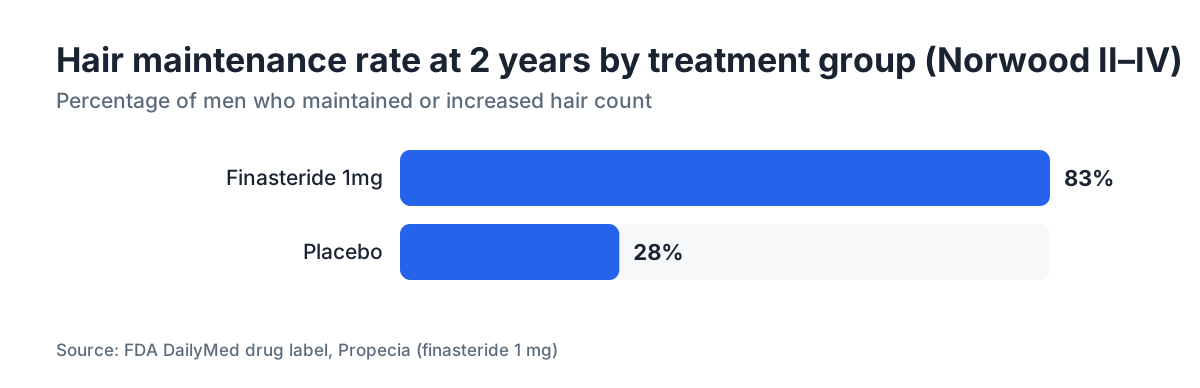
The two-year results showed 83 percent of men on finasteride maintained or increased hair count, versus 28 percent on placebo. A five-year extension found continued benefit [4]. If you are at Stage II or III, finasteride is the drug most likely to slow or stop progression. You can read more about how it works in our finasteride guide.
Minoxidil (2 percent or 5 percent topical, OTC) is FDA-approved for vertex thinning specifically, and works best in men with less than five years of loss in that zone [5]. The minoxidil for men overview covers dosing and what to realistically expect. Using both drugs together has better evidence than either alone across most Norwood stages [6]. See the finasteride and minoxidil breakdown for specifics.
For Stages V through VII, medication can preserve existing hair in theory, but the visual payoff is limited because so much has already gone. Hair transplant surgery becomes the more relevant conversation. Surgeons generally want to see that you have stabilized before operating, and Norwood stage is one of the main inputs for estimating donor graft availability and whether the result will look natural. Our hair transplant article walks through the planning process.
One thing to not do: wait to reach a "bad enough" stage before treating. The follicles that have already miniaturized are largely gone. Treatment preserves what remains. Starting at Stage II beats starting at Stage V, full stop.
How does the Norwood scale compare to other hair loss classification systems?
| System | Used for | Stages | Main limitation |
|---|---|---|---|
| Hamilton-Norwood | Male-pattern (androgenetic) alopecia | I to VII (+ A variants) | Poor fit for female pattern or diffuse loss |
| Ludwig | Female-pattern hair loss | I to III | Does not address hairline recession patterns |
| Sinclair | Female diffuse thinning | 1 to 5 | Less common outside academic research |
| BASP (Basic and Specific) | Both sexes | 4 basic + 2 specific types | More complex; used more in Asia and transplant research |
| Savin | Female vertex thinning density | 1 to 5 (+ frontal) | Built for clinical trial use, not self-assessment |
For a man trying to self-stage, the Hamilton-Norwood is the right tool. It is the one every hair transplant surgeon, dermatologist, and clinical trial uses. If your loss is mainly diffuse (thinning all over rather than receding or balding in a zone), that may point toward telogen effluvium or another cause entirely, not androgenetic alopecia at all. In that case Norwood staging is the wrong framework.
The BASP classification has been proposed as a more nuanced replacement [7], but it has not displaced Norwood in clinical practice. When you talk to a surgeon or dermatologist, they will almost certainly quote you a Norwood stage.
Does the Norwood scale apply to women?
Not really. The Norwood scale was built on male-pattern baldness, which shows up as hairline recession and vertex loss driven by dihydrotestosterone (DHT) sensitivity. Female-pattern hair loss usually presents as diffuse thinning over the crown while the frontal hairline holds. That is the Ludwig pattern, not the Norwood pattern [11].
Some women do get hairline recession similar to male-pattern loss, particularly after menopause or with elevated androgen levels. In those cases a clinician might loosely reference Norwood stages, but it is not standard practice.
If you are a woman researching your hair loss, the Ludwig scale or Sinclair scale is the right classification system. The underlying causes and treatment logic also differ a lot from male-pattern loss. What causes hair loss covers both sexes in more detail.
Women who try to self-stage using the Norwood diagrams often get false reassurance. A woman with significant Ludwig Stage II diffuse thinning might not match any Norwood diagram and conclude she is fine when she is not.
What does the Norwood stage tell a hair transplant surgeon?
Your Norwood stage is one of three main inputs surgeons use to plan a transplant. The others are your donor density (how many viable grafts sit in the back and sides) and your age.
Stage drives graft count estimates. Covering a Stage III hairline might take 1,500 to 2,500 grafts. A Stage VI restoration often needs 5,000 to 7,000 grafts or more, which may exceed what a single donor area can safely provide [8]. The International Society of Hair Restoration Surgery has published guidance using Norwood stages as the baseline for these estimates [8].
Age matters because a 25-year-old at Stage III will very likely progress further. A surgeon who restores a Stage III hairline on a 25-year-old may be creating an island of transplanted hair in the front surrounded by future bald areas behind it. Good surgeons plan for the projected final Norwood stage (assessed partly by family history) and design the hairline for that, not for what you look like today.
Stage also shapes donor planning for FUE versus FUT. At Stage VII, the permanent zone (the horseshoe band of DHT-resistant hair) is narrower, which means fewer safe donor follicles. Overharvesting that zone is a real risk at advanced stages. Read the full hair transplant article for a deeper breakdown of graft math and technique.
Here is why staging drives the plan. Two patients can present with visually similar bald areas but sit at different Norwood stages (one at V, one at early VI), and their transplant plans will differ a lot because of projected future loss.
Can Norwood stage be reversed or slowed?
Slowed, yes, for many men. Reversed in a meaningful visual sense, occasionally and modestly. Not cured.
Finasteride lowers DHT in the scalp by about 60 percent [4], which slows or stops miniaturization in most responders. In a minority of men (roughly 36 to 48 percent in trials, depending on the study and endpoint), some regrowth happens. That regrowth tends to move the visual appearance back by about half a stage in favorable cases, not multiple stages.
Minoxidil can produce visible regrowth, particularly at the vertex, but the FDA label is blunt that it is "not intended to achieve total hair regrowth" [5]. The label also notes that hair regrown with minoxidil sheds within a few months if you stop.
What finasteride and minoxidil together do best is hold the stage you are at and prevent further progression. For most men starting at Stage II or III, staying at that stage for ten or more years is realistic and genuinely good. Our dht blocker article explains the mechanism in more detail.
At Stage VI or VII, the follicles in the bald zones are essentially fibrosed and gone. No medication regenerates them. Transplant surgery physically moves DHT-resistant follicles from the back of the scalp to the bald zones. That is the only intervention with strong evidence for visible restoration at those stages [8].
Some men ask about supplements. The honest answer is that the evidence base for hair loss supplements is thin compared to FDA-approved medications. Saw palmetto has some weak evidence as a mild DHT inhibitor. Everything else is largely unproven.
How often should you reassess your Norwood stage?
If you are not on treatment, checking every three to six months with standardized photos (same lighting, same angle, same wet-versus-dry state) gives you a useful progression record. Annual photos are the minimum if loss is slow.
If you are on treatment, the question changes. You are watching for response, not progression. Dermatologists typically assess treatment response at six months (too early to see the full effect) and twelve months (a more reliable read). The Norwood scale is a coarse tool for this. Clinical phototrichograms or trichoscopy give finer data, but they require a clinic visit.
One practical system: pick one date a year, take the same set of four photos (frontal, top-down, left 45, right 45), save them in a folder named with the date, and compare year over year. Day-to-day changes in density from lighting and hydration are enough to fool you. Year-over-year comparison is more honest.
Want a documented AI-assisted baseline right now? Myhairline.ai's free scan generates a stage estimate from your photos that you can save and compare to future scans. Think of it as a timestamp for your hairline.
What can push hair loss to a higher Norwood stage faster than normal?
Several things speed up progression beyond the typical genetic baseline.
DHT sensitivity and genetics stay the dominant drivers. If your father and maternal grandfather both reached Stage VI, your risk of reaching advanced stages is much higher than if both kept full heads of hair into their 60s. Androgenetic alopecia is polygenic, meaning dozens of genes contribute, but androgen receptor sensitivity variants on the X chromosome are among the most studied [9].
Stress and illness can trigger telogen effluvium on top of androgenetic alopecia, causing a sudden shed that makes staging temporarily worse. When the effluvium resolves, hair count returns to the androgenetic baseline, not to a healthier one. Understanding telogen effluvium matters if your shedding seems sudden rather than gradual.
Nutritional deficiencies (particularly iron and ferritin in men who restrict calories, and zinc in vegetarians) can worsen diffuse thinning. This does not change the Norwood pattern directly, but it can thin the remaining hair enough to make an existing stage look worse.
Creatine supplementation has a proposed mechanism involving increased DHT conversion. A small 2009 study in rugby players showed a rise in the DHT-to-testosterone ratio [10]. The evidence is not strong enough to say creatine directly advances Norwood staging, but if you are genetically susceptible and worried, read the does creatine cause hair loss analysis before committing to high-dose creatine.
Stopping finasteride or minoxidil can cause a rebound shed that moves you to a higher stage than when you started. This is not a myth. The hair that medication preserved depends on it. Remove the medication and progression resumes, sometimes quickly.
When should you see a dermatologist instead of just self-staging?
Self-staging is fine for initial orientation. See a board-certified dermatologist (ideally one who specializes in hair) in these situations:
- You are under 25 and progressing faster than Stage II to III in under a year.
- Your loss is diffuse (thinning everywhere, beyond the hairline and crown), which suggests a cause other than androgenetic alopecia.
- You have scalp symptoms: itching, flaking, redness, or pain. These may point to seborrheic dermatitis, lichen planopilaris, or other conditions that need different treatment.
- You are a woman.
- You are considering finasteride (a prescription drug) and need a provider who can discuss side effects and contraindications, particularly if you have existing health conditions.
- You have been on treatment for twelve months with no stabilization and want a formal trichoscopy assessment.
The AAD has guidance on when to see a dermatologist for hair loss, and it flags sudden loss, patchy loss, and scalp symptoms as triggers for professional evaluation [2]. Do not use the Norwood scale to talk yourself out of a visit when the pattern does not fit.
A dermatologist can also offer dermoscopy (trichoscopy), which shows follicular miniaturization under magnification. This can detect androgenetic alopecia at Stage I or even earlier, before it is visible to the naked eye, and it can confirm whether the cause is androgenetic rather than something else [2].
Sources
- Norwood OT, Journal of the American Academy of Dermatology, 1975 revision of the Hamilton-Norwood scale
- American Academy of Dermatology, Hair Loss resource center and when to see a dermatologist
- Gupta AK et al., Journal of the American Academy of Dermatology, 2012, inter-rater reliability of Hamilton-Norwood scale
- FDA, DailyMed drug label for Propecia (finasteride 1 mg)
- FDA, DailyMed drug label for minoxidil topical solution 2% and 5%
- Kanti V et al., Journal of the European Academy of Dermatology and Venereology (JEADV), 2018, evidence-based S3 guideline for androgenetic alopecia
- Lee WS et al., Journal of the American Academy of Dermatology, 2007, BASP classification proposal
- International Society of Hair Restoration Surgery, ISHRS practice standards and graft planning guidance
- Hillmer AM et al., American Journal of Human Genetics, 2005, androgen receptor gene and male-pattern baldness
- van der Merwe J et al., Clinical Journal of Sport Medicine, 2009, creatine supplementation and DHT ratio in rugby players
- National Library of Medicine, MedlinePlus, androgenetic alopecia and female-pattern hair loss overview