

TL;DR: Receding hairlines are classified using the Norwood-Hamilton scale, which runs from Type I (no recession) to Type VII (only a horseshoe fringe remains). Most men notice real change between Types II and IV. Early stages respond well to minoxidil and finasteride. By Type VI or VII, hair transplant surgery is usually the only way to restore density.
What is the Norwood scale and why does it matter?
The Norwood-Hamilton scale is the standard system doctors use to describe male-pattern baldness. James Hamilton published the original classification in 1951, and O'Tar Norwood revised it in 1975 into the version dermatologists still use today [1]. It runs from Type I through Type VII, with a separate "A" variant track for men whose hairline recedes straight back rather than forming the classic temple-and-crown pattern.
Why does the classification matter? Because the stage you're at determines which treatments are worth trying. A Type II with early temple recession has a very different prognosis than a Type V with a large bald patch at the crown. Doctors use the scale to set expectations, compare results across studies, and decide whether a patient is a realistic transplant candidate.
The scale is not perfect. It describes male androgenetic alopecia specifically. Women experience a different pattern (diffuse thinning across the crown, usually without a receding frontal hairline), which is better described by the Ludwig or Sinclair scale [2]. If you're a woman reading this because your hairline is moving back, that's worth flagging to a dermatologist because frontal fibrosing alopecia and traction alopecia can both cause similar-looking recession and have very different treatments.
What does each receding hairline stage look like?
Here is a plain-language description of each Norwood type, written so you can figure out roughly where you are without a medical degree.
Type I. No meaningful recession. The hairline sits in a juvenile position across the forehead. Most men in their late teens have a Type I hairline. If you're in your 30s and still here, count yourself lucky.
Type II. Small triangular recessions appear at both temples. The hairline is still clearly present across the forehead, just slightly higher at the sides. A lot of men notice this in their early 20s and panic. It doesn't always progress quickly.
Type IIA (A variant). The frontal hairline retreats evenly across the forehead rather than at the corners. There's no deep temple recession; the whole line just moves backward.
Type III. This is where most dermatologists consider recession clinically significant. The temple recession is now deep, forming U-shaped or V-shaped bays. The remaining frontal bridge of hair may feel thin. Type III is the earliest stage at which finasteride trials have consistently shown measurable benefit [3].
Type III Vertex. Same frontal picture as Type III, but now a small bald spot has appeared at the crown. Many men don't notice the crown spot until someone mentions it.
Type IV. The temple recession and the crown patch have both grown. They're still separated by a band of hair across the top of the scalp, but that band is starting to look thin.
Type IVA (A variant). The frontal recession has marched back past the top of the head without much crown involvement. The hairline is very high.
Type V. The band of hair separating the frontal recession from the crown spot is now narrow and sparse. From above, the bald area is starting to look connected.
Type VA (A variant). Again, frontal-dominant, but the entire top of the scalp is now essentially bare.
Type VI. The frontal and crown zones have merged into one large bald area covering the entire top and sides of the crown. Only the side and back fringe remains.
Type VII. The most advanced stage. Only a narrow horseshoe band of hair survives around the back and sides. Even that fringe may be sparse. Hair transplant surgeons look carefully at Type VII patients because donor supply from the fringe is limited.
How common is each stage of hair loss in men?
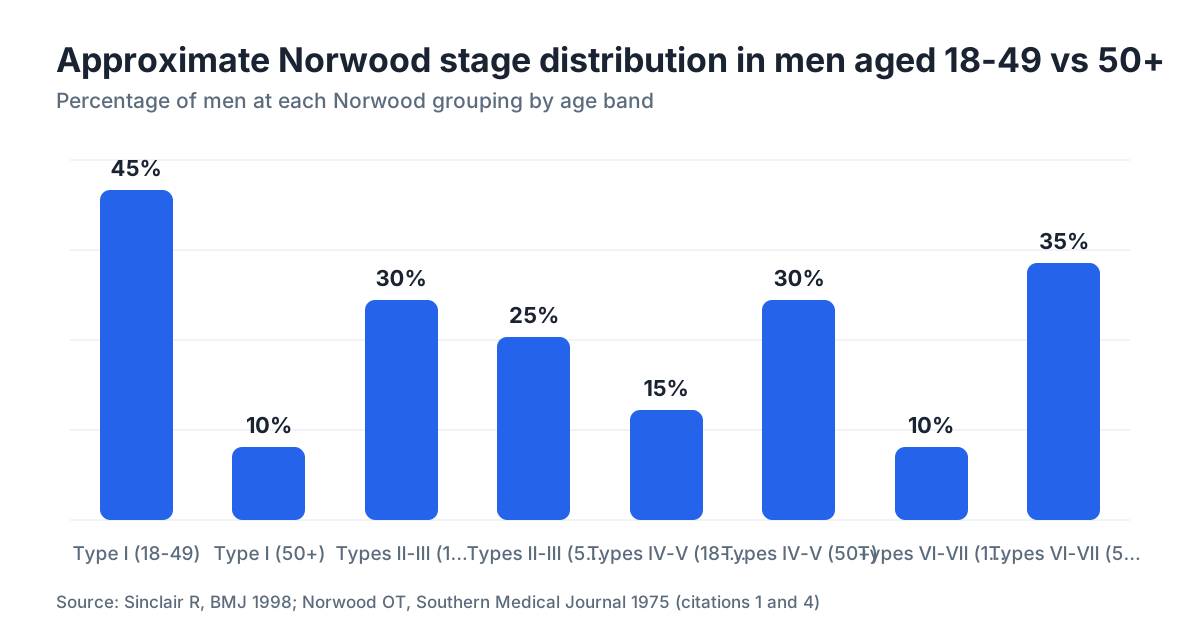
Population data on Norwood distribution comes from a few large cross-sectional studies. The most-cited is Norwood's own 1975 survey of over 1,000 men, which found that roughly 80% of white men over 70 had some degree of androgenetic alopecia, with Type II or higher [1]. More recent epidemiological work has refined the age breakdown.
A 2000 study in the Journal of Investigative Dermatology Symposium Proceedings estimated that androgenetic alopecia affects approximately 50% of men by age 50 [4]. The progression curve is steep in the 20s and 30s, then slows somewhat.
| Norwood Type | Approximate prevalence in men 18-49 | Approximate prevalence in men 50+ |
|---|---|---|
| I | ~45% | ~10% |
| II-III | ~30% | ~25% |
| IV-V | ~15% | ~30% |
| VI-VII | ~10% | ~35% |
These are rough estimates synthesized from published surveys; individual studies vary by population, measurement method, and age bracket. The honest answer is that nobody has perfect global prevalence data broken down by Norwood type and decade of life. What is clear: by your 50s, being at Type IV or beyond is statistically normal for a white man. Prevalence is somewhat lower in men of East Asian descent and somewhat higher in men of South Asian descent, though the data on ethnic variation is thinner than researchers would like [4].
Genetics loads the gun heavily here. If your father and maternal grandfather both went fully bald, your odds of reaching Type VI or VII are meaningfully higher than average. That's not destiny, but it's a reasonable prior.
At what age does a receding hairline typically start?
The short answer: earlier than most people expect. About 25% of men who will eventually have significant androgenetic alopecia begin to lose hair before age 21 [4]. The process of miniaturization, where DHT progressively shrinks hair follicles, can begin in the mid-to-late teens in genetically susceptible men.
The most common pattern is a gradual shift from Type I to Type II between ages 18 and 25, followed by a period of slow progression or plateau. Some men hit Type III or IV in their late 20s. Others stay at Type II until their 40s. There is no universal timeline.
One useful rule of thumb from the clinical literature: a man's Norwood stage at age 30 is a reasonable (but not reliable) predictor of where he'll land by 60. Men who are Type IV at 30 rarely plateau at Type IV for life. But progression speed varies enormously, and there is no test that accurately predicts individual rate of loss. Understanding what causes hair loss in the first place, specifically the role of DHT and follicle sensitivity, helps explain why this timeline differs so much person to person.
How do you know if your hairline is receding or just maturing?
This is one of the most common questions men in their early 20s ask, and the answer genuinely matters because the two things need different responses.
A "maturing" hairline is a normal process where the juvenile hairline (flat and very low, about 1-2 cm above the upper forehead wrinkle) moves slightly upward and takes on a slightly rounded or widowed shape. This usually happens between ages 17 and 21 and is not androgenetic alopecia. The hairline simply settles into an adult position.
A receding hairline due to androgenetic alopecia shows different features: the temples recede more than the frontal hairline, the receding hairs often look thinner and shorter (miniaturized) rather than just absent, and the pattern tends to keep moving over months and years rather than stabilizing.
The best way to tell them apart is time and texture. Take a photo in the same lighting today, then again in six months. Measure from a fixed point (like the tip of your nose) to the hairline in the photo. If there's no change and the hairline hairs look the same thickness as the rest of your hair, you probably matured. If the temples are creeping back and the hairs at the margin look finer and shorter, that's early androgenetic alopecia, and it's worth taking seriously.
A dermatologist can also use a dermatoscope to look at follicle diameter variation, which is a more objective sign of miniaturization than the naked eye can catch.
What causes a hairline to recede at each stage?
The mechanism is the same across all stages: dihydrotestosterone (DHT) binds to androgen receptors in genetically susceptible follicles, shortening the anagen (growth) phase of the hair cycle and progressively shrinking the follicle diameter [5]. Each cycle, the follicle produces a shorter, thinner hair. Eventually it produces no visible hair at all.
The follicles at the temples and crown have higher androgen receptor density and greater 5-alpha reductase activity (the enzyme that converts testosterone to DHT) than follicles at the back and sides. This is why the Norwood pattern looks the way it does rather than causing uniform thinning. A full breakdown of DHT blockers and how they interrupt this process is worth reading alongside this guide.
Stage progression is more than about DHT levels. It's about follicle sensitivity, which is largely genetic. A man with low DHT but highly sensitive follicles can still reach Type VI. This is why testosterone replacement therapy doesn't cause baldness in men who don't have the genetic sensitivity, and why some men with high testosterone keep a full head of hair their whole lives.
Stress and illness can accelerate shedding through a separate mechanism called telogen effluvium, where follicles prematurely enter the resting phase. This can make androgenetic alopecia look like it's worsening rapidly, but the underlying cause is different, and much of that shed hair can return once the trigger resolves.
Which treatments work at which Norwood stage?
This is the section that actually matters for most readers, so let's be direct.
Minoxidil (topical or oral). Works at essentially any stage where there are still living follicles to stimulate. The FDA approved topical minoxidil 2% and 5% for androgenetic alopecia; the 5% formula is more effective in men [6]. It does not stop DHT-driven miniaturization at the root level; it extends the growth phase and improves blood flow to follicles. Expect to wait four to six months before judging results. Stopping it means losing whatever you gained within three to four months. A full breakdown of minoxidil for men covers dosing and realistic expectations. The minoxidil side effects page covers the scalp irritation and unwanted facial hair growth that some users report.
Finasteride. A 1 mg oral daily dose of finasteride is FDA-approved for male androgenetic alopecia [7]. It blocks 5-alpha reductase type II, reducing scalp DHT by approximately 60% in published trials. The 5-year clinical trial published in the Journal of the American Academy of Dermatology found that 48% of men taking finasteride showed improvement in hair count versus 6% on placebo [3]. It works best at Types II through IV. By Type VI or VII, there are simply too few surviving follicles to make a meaningful visible difference. Sexual side effects (decreased libido, erectile dysfunction) affect roughly 1.4-3.8% of men in trials, and the FDA label carries a warning about post-finasteride syndrome, though causality for persistent effects remains debated [7]. Read the full finasteride guide before starting. Many clinicians now combine both drugs; see the finasteride and minoxidil guide for combination data.
Hair transplant surgery. Realistically useful from Type III onward, though most surgeons prefer to wait until Type IIIA-IV when the eventual bald zone is predictable. Transplanting hair into a zone that will keep receding without medical maintenance just means you'll need another transplant later. At Type VI-VII, the available donor hair from the permanent fringe may not cover the bald area convincingly without very careful planning. The hair transplant guide covers FUE vs. FUT, cost ranges, and what to realistically expect.
The honest picture. Early-stage treatment (Types II-III) gives you the most to work with. Once follicles are gone (Types VI-VII), no drug grows them back. If you're at Type II right now and do nothing, you will almost certainly progress. That's not a scare tactic; it's what the natural history data shows [4].
| Norwood Stage | Minoxidil | Finasteride | Hair Transplant |
|---|---|---|---|
| I-II | Possible; minimal visible gain | Useful prevention | Not indicated |
| III-IV | Meaningful regrowth possible | Most effective range | Appropriate if stable |
| V | Moderate benefit | Slows further loss | Needs good donor supply |
| VI-VII | Maintains fringe | Limited benefit | Complex; density limited |
If you want a baseline picture of where your hairline currently sits before deciding anything, MyHairline's free AI hair analysis can map your recession against the Norwood scale from a photo.
Can a receding hairline stop on its own?
Sometimes, yes. About 10-15% of men with early androgenetic alopecia experience long plateaus that last years or decades, for reasons that aren't fully understood [4]. The progression is not a straight line for everyone.
But "it might plateau" is not a reliable plan. The majority of men with a Type III hairline at 30 will progress further without intervention. The problem with waiting to see if it plateaus is that follicles lost past the point of no return can't be recovered by drugs. Early intervention preserves more options.
Lifestyle factors like sleep, nutrition, and reducing crash dieting can reduce the additional shedding that makes androgenetic alopecia look worse, but they don't address the DHT mechanism. Hair loss supplements marketed for this purpose have weak evidence behind most of them; biotin is almost always unnecessary unless you have a documented deficiency.
How fast does a receding hairline progress through stages?
Progression speed is one of the most variable things in hair loss medicine. Some men move from Type II to Type V in three years. Others stay at Type III for a decade. There is no reliable clinical test that tells an individual man how fast his hair will go.
A few patterns are worth knowing. Rapid early progression (Types II to IV before age 25) often predicts more extensive eventual baldness. This is consistent with what dermatologists see clinically, though the published natural history data is older and not from large randomized cohorts.
The average time to progress one Norwood stage without treatment is roughly 2-5 years, but that range is so wide it's almost useless for individual planning. What you can control is whether you start a treatment that has decent evidence behind it at a stage when it's still likely to help.
Photographic monitoring every three to six months, from the same angle and lighting, is the best low-cost tool for tracking your own rate of change. Apps that standardize the photo conditions make this easier.
Does a receding hairline at the temples mean you'll go completely bald?
Not necessarily, but temple recession is the clearest early sign of androgenetic alopecia, and ignoring it is not the same as it not existing.
Temple recession alone (Type II-III with no crown thinning) does not guarantee you'll reach Type VI or VII. A significant portion of men with early temple recession plateau at Types III-IV and never develop a large crown bald spot. That said, crown thinning and temple recession tend to converge over time in men with stronger genetic loading.
The shape of your early recession offers some predictive signal. Men whose hairline shows the classic A-variant pattern (straight-back recession rather than deep temple bays) sometimes progress differently from the standard Norwood track, but the evidence on this as a prognostic tool is not strong enough to act on without other data points.
If you have a receding hairline and want a fuller picture of what's driving it, reading about what causes hair loss and the role of genetics versus environment helps set realistic expectations.
Are there receding hairline stages specific to women?
Yes, but the Norwood scale does not apply to women. Female androgenetic alopecia typically presents as diffuse thinning across the top of the scalp, with the frontal hairline largely preserved. The Ludwig scale (I, II, III) and the Sinclair scale are the standard classification tools for women [2].
A woman experiencing a receding frontal hairline, where the line is actually moving backward, should be evaluated carefully. The most common causes are traction alopecia (from tight styles over years), frontal fibrosing alopecia (a form of scarring alopecia that is increasingly common and incompletely understood), and less commonly female-pattern androgenetic alopecia with frontal accentuation.
Treatment for female hair loss differs meaningfully from male treatment. Finasteride is not FDA-approved for women, is contraindicated in women who may become pregnant, and has a different evidence base. Topical minoxidil 2% is FDA-approved for women [8]. Getting the diagnosis right matters a lot because treating frontal fibrosing alopecia with minoxidil alone is not sufficient.
What should you do if you think you're at an early stage?
The single most useful thing you can do at an early stage (Types II-III) is see a board-certified dermatologist who specializes in hair loss, get a clear diagnosis, and make a treatment decision based on accurate information. That sounds obvious, but a lot of men spend two or three years trying supplements and shampoos before doing this, losing ground they didn't have to lose.
If you want to start gathering information before that appointment, document your hairline photographically right now. Consistent photos over six months will give your dermatologist (and you) real data on rate of change.
For men who are diagnosed with androgenetic alopecia and want to act: the evidence most strongly supports finasteride (oral, daily, prescription required) or topical minoxidil 5%, or both together [3][6]. Neither is a cure. Both require long-term use. Both have real side-effect profiles you should read before starting.
MyHairline's AI scan tool at /scan can give you a quick Norwood-stage estimate from a photo if you want a starting point before a clinical visit. It's not a substitute for a diagnosis, but it can help frame the conversation.
If you're in your early 20s and not sure whether your hairline is maturing or receding, the most practical advice is: photograph it today, check it in six months, and don't spend real money on unproven products in the meantime. Time and a camera are free.
Sources
- Norwood OT, Male Pattern Baldness: Classification and Incidence, Southern Medical Journal, 1975
- American Academy of Dermatology, Hair Loss Types: Alopecia
- Kaufman KD et al., Finasteride in the Treatment of Men With Androgenetic Alopecia, Journal of the American Academy of Dermatology, 1998
- Sinclair R, Male pattern androgenetic alopecia, BMJ, 1998; and Birch MP et al., Journal of Investigative Dermatology Symposium Proceedings, 2003
- Randall VA, Androgens and hair growth, Dermatologic Therapy, 2008
- FDA, Minoxidil Topical Solution Drug Label
- FDA, Propecia (finasteride) Prescribing Information
- van Zuuren EJ et al., Interventions for female pattern hair loss, Cochrane Database of Systematic Reviews, 2016
- Sinclair RD and Dawber RP, Androgenetic alopecia in men and women, Clinics in Dermatology, 2001
- Hamilton JB, Patterned loss of hair in man, Annals of the New York Academy of Sciences, 1951