
TL;DR: Robotic hair transplant systems (mainly ARTAS) use computer vision and a robotic arm to extract individual follicles from the donor scalp. They harvest more consistently than an average surgeon by hand, but the evidence on final hair density is thin. Costs run $6,000 to $15,000 or more. The robot does extraction only. A surgeon still designs the hairline and places every graft.
What is a robotic hair transplant and how does it actually work?
A robotic hair transplant is a follicular unit extraction (FUE) procedure where a computer-guided robotic arm does the harvesting step instead of a surgeon holding a manual punch by hand. The dominant system in the United States is the ARTAS iX, made by Restoration Robotics (bought by Venus Concept in 2019). The FDA cleared the original ARTAS system in 2011 for harvesting hair follicles from the scalp in men with black or brown straight hair [1].
Here's the sequence. Your donor zone (usually the back and sides of the scalp) gets shaved or closely trimmed. The robotic arm uses stereoscopic cameras and image-recognition software to spot individual follicular units in real time. It then makes two concentric circular incisions around each follicle with tiny punch tools, loosening it from the surrounding tissue. A technician or the surgeon removes the loosened grafts by hand. After harvesting, the surgeon designs the recipient sites (the tiny incisions where grafts will go) and places each follicle by hand. The robot does not place grafts. That step is entirely human.
The system also includes planning software that maps the donor area, sets extraction density limits (so no single zone gets over-harvested), and models the finished result digitally before anyone touches the scalp.
So when a clinic markets "robotic hair restoration," they mean AI-assisted FUE harvesting. The artistry of hairline design and graft placement stays with the surgeon.
How is robotic FUE different from manual FUE and FUT strip surgery?
It helps to see all three side by side.
| Method | How follicles are removed | Linear scar? | Shaving required? | Graft placement | Robot involved? |
|---|---|---|---|---|---|
| FUT (strip) | Surgeon cuts a strip of scalp, technicians dissect grafts under microscope | Yes, one linear scar | Partial (strip area) | Manual | No |
| Manual FUE | Surgeon uses handheld punch tool to extract each follicle | No (tiny dot scars) | Usually full donor zone | Manual | No |
| Robotic FUE (ARTAS) | Robot arm with punch tool, guided by computer vision | No (tiny dot scars) | Yes, full or partial donor zone | Manual | Harvesting only |
The main argument for robotic over manual FUE is consistency. Skilled manual FUE surgeons can hold transection rates (accidentally severing a follicle during extraction, making it unusable) as low as 2 to 5 percent. Less experienced surgeons can run 10 percent or higher. A 2018 review in Dermatologic Surgery reported mean transection rates of about 7.9 percent with the ARTAS system across a multi-site sample, though rates varied with operator experience [2]. So the robot beats a novice and matches an average surgeon, but it does not automatically beat a skilled FUE specialist's hands.
FUT still yields the most grafts per session for people with advanced loss, and it hides its single linear scar under surrounding hair. It usually costs less per graft than robotic FUE. If you're a Norwood 6 or 7 who needs 3,000 or more grafts, a good FUT surgeon often makes more practical sense. Robotic FUE fits best if you want to keep your donor hair very short and avoid a visible linear scar.
For the bigger transplant decision, see our guide to hair transplant.
What does the evidence say about robotic hair transplant results?
Honest answer: the independent peer-reviewed literature is thin. Most published studies are small, sponsored by Restoration Robotics, or missing control groups.
The clearest finding in the literature is on transection rates, not on final cosmetic outcome. A 2017 study in the Journal of Cosmetic Dermatology compared ARTAS robotic extraction to manual FUE in 37 patients and found the robot achieved lower transection rates than the manual technique used at that center. It was a single center, and the manual surgeon was not described as highly experienced [3].
On hair density, a 2021 review in JAMA Dermatology noted that across FUE studies generally (robotic and manual), reported graft survival rates land somewhere between 85 and 95 percent, but measurement methods vary so widely that comparing across studies is unreliable [4]. No large randomized controlled trial has directly compared robotic FUE to manual FUE on density at 12 months.
What does this mean in practice? The robot is a harvesting tool. If a clinic's surgeons already harvest beautifully by hand, the robot adds cost without necessarily adding quality. If they're average at manual FUE, the robot may improve their transection rate. The final result depends most on how many viable grafts came out, how well the recipient sites were designed, and how precisely grafts were placed. All of that still rides on the surgeon.
Nobody should assume robotic equals better results. The machine is only as good as the team running it.
How much does a robotic hair transplant cost?
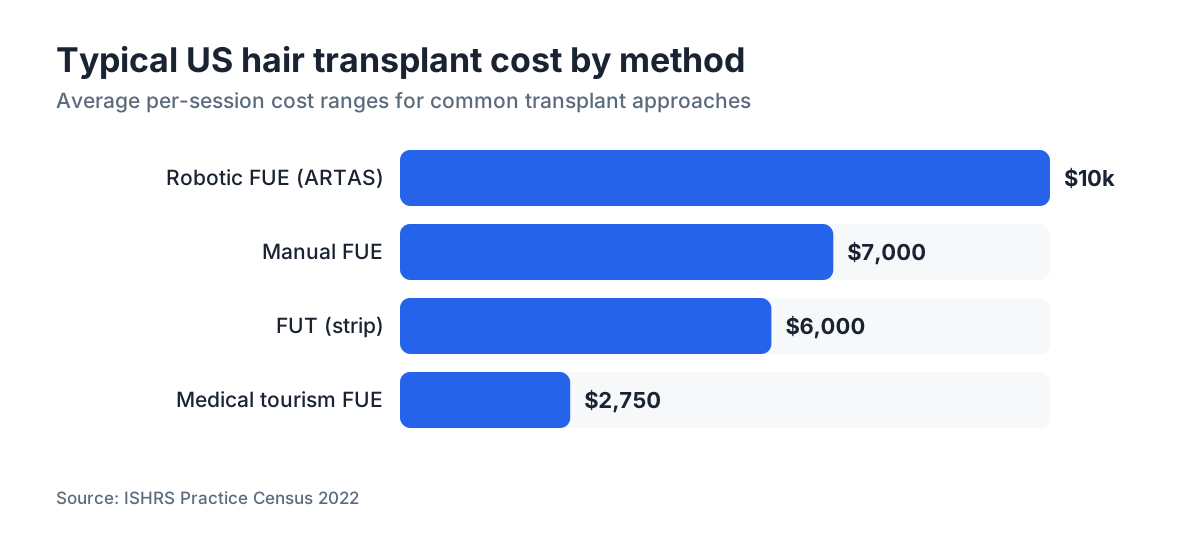
Robotic hair transplants are consistently the most expensive FUE option. ARTAS machines cost clinics roughly $200,000 to $250,000, and that capital cost gets passed to patients.
Typical US pricing runs $6,000 to $15,000 or more for a full session [5]. Some clinics price by the graft (often $8 to $15 per graft for ARTAS) instead of a flat fee. A patient needing 1,500 grafts might pay $12,000 to $22,500 at per-graft pricing; 2,500 grafts could hit $20,000 to $37,500 at the high end.
Comparison context:
- Manual FUE in the US: typically $4,000 to $10,000 depending on graft count and clinic
- FUT strip: typically $3,000 to $9,000
- Medical tourism (Turkey, especially): manual FUE packages advertised at $1,500 to $4,000 all-in, though quality varies enormously and you have limited recourse if something goes wrong
Insurance does not cover hair transplants. They're considered cosmetic procedures. You will not get reimbursement through any major US payer.
If cost is your ceiling, ask a clinic for both their manual FUE and robotic FUE quotes. You may get near-identical graft survival with manual FUE from the same surgeon at meaningfully lower cost. The robot does not guarantee a better hairline.
Who is a good candidate for robotic hair transplant?
The FDA clearance for ARTAS names men with straight, dark (brown or black) hair [1]. That matters because the image-recognition algorithm was trained and validated on that hair type. People with blonde, gray, red, or very curly or wavy hair have been reported to run higher transection rates with the system, because the cameras struggle to read the follicle angle and grouping. Some clinics attempt robotic FUE in lighter or curlier hair anyway. Ask your surgeon directly for transection rate data from their own practice for your hair type.
You also need an adequate donor area. The standard donor zone is the back and sides of the scalp, and that hair has to be dense enough to survive ongoing genetic miniaturization. A surgeon will assess your donor density, scalp laxity, and the likely path of your hair loss (using Norwood staging and family history) before recommending any transplant.
People with very fine hair, low donor density, or extensive loss (Norwood 6 or 7) often get fewer usable grafts per session with robotic FUE than with FUT, because the strip method pulls from a wider band of scalp and grafts get dissected under magnification.
Age matters too. Most surgeons prefer to wait until loss has stabilized before transplanting, because placing grafts into areas where native hair keeps thinning produces a patchy look over time. See our overview of what causes hair loss for how loss usually progresses.
For a receding hairline specifically, robotic FUE can work well. Frontal zone cases often need 1,000 to 2,500 grafts, a range the robot handles efficiently. Read more on receding hairline patterns and timing.
What happens during recovery after a robotic hair transplant?
Recovery from robotic FUE tracks the same timeline as manual FUE, because the tissue trauma is similar.
Days 1 to 3: The donor zone has hundreds to thousands of tiny punch wounds. Mild swelling, redness, and tenderness are normal. Some patients get forehead or eyelid swelling as fluid tracks down by gravity. The transplanted grafts are fragile. Avoid touching, rubbing, or letting water pressure hit them.
Day 7 to 10: Most clinics have you come back for a wash check. Tiny scabs form around each graft and shed within 1 to 2 weeks. Do not pick them.
Weeks 2 to 6: "Shock loss" happens. The transplanted hairs shed their shafts while the follicles stay alive underground. This is expected and does not mean the procedure failed. The donor zone sometimes sheds surrounding native hairs temporarily from the trauma, a phenomenon related to telogen effluvium. Learn more about telogen effluvium if that worries you.
Months 3 to 6: New hair starts emerging, thin and fine at first.
Month 9 to 12: Density and shaft thickness approach the final result, though full maturation can take up to 18 months.
Skip hard exercise for about 1 to 2 weeks. Protect the scalp from sun for several months. Most patients return to desk work within 3 to 5 days.
What are the risks and side effects of robotic hair transplant?
Robotic FUE carries the same risk profile as manual FUE, with a few specific wrinkles.
Transection: The robot's main risk is the same as manual FUE. If the punch angle is off, follicles get severed and lost. Rates depend on operator experience with the system and the patient's hair characteristics.
Overharvesting: The planning software has safeguards, but if a clinic pushes for maximum graft counts in a single session, the donor zone can be stripped to the point where it looks permanently thin. This is an operator and ethics risk more than a technology risk.
Infection: Uncommon (under 1 percent in reported FUE series) but possible. Watch for increasing redness, warmth, and discharge beyond day 3.
Scarring: FUE leaves tiny round scars, each roughly 0.8 to 1.0 mm across. They're invisible once hair is longer than about a grade 3 clipper length, but shaving completely bald will show them. True of both robotic and manual FUE.
Nerve injury: Rare, but the occipital nerves run through the donor zone. Temporary numbness or tingling in the back of the scalp after surgery is fairly common and usually clears within weeks to months. Permanent nerve injury is rare.
Unrealistic expectations: The most common source of dissatisfaction. Hair transplants redistribute existing hair; they do not create new follicles. If your donor supply is limited and your loss is extensive, you will not get a full-looking head of hair no matter what technology is used.
None of these risks are unique to the robot. It does not lower biological risk. It only changes who is holding the punch.
Does robotic hair transplant work better than manual FUE?
On pure outcomes measured by hair density at 12 months, no published randomized controlled trial shows robotic FUE outperforms expert manual FUE. The honest answer is we don't know, because that comparison hasn't been done rigorously.
Where the robot has a defensible argument: consistency of extraction angle. The ARTAS system reads follicle angle and depth from stereoscopic imaging and adjusts the punch trajectory in real time. A tired surgeon at hour 6 of a long manual case can drift from optimal angles. The robot does not fatigue. For very large sessions (2,000 or more grafts), that fatigue argument carries more weight.
Where the robot clearly does not help: hairline design, graft placement, and the aesthetic judgment that separates good results from great ones. Those stay surgeon-dependent.
Some of the best transplant results in the world come from surgeons doing pure manual FUE or FUT. Some mediocre results come from clinics marketing their ARTAS machine hard. The machine is a tool. The surgeon is the variable that matters most.
If a clinic's main selling point is "we have the robot," that should prompt more questions, not more confidence.
Should you combine a hair transplant with medications like finasteride or minoxidil?
Yes, and this is where most patients shortchange themselves. A transplant moves hair you already have. It does not stop ongoing miniaturization of the native hairs that weren't transplanted. Put 2,000 grafts into your frontal zone while the crown and mid-scalp keep thinning from DHT, and you end up with an island of restored hair surrounded by progressive loss.
Finasteride (1 mg daily) cuts serum DHT by roughly 60 percent and has been shown in clinical trials to slow or stop progression in the majority of men with androgenetic alopecia [6]. It doesn't regrow everything you've lost, but it protects existing follicles, including the native neighbors of your grafts. Most transplant surgeons recommend starting or continuing finasteride if you're a candidate. Read the full breakdown at finasteride.
Minoxidil (topical or oral) increases blood flow to follicles and extends the growth phase. Evidence for topical minoxidil in men is well established. It was the first FDA-approved treatment for androgenetic alopecia [7]. Some surgeons recommend it before and after transplant to reduce shock loss and support graft survival. See minoxidil for men and oral minoxidil for comparisons.
Running both is the most evidence-backed medical approach to male pattern hair loss. A meta-analysis in the Journal of the American Academy of Dermatology found the combination outperformed either drug alone on hair count endpoints [8]. That applies post-transplant too. See finasteride and minoxidil for a detailed comparison.
Want an objective read on how much hair you still have before committing to a procedure? The free AI hair analysis at MyHairline helps you visualize your current pattern and think through next steps before your first clinic consultation.
How do you find a qualified robotic hair transplant surgeon?
This matters more than the machine. Here's what to actually check.
Board certification: Look for a physician board-certified in dermatology or plastic surgery. The International Society of Hair Restoration Surgery (ISHRS) maintains a physician finder and publishes practice standards [9].
Photographic portfolio: Ask for before-and-after photos at 12 months, not 6. Ask specifically to see patients with your hair type, loss pattern, and skin tone.
Transection rate data: Ask the surgeon their personal transection rate with the robot for your hair type. Any honest surgeon can answer this. If they can't, that tells you something.
Graft placement: Ask who places the grafts. In some high-volume clinics, technicians place while the surgeon does something else. Placement drives density and angulation in the final result.
Consultation quality: A good surgeon walks through your long-term loss trajectory, your donor supply limits, and whether medication is right for you. They spend more time on what the transplant can't do than what it can.
The ISHRS reports that unauthorized practitioners performing hair transplants (non-physician technicians acting as the lead operator) are a growing problem globally, especially in certain medical tourism markets [9]. In the US, hair transplant surgery must be performed by a licensed physician.
Get at least two or three in-person consultations before deciding. A good surgeon will not pressure you to book on the spot.
Is a robotic hair transplant worth the extra cost?
For most patients, the honest answer is probably not, if you're paying for the technology alone. The premium reflects the machine's capital cost, not proven superiority in final hair density.
There are scenarios where the robot makes sense:
- The specific surgeon you want uses ARTAS and has excellent results documented at 12 months
- You have straight dark hair and prefer the peace of mind of computer-guided extraction
- The clinic's robotic FUE cost is not dramatically higher than their manual FUE quote (some are surprisingly close)
Scenarios where the robot is probably not worth chasing:
- You're choosing a clinic mainly because it has the machine
- You have light, gray, or curly hair where ARTAS has known limits
- You need a very high graft count and FUT would serve you better
- The robotic option costs 30 to 50 percent more than a highly reviewed manual FUE surgeon
The best transplant you can get comes from the best surgeon available to you, one who takes the time to understand your loss pattern, donor supply, and goals. The technology is secondary. Spend your research time on surgeon track records, not equipment brands.
Still figuring out what stage your loss is at, and whether a transplant is even the right next step? MyHairline's free AI scan can give you a clearer picture of your pattern before you start booking consultations.
What other hair loss treatments should you consider before or alongside a transplant?
A transplant is rarely the first step and almost never the only step. Here's where the evidence actually sits.
Finasteride: The only oral FDA-approved treatment for androgenetic alopecia in men. Clinically proven to reduce progression in the majority of men. Side effects exist (sexual function changes in roughly 2 to 4 percent of users in clinical trial data) and deserve an honest conversation with a physician [6]. Read more at finasteride and consider DHT blocker options broadly.
Minoxidil: Topical 5% is FDA-approved and available over the counter. The main side effects are scalp irritation and, less commonly, unwanted facial hair growth. See minoxidil side effects for the full picture.
Hair loss supplements: Biotin, saw palmetto, and various blends get marketed hard. The evidence base for most is weak. A 2017 review in the Journal of Drugs in Dermatology found nutritional deficiencies (iron, zinc, vitamin D) can worsen shedding, but supplementing beyond adequacy in people who aren't deficient shows limited benefit [10]. See hair loss supplements for an honest breakdown.
PRP (platelet-rich plasma): Injections of concentrated growth factors from your own blood into the scalp. Some small studies show modest effect on hair count; no large randomized trial establishes it as a first-line treatment. Often added as an adjunct to transplant to support graft survival.
Low-level laser therapy: FDA-cleared devices (combs, helmets) have some supporting evidence in mild to moderate loss, but effect sizes are modest.
For most men in the early to mid stages of male pattern loss, starting finasteride and minoxidil, giving them 12 months, then reassessing is the evidence-based sequence. Transplants make more sense once loss has stabilized, or when medical therapy alone won't close the cosmetic gap.
Sources
- FDA 510(k) Premarket Notification Database, ARTAS Robotic System clearance K101570
- Rose PT, Nusbaum B. 'Robotic hair restoration.' Dermatologic Surgery, 2018
- Rashid RM, Morgan GJ. 'Robotic FUE vs. manual FUE.' Journal of Cosmetic Dermatology, 2017
- JAMA Dermatology, FUE graft survival systematic review, 2021
- International Society of Hair Restoration Surgery (ISHRS), Practice Census 2022
- FDA label for finasteride 1mg (Propecia), NDA 020788, DailyMed
- FDA, topical minoxidil OTC labeling, DailyMed
- Adil A, Godwin M. 'The effectiveness of treatments for androgenetic alopecia.' Journal of the American Academy of Dermatology, 2017
- International Society of Hair Restoration Surgery (ISHRS), Physician Finder and Standards of Practice
- Guo EL, Katta R. 'Diet and hair loss: effects of nutrient deficiency and supplement use.' Journal of Drugs in Dermatology, 2017
- American Academy of Dermatology (AAD), Hair loss treatment overview