TL;DR: One randomized controlled trial (Panahi et al., 2015) found rosemary oil grew as many hairs as 2% minoxidil after 6 months, with less scalp itch. But 2% minoxidil is the weaker OTC dose, the trial was small (100 people), and no study has compared rosemary oil to 5% minoxidil or finasteride. Minoxidil has 40 years of evidence behind it. Rosemary oil is a reasonable add-on, not a replacement.
What does the head-to-head clinical trial actually show?
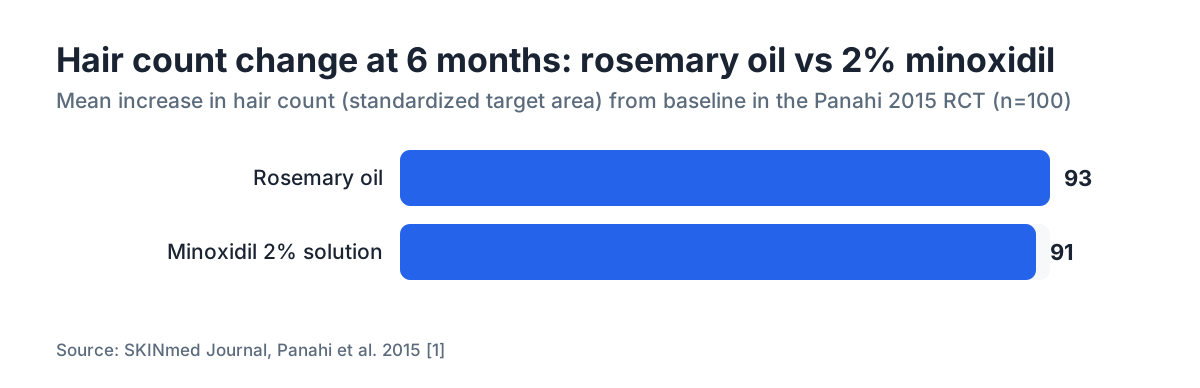
One study is responsible for almost every headline claiming rosemary oil "beats" minoxidil. It's a 2015 randomized controlled trial published in SKINmed Journal by Panahi and colleagues, running 100 patients with androgenetic alopecia for six months. Half used rosemary oil, half used 2% minoxidil solution, applied twice daily. At six months, both groups had statistically similar increases in hair count. [1]
That's a real finding. It's not made up, and it's not meaningless.
But read the fine print before you throw your minoxidil in the trash. The comparator was 2% minoxidil, not 5% minoxidil or the foam version most men use today. The FDA-approved 5% concentration for men was available for years before this study ran, and it consistently outperforms 2% in its own trials. One registration study found 5% minoxidil produced 45% more hair regrowth than 2% at 48 weeks. [2] The Panahi study never tested against that dose.
The sample was also small. One hundred people across two groups gives you enough statistical power to say "these two things aren't wildly different," not enough to say "they're equivalent." Equivalence trials require much larger samples and pre-specified non-inferiority margins. This study was not designed as an equivalence trial. [1]
Rosemary did score one real win: scalp itch and dryness were significantly lower in the rosemary group compared to the minoxidil group at both the 3- and 6-month marks. [1] If you've dealt with minoxidil side effects, that's not trivial.
How does rosemary oil work on hair loss?
Rosemary oil's main studied mechanism is improved scalp circulation. Its active component, carnosic acid, appears to stimulate nerve growth factor (NGF) in animal models, and NGF has been linked to hair follicle cycling. A 2013 study in rats compared rosemary leaf extract to minoxidil and found comparable hair growth after 7 days of topical use, attributed partly to this circulation-improving effect. [3]
There's also evidence that rosemary oil mildly inhibits 5-alpha-reductase, the enzyme that converts testosterone to DHT, the hormone most responsible for pattern baldness. This is the same pathway that finasteride targets, though finasteride blocks that enzyme far more aggressively and specifically than rosemary oil does. The inhibition seen in lab studies with rosemary is modest, and no human trial has measured DHT levels before and after topical rosemary use in a well-controlled design. [3]
It does not appear to work the same way as minoxidil. Minoxidil is a vasodilator and a potassium channel opener that extends the anagen (growth) phase of the hair cycle. Rosemary oil seems to work through a different, less understood combination of mechanisms. That actually matters: two treatments that work differently could complement each other rather than just duplicate effort.
How does minoxidil actually work and how strong is the evidence?
Minoxidil has been FDA-approved for topical hair loss use since 1988, first at 2% for women and men, then at 5% for men in 1991. [2] That's nearly four decades of post-market data, multiple large randomized trials, and clear mechanistic understanding.
It works as a potassium channel opener. Opening those channels hyperpolarizes follicle cells, which extends the anagen (active growth) phase and shortens telogen (resting/shedding). It also increases blood flow to the scalp. [9] Follicles in early-to-mid miniaturization respond better than those that are already gone, which is why starting earlier produces better results.
The 5% foam formulation, studied in a 352-patient randomized trial published in the Journal of the American Academy of Dermatology, produced significantly greater hair count increase than vehicle (placebo) at 16 weeks, and patients rated it easier to use than the liquid. [4] Unlike the 2% solution, the foam has lower propylene glycol content, which reduces scalp irritation for most people.
For men dealing with a receding hairline or vertex thinning, minoxidil for men at 5% is the starting point recommended by the American Academy of Dermatology. AAD guidance names topical minoxidil 5% twice daily as a first-line treatment for androgenetic alopecia in men. [5] No equivalent guideline exists recommending rosemary oil as a standalone treatment.
Side by side: rosemary oil vs minoxidil at a glance
Here's how the two compare across the factors that matter most to someone deciding what to use:
| Factor | Rosemary Oil | Minoxidil 5% (topical) |
|---|---|---|
| Human RCT evidence | 1 trial (vs 2% minox only) [1] | Multiple large RCTs [2][4] |
| FDA approval | No | Yes (1988/1991) [2] |
| AAD guideline recommendation | No | Yes, first-line [5] |
| Mechanism | Circulation, mild DHT inhibition | Potassium channel opener, vasodilation |
| Scalp irritation | Low [1] | Moderate (especially liquid) [4] |
| Typical cost/month | $10-25 | $15-40 (OTC generic) |
| Onset of visible results | 3-6 months | 3-6 months |
| Studied in women | Limited | Yes, 2% and 5% both approved [2] |
| Works after follicle death | No | No |
| Can combine with other treatments | Yes | Yes |
Cost data reflects typical OTC retail pricing for generic minoxidil and commercial rosemary oil products as of mid-2025; prices vary by brand and retailer.
One honest note: oral minoxidil is a newer option worth knowing about. It's used off-label at very low doses (0.25-5 mg/day) and some dermatologists prefer it for patients who find topical minoxidil messy. If that's on your radar, read more about oral minoxidil.
Does rosemary oil work for androgenetic alopecia specifically?
The Panahi 2015 trial enrolled patients with androgenetic alopecia (AGA), so yes, the evidence that exists is specific to pattern hair loss, not diffuse shedding from stress or illness. [1] That matters, because telogen effluvium and AGA look similar at first and respond to different things.
Pattern hair loss is driven primarily by DHT sensitivity in genetically predisposed follicles. Rosemary oil's mild 5-alpha-reductase inhibition could theoretically help there, but the human evidence doesn't yet measure DHT changes or show it stops the progression of AGA the way finasteride clearly does. Finasteride reduces scalp DHT by roughly 64% and has been shown in large trials to halt or reverse AGA progression over years, more than months. [6]
If you're at an early Norwood stage and want to add rosemary oil to an existing routine, that's low-risk and possibly helpful. Using it as your only intervention while pattern loss progresses is a gamble the current data doesn't justify.
Is rosemary oil safe, and are there any side effects?
Topical rosemary oil is generally well-tolerated. The Panahi trial reported significantly less scalp pruritus (itch) and dandruff in the rosemary group versus the minoxidil group across both three and six months. [1] No serious adverse events were reported in that trial.
That said, rosemary oil is a concentrated botanical and some people develop contact dermatitis. If you're patch-testing something new, dilute it in a carrier oil (jojoba and coconut oil are common choices) at around a 5-10% concentration of rosemary to carrier. Undiluted essential oils applied directly to the scalp can cause irritation or even chemical burns in sensitive individuals.
The National Center for Complementary and Integrative Health treats rosemary as generally safe at food levels while noting that research on its therapeutic uses stays limited and mostly preliminary. [8] Rosemary oil also has no known systemic absorption risk at topical doses, unlike oral finasteride (which can affect hormone levels system-wide) or even topical minoxidil (which does absorb and can, rarely, cause unwanted hair growth on the face or drop blood pressure). From a pure safety standpoint, rosemary oil is the lower-risk option. But lower risk and more effective are not the same thing.
What are the real limitations of the rosemary vs minoxidil research?
The honest answer is that there is one small trial. That's it for direct human comparisons.
The Panahi 2015 study has several limitations worth naming clearly. It used 2% minoxidil, not 5%. It ran for only 6 months; longer trials with minoxidil show continued benefit that may not have appeared in that window. The funding source isn't pharmaceutical, which is good for bias in one direction, but the study also wasn't blinded in a way that prevents placebo effect (patients knew what they were using). Hair count via phototrichogram is a reasonable endpoint but not the only one that matters clinically. [1]
No peer-reviewed trial has compared rosemary oil directly to 5% minoxidil foam, oral minoxidil, finasteride, or any combination therapy. That's a huge gap. The studies that do exist on rosemary oil's mechanism are mostly in rodents or cell cultures. [3] We don't know the optimal concentration, application frequency, or whether it works better combined with minoxidil than either does alone.
Nobody has good long-term data on rosemary oil for AGA. The closest we have is that one 6-month trial. Anyone claiming certainty beyond that is outrunning the evidence.
Can you use rosemary oil and minoxidil together?
Nothing in the published literature suggests combining them is harmful, and some dermatologists do suggest it for patients who want to try both. The rationale is that they likely work through different mechanisms, so stacking them might produce additive benefit.
Practically: if you're using minoxidil foam or solution twice a day, you could apply a diluted rosemary oil blend on one of those applications instead, or add it as a separate overnight treatment. There's no published dosing protocol for this combination, so you're working without a map.
If you're already on minoxidil and it's working, adding rosemary oil is low risk and might help with scalp comfort. If you're starting fresh and considering rosemary oil instead of minoxidil, I'd think hard about that. The evidence for minoxidil across 40 years is just larger and more reliable. One trial against the weaker minoxidil dose isn't enough to make rosemary oil a substitute.
For people who want to understand all the tools available, looking at the broader picture of what causes hair loss often helps clarify which interventions make sense for your specific pattern. If DHT is the main driver, combining something like finasteride and minoxidil has more combined evidence than any rosemary-based regimen.
If you're not sure where your hair loss stands right now, MyHairline's free AI scan (/scan) can analyze your hairline and help you figure out which Norwood stage you're at before committing to a regimen.
Who might genuinely benefit from rosemary oil over minoxidil?
A few real scenarios where rosemary oil makes practical sense:
First, people with significant scalp sensitivity to minoxidil's propylene glycol. The Panahi trial documented less itch and irritation with rosemary, and that's a real quality-of-life difference. If scalp irritation has made you stop minoxidil repeatedly, rosemary oil is worth trying.
Second, people who want a completely drug-free approach and understand the trade-off. The evidence for rosemary oil isn't as strong, but it isn't zero. For someone at an early stage of thinning who prefers natural options, it's a defensible low-risk choice, as long as they monitor their hair density over time and switch to proven treatments if they're losing ground.
Third, as part of a broader routine that includes hair loss supplements, scalp massage, and other supportive steps. Rosemary oil fits well here because its risk profile is minimal.
Fourth, women who can't use finasteride (it's contraindicated in women of childbearing potential). Women with AGA have fewer options, and rosemary oil as an adjunct to 2% or 5% minoxidil is a low-risk addition.
Who should not rely on rosemary oil alone: anyone with moderate-to-advanced pattern loss (Norwood 3 and above), anyone who is shedding rapidly, or anyone who wants the best-evidenced treatment available. For those people, proven options win.
What does the research say about combining rosemary oil with other hair loss treatments?
There are no published human trials on rosemary oil combined with minoxidil, finasteride, or other standard treatments. The combination is popular in hair loss communities and among integrative dermatologists, but the evidence is entirely anecdotal at this point.
What we do know is that DHT-blocking mechanisms and circulation-based mechanisms can work together in theory. That's the logic behind stacking a DHT blocker like finasteride with minoxidil, and there's good evidence for that combination. Whether rosemary oil adds meaningful incremental benefit on top of that stack is unknown.
Worth noting: a 1998 randomized trial of aromatherapy for alopecia areata used rosemary as one of four essential oils in a scalp massage protocol and showed improvement, but the design never isolated rosemary as the sole active ingredient, so it tells you nothing clean about rosemary alone. [10]
For now, the practical guidance is: if you're on a proven treatment that's working, you can add rosemary oil without expecting harm. Track your hair density with photos every three months. If you see continued improvement, great. If you see continued loss, the rosemary isn't enough.
Patients considering a hair transplant should know that neither rosemary oil nor minoxidil prevents the need for transplantation in advanced cases. Both are best used early, when follicles are miniaturizing rather than gone.
What should you actually do if you're deciding between the two?
Here's my honest take, not a marketing pitch.
If you have confirmed androgenetic alopecia and want the best-studied treatment available, start with 5% minoxidil foam. It has the most evidence, the most clinical experience behind it, and it's cheap. If you tolerate it well, stay on it. Adding rosemary oil is optional.
If minoxidil causes significant scalp irritation or you've tried it and quit because of side effects, rosemary oil is a reasonable alternative to try for 6 months. Take phototrichogram-equivalent photos every 30 days so you can actually measure what's happening, because self-reporting is notoriously unreliable for hair loss.
If your hair loss has a hormonal driver (most male pattern baldness does), and you're not already on finasteride, that conversation with a dermatologist matters more than the rosemary-vs-minoxidil debate. No topical treatment, natural or pharmaceutical, blocks DHT the way oral finasteride does. AAD guidance specifically names finasteride 1 mg/day as a first-line systemic option for male AGA. [5]
If you're early in the process and not sure what type of hair loss you have, MyHairline's free AI scan (/scan) gives you a baseline Norwood assessment so you're at least making decisions with accurate information about where you stand.
Here's the bottom line: rosemary oil is real, not a scam, not a miracle. It matched a weak dose of minoxidil in one small trial. That's genuinely interesting and worth taking seriously. It's not enough to replace a treatment with 40 years of data.
Sources
- SKINmed Journal, Panahi et al. 2015 - Rosemary oil vs minoxidil 2% for the treatment of androgenetic alopecia
- FDA Drug Approval History - Rogaine/Minoxidil topical label and approval
- Phytotherapy Research, Murata et al. 2013 - Promotion of hair growth by rosemary leaf extract
- Journal of the American Academy of Dermatology, Olsen et al. 2007 - 5% minoxidil topical foam for male AGA
- American Academy of Dermatology - Hair Loss main resource page
- New England Journal of Medicine, Kaufman et al. 1998 - Finasteride 1 mg for male androgenetic alopecia
- FDA - Drugs section, OTC topical minoxidil drug facts information
- National Center for Complementary and Integrative Health - Herbs at a Glance
- Journal of Dermatology, Ito et al. 2011 - Minoxidil mechanism of action review
- PubMed - Hay et al. 1998 - Randomized trial of aromatherapy for alopecia areata