

TL;DR: No drug cures telogen effluvium. The cure is finding and removing the trigger: a nutrient deficiency, chronic stress, illness, or a medication. Once the trigger is gone, most people see full regrowth within 3 to 6 months. A smaller group develops chronic telogen effluvium lasting over six months, and that needs a dermatologist workup with bloodwork.
What is telogen effluvium and why does it happen?
Telogen effluvium (TE) is diffuse, temporary hair shedding. It happens when a large batch of follicles gets pushed out of their growth phase (anagen) and into their resting phase (telogen) at the same time. Normally about 5-15% of your follicles sit in telogen at any moment. After a major physical or emotional shock, that number can jump to 30% or more, and when those hairs let go two to three months later, the loss looks alarming. [1]
The delay is the part that trips everyone up. You lose your job in January, your hair starts falling out in March, and you spend weeks convinced something new is wrong. It isn't. You're watching the tail end of a clock that started ticking months earlier.
The usual triggers: fever or serious illness (including COVID-19), crash dieting or steep caloric restriction, major surgery or trauma, childbirth (postpartum TE is very common), iron deficiency, thyroid disorders, and certain drugs including beta-blockers, retinoids, and anticoagulants. [2] Chronic psychological stress can do it too, though the human evidence for that specific mechanism is messier than most people assume.
Our guide to telogen effluvium has the full picture of what's happening inside the follicle.
Is there an actual cure for telogen effluvium?
Bluntly, no. No FDA-approved drug carries the indication "cure telogen effluvium." What exists is a two-part plan: remove the trigger, and give the follicle the conditions it needs to re-enter anagen. That's the whole strategy.
The American Academy of Dermatology (AAD) puts the prognosis simply: "Hair generally grows back without treatment once the triggering event is no longer present." [2] That one sentence is genuinely the best evidence on offer. For most people, shedding slows about three months after the trigger resolves, and visible density returns six to twelve months after that.
This doesn't mean you're helpless. Fixing a deficiency, swapping a medication, or treating an underlying condition can shorten the recovery window. But buying an expensive serum or a hair supplement before you've found your trigger is, honestly, mostly a waste of money.
Here's the distinction that matters most. Acute TE has one clear trigger and resolves within six months. Chronic TE lasts more than six months, often with several overlapping triggers or an ongoing stressor nobody has pinned down yet. Chronic TE is a different animal, and it earns a formal dermatology workup including bloodwork.
How long does telogen effluvium last before it resolves?
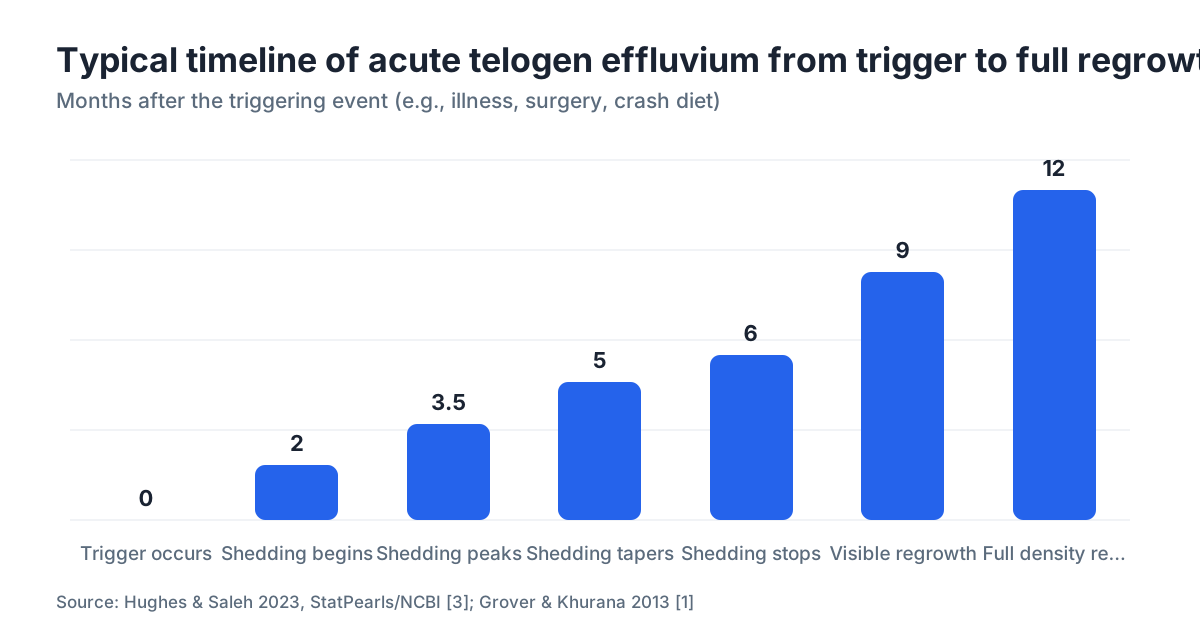
For acute telogen effluvium, the timeline runs like clockwork: shedding starts two to three months after the trigger, peaks around month three to four, then tapers over the next two to three months. Most people stop shedding excessively by month six, and visible regrowth shows up by month nine to twelve. [1]
The chronology matters for your sanity. Shedding that continues for weeks after you've fixed the trigger does not mean the fix failed. Follicles that entered telogen before you addressed the problem still shed on their own schedule. You're seeing the end of the old wave, not the start of a new one.
Postpartum TE is the most predictable form. It usually begins six to twelve weeks after delivery, peaks around four months postpartum, and resolves fully by twelve months in the large majority of cases. [3] No treatment is typically needed, though checking iron and ferritin is worth doing because delivery can drop iron stores hard.
Chronic TE is defined as shedding lasting longer than six months. It hits women far more often than men, waxes and wanes, and often ties back to ongoing nutritional gaps, thyroid dysfunction, or autoimmune issues that haven't been caught. [4] Past six months of heavy shedding, see a dermatologist, not a supplement brand.
What blood tests should you get to find the cause?
This is where most self-treaters go wrong. They buy supplements before they know what they're deficient in. The right first move is bloodwork. A reasonable baseline panel for unexplained TE:
| Test | What it checks | Target range (approximate) |
|---|---|---|
| Ferritin | Iron stores (more telling than serum iron) | >40 ng/mL for hair regrowth [5] |
| Complete blood count | Anemia, underlying illness | Within reference range |
| TSH (thyroid) | Hypo- or hyperthyroidism | 0.4-4.0 mIU/L |
| Free T4 | Thyroid function detail | Lab-specific reference range |
| Vitamin D | Deficiency common, linked to hair cycling | 30-100 ng/mL |
| Zinc | Less common but real trigger | 70-120 mcg/dL |
| ANA screen | Rule out lupus or other autoimmune | Negative |
Ferritin is the single most important test, and the one labs miss or misread most often. Many flag ferritin as "normal" above 12-15 ng/mL, but hair-loss research suggests ferritin below 30-40 ng/mL can impair hair cycling even without frank anemia. [5] A result of 18 ng/mL reads as "in range" and can still be your problem.
Thyroid is the other big catch. Both hypothyroidism and hyperthyroidism cause significant shedding, and both slip through if you only check TSH and it comes back borderline. Ask for free T4 too.
Our article on what causes hair loss covers the broader landscape.
Which deficiencies actually cause telogen effluvium, and how much do you need to correct them?
Iron deficiency has the strongest evidence among nutritional causes. A 2006 review in the Journal of the American Academy of Dermatology found low ferritin associated with TE in premenopausal women, and noted that raising ferritin above 70 ng/mL appeared to help, though the authors flagged study limitations. [5] The mechanism holds up: iron feeds ribonucleotide reductase, an enzyme the rapidly dividing hair matrix cells need for DNA synthesis.
Vitamin D deficiency is plausible and gets cited constantly, but the evidence is softer. Vitamin D receptors exist in hair follicles, and several observational studies show lower vitamin D in people with TE than in controls. [6] What those studies can't tell us is whether supplementing D reverses shedding. D deficiency has plenty of other downsides, so correcting a real one is reasonable regardless.
Zinc deficiency causes hair loss. That's settled. It's also uncommon in people eating a varied diet. Routine zinc when you're not deficient does nothing for hair and can interfere with copper absorption at high doses. [7] Test before you supplement.
Biotin gets sold hard for hair loss and has no convincing evidence of benefit in people who aren't deficient. Real biotin deficiency is rare outside certain genetic disorders or raw-egg-heavy diets. The FDA has specifically warned that high biotin intake can throw off troponin lab tests used in cardiac diagnostics. [8] Take it if your dermatologist found you deficient. Otherwise skip it.
Protein restriction is a real and underrated trigger. Hair is almost entirely keratin, and a diet below roughly 50 grams of protein a day can impair hair growth. [11] Crash diets and very-low-calorie plans are common TE triggers, especially the 500-800 kcal/day protocols people run now. If that's in your recent history, that's likely your answer.
Does minoxidil help with telogen effluvium recovery?
Minoxidil is the one off-label treatment with a rational basis in TE. It's a vasodilator that shortens telogen and pushes follicles back into anagen. The FDA approves topical minoxidil (2% for women, 5% for men) for androgenetic alopecia, not TE, but some dermatologists reach for it off-label to speed up prolonged cases. [9]
The honest answer: the evidence in TE specifically is thin. Most of what we know about minoxidil comes from androgenetic alopecia trials, which is a structurally different kind of hair loss. In TE, follicles aren't miniaturized and will recover on their own, so it's unclear how much minoxidil adds beyond what time already does.
There's one complication worth knowing. Starting minoxidil can trigger a shed of its own in the first four to eight weeks as follicles get pushed out of telogen. If you're already shedding from TE, that extra shedding is alarming and makes it hard to tell whether the treatment is helping or hurting. [9]
If a dermatologist recommends minoxidil for your TE, the usual advice is to start low and give it at least four to six months before judging. Read up on minoxidil side effects before you start, and our guide to minoxidil for men has dosing specifics if that applies.
Oral minoxidil at low doses (0.25-1.25 mg/day for women, 2.5-5 mg/day for men) is an increasingly common prescription. Our piece on oral minoxidil compares topical and oral, risks included.
What about finasteride or DHT blockers for telogen effluvium?
Finasteride blocks the conversion of testosterone to DHT, the mechanism behind androgenetic alopecia (pattern hair loss). Telogen effluvium isn't driven by DHT. It's driven by a systemic shock to the hair cycle. So finasteride does nothing for TE.
The confusion is real, and worth naming directly. Some people run TE and underlying pattern hair loss at once. The TE brings the dramatic acute shedding, while a quieter, slower miniaturization grinds along underneath. Treating the pattern loss with finasteride can make sense for the androgenetic part, but it won't touch the TE.
If you're a man with heavy shedding wondering whether it's TE, early pattern baldness, or both, see a dermatologist. A dermoscopy exam usually tells the two apart. Our overview of finasteride covers what it does and doesn't do, and our guide to DHT blockers covers the broader category.
Women should not take finasteride outside close medical supervision because of teratogenicity risk. It's not a TE treatment for anyone.
Are there any supplements that genuinely help?
I'll be blunter than most hair content: the supplement industry makes real money off TE sufferers during the three-to-nine-month recovery window, which was going to resolve with or without the pills.
What has reasonable evidence behind it:
- Iron, if ferritin is confirmed low. Aim to bring ferritin above 40-70 ng/mL under medical supervision. Oral iron takes three to six months to rebuild stores. [5]
- Vitamin D, if you're deficient. 1,000-2,000 IU/day is a typical correction dose; your doctor should recheck levels in three months.
- Protein. Not a supplement, but it counts. If you've been undereating protein, getting intake to 1.2-1.6 g/kg/day is the cheapest evidence-backed thing you can do for hair growth. [11]
What lacks evidence:
- Biotin, unless you're deficient, which is rare. [8]
- Collagen powder for hair loss specifically.
- Saw palmetto for TE (small evidence base for androgenetic alopecia, none for TE).
- "Hair, skin, and nails" multivitamins, which usually pack doses too small to fix a real deficiency and often carry biotin high enough to skew lab tests.
Our guide to hair loss supplements breaks down the evidence ingredient by ingredient.
If you want to track whether shedding is changing, the AAD suggests a "60-second hair count": collect the shed hairs during one minute of morning combing and count them. Consistently more than 100 per day can point to active shedding, though the method has a lot of day-to-day variability. [2]
How is chronic telogen effluvium different, and does it need different treatment?
Chronic TE (lasting more than six months) is a meaningfully different situation from the acute version. The prognosis is fuzzier, the triggers tend to overlap or persist, and in some people it drags on for years. [4]
Research on chronic TE finds it mostly affects women aged 30-60, tends to fluctuate rather than run steady, and usually links to a stack of factors: borderline iron stores, subclinical thyroid dysfunction, and ongoing psychological stress. [4] No single clean trigger explains it, which is part of why it's hard to treat.
Treatment here is an iterative elimination process. You address every identifiable contributor, recheck bloodwork, and wait. Off-label minoxidil shows up more often in chronic TE than acute TE precisely because chronic TE won't resolve on the tidy timeline acute TE usually follows.
One thing to rule out explicitly is female pattern hair loss (FPHL), which can look similar but needs different long-term management. Dermoscopy showing follicular miniaturization points toward FPHL. A dermatologist, not a trichologist or a supplement brand, is the right person for that call.
If you've been at this more than six months without a thorough dermatology evaluation, that evaluation is the priority. A free AI hair analysis at MyHairline (/scan) can give you a preliminary read on your shedding pattern and help you organize what to ask your dermatologist. It doesn't replace the in-person workup.
What lifestyle changes genuinely support recovery?
Once the primary trigger is fixed and deficiencies are corrected, lifestyle factors can help. None are dramatic. They're real.
Sleep is the most underrated. Growth hormone is secreted mainly during slow-wave sleep, and growth hormone is one of the signals that nudges follicles into anagen. Chronic sleep deprivation is a plausible TE trigger on its own. The CDC recommends seven to nine hours a night for adults. [10]
Caloric adequacy counts. If you're still eating below maintenance, hair is a low-priority tissue and it suffers first. A mild surplus for a few months during recovery is reasonable.
Mechanical traction makes things worse. Tight ponytails, braids, and extensions cause traction alopecia, a separate condition, but they also load extra stress onto already vulnerable follicles during a TE episode. Loose styles and gentle washing are practical during recovery.
What almost certainly doesn't help, despite the marketing: aggressive scalp massage gadgets, laser hair combs, PRP (platelet-rich plasma) injections for TE (the PRP evidence sits in androgenetic alopecia, not TE), and essential oil treatments. They probably won't hurt you. Spending money there before you've addressed the actual trigger is misplaced.
One more thing. Some people respond to TE by washing less to cut down on shedding. That backfires. The hairs that come out in the shower were shedding regardless; washing doesn't yank healthy hairs. Sebum and product buildup can slow healthy regrowth. Wash normally.
When should you see a dermatologist vs. waiting it out?
See a dermatologist if any of these apply:
- Shedding has lasted more than six months.
- You can't identify any plausible trigger despite trying.
- You're losing hair in patches rather than diffusely (that points to alopecia areata, not TE).
- You're a man with hairline recession alongside the diffuse shedding (that's probably androgenetic alopecia over top of, or instead of, TE).
- Your primary care doctor's bloodwork came back "normal" but you're still shedding at six months. Borderline results and context both matter.
- Your shedding is heavy enough that you see visible thinning or scalp showing through.
For a man noticing both increased shedding and a receding hairline, those two often travel together. Our guide to receding hairline explains when hairline change is TE-related and when it's pattern loss.
Primary care doctors are good at ruling out systemic illness. Dermatologists who specialize in hair are better at reading the subtle signs that separate TE from pattern loss, alopecia areata, and other conditions. If your GP isn't a hair specialist and your shedding drags on, escalate.
Hair transplants are not a treatment for telogen effluvium. TE is a temporary state of existing follicles; transplanting new ones makes no sense, and any reputable surgeon will say so. Transplants exist for permanent follicle loss, typically androgenetic alopecia. Our overview of hair transplant options covers when they fit and when they don't.
What should you actually do right now, step by step?
An honest sequence, ordered by cost-effectiveness and evidence:
-
Stop adding new triggers. On a crash diet? Stop. Started a new medication around the time shedding began? Ask your prescribing doctor about alternatives.
-
Get bloodwork. At minimum: ferritin, CBC, TSH, free T4, vitamin D, zinc. Do this before buying anything.
-
Correct what's actually low. Ferritin below 40-70 ng/mL: start iron (ferrous sulfate 325 mg with vitamin C for better absorption) and retest in three to four months. Vitamin D below 30 ng/mL: supplement under medical supervision. Thyroid off: treat it.
-
Eat enough protein. If you've been restricting, push protein to 1.2-1.6 g/kg of body weight per day. [11]
-
Wait. Acute TE usually resolves in three to six months after the trigger is handled. The first two months after fixing the root cause still look bad, because you're still shedding the telogen hairs that entered that phase before you stepped in.
-
If it's not improving by month four to six, see a dermatologist. Consider off-label minoxidil only after that conversation.
-
Don't spend on biotin cocktails, laser combs, or "anti-shedding" shampoos until you've done steps one through six.
MyHairline's free AI scan (/scan) can document your current hair state and flag patterns worth raising with your doctor, which helps when you're trying to communicate the timeline and severity of your shedding.
Sources
- Grover C & Khurana A, 'Telogen effluvium', Indian Journal of Dermatology, Venereology and Leprology (2013), via NCBI PMC
- American Academy of Dermatology Association, hair loss guidance
- Hughes EC & Saleh D, 'Telogen Effluvium', StatPearls (NCBI Bookshelf), 2023
- Sinclair R, 'Diffuse hair loss', International Journal of Dermatology (1999), via PubMed
- Trost LB, Bergfeld WF & Calogeras E, 'The diagnosis and treatment of iron deficiency and its potential relationship to hair loss', Journal of the American Academy of Dermatology (2006), via PubMed
- Almohanna HM et al., 'The role of vitamins and minerals in hair loss: a review', Dermatology and Therapy (2019), via NCBI PMC
- NIH Office of Dietary Supplements: Zinc Fact Sheet for Health Professionals
- U.S. Food and Drug Administration, safety communications on biotin interference with lab tests
- DailyMed (NIH/NLM), minoxidil topical solution prescribing information
- CDC: About Sleep
- Rushton DH, 'Nutritional factors and hair loss', Clinical and Experimental Dermatology (2002), via PubMed