

TL;DR: Telogen effluvium concentrates at the top of the scalp because that zone packs the most follicles (roughly 300 to 400 per square centimeter) and reacts most to systemic shocks like illness, crash dieting, or surgery. Shedding starts 2 to 4 months after the trigger. Most cases regrow fully within 6 to 12 months once the cause is fixed. Shedding past 6 months, or loss stuck at the crown, needs a dermatology workup to rule out pattern hair loss.
Why does telogen effluvium hit the top of the head so hard?
The top and crown of the scalp carry the highest follicle density on your head, roughly 300 to 400 follicles per square centimeter, far more than the sides and back [10]. More follicles means more hairs available to drop when a systemic shock pushes them into the resting (telogen) phase all at once. That's why diffuse shedding from telogen effluvium looks worst where you have the most hair to lose.
There's a second factor. The vertex and mid-scalp are more sensitive to DHT than the occipital region at the back, so any underlying pattern tendency can amplify the apparent thinning in that same zone. This is a big reason TE at the crown gets misread as male or female pattern loss, and why telling the two apart changes what you should do next.
Shedding usually begins 2 to 4 months after the triggering event, which is why most people can't connect cause and effect [1]. You get sick in January. The hair starts coming out in March. By April you're convinced something is permanently wrong with your scalp, when the follicles actually shifted phase months earlier.
What does telogen effluvium at the top of the head look like?
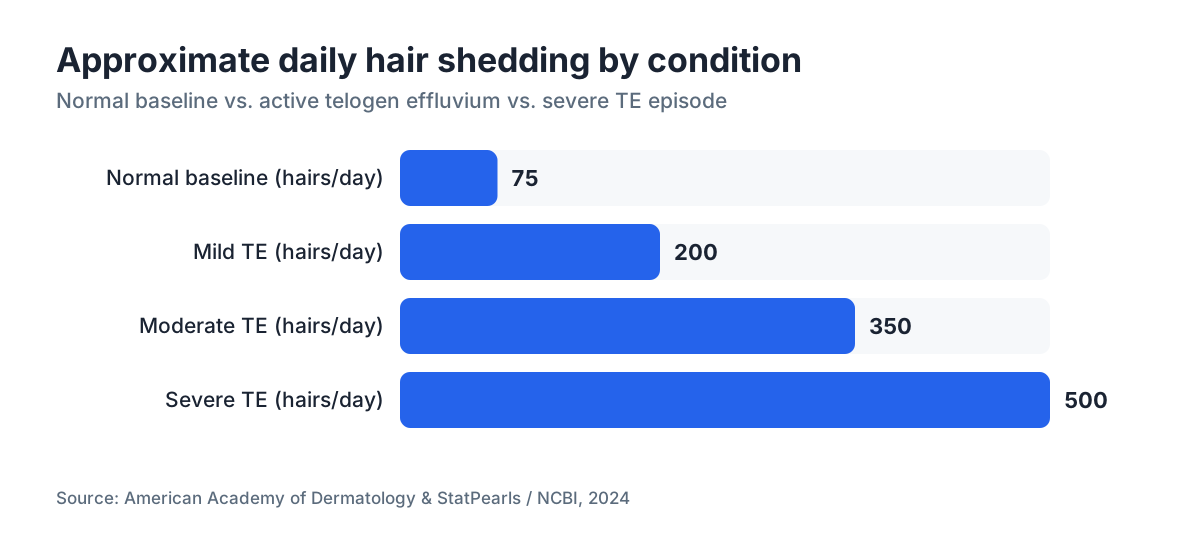
The classic look is diffuse thinning, meaning hair loss spread across the whole crown and mid-scalp rather than one bald patch. You notice a wider part, more scalp showing under bright light, and a jump in hairs on the pillow or in the drain. Some people shed 200 to 500 hairs a day during a TE episode, against a normal baseline of 50 to 100 [2].
What TE does not look like is a sharp circular patch (think alopecia areata) or a steadily retreating hairline. The hairline itself stays put in TE. The top feels thin and airy instead of the temples getting pushed back.
One clinical clue is the pull test. A dermatologist grasps 40 to 60 hairs near the scalp and pulls gently. Extracting more than 6 hairs on a single pull counts as positive for active shedding, and in TE the result is usually positive at the crown and negative or weak at the sides [3]. You can do a rough version at home. A board-certified dermatologist will confirm with trichoscopy or a scalp biopsy if the picture isn't clear.
How is TE at the crown different from male or female pattern baldness?
This is the most common mix-up, and it matters because the treatments split completely.
Androgenetic alopecia (AGA), the technical name for pattern hair loss, comes from DHT shrinking follicles over years. In men it starts at the temples and crown and moves through the Norwood stages. In women it shows as diffuse thinning at the top with the frontal hairline mostly preserved (the Ludwig pattern). Both are permanent without ongoing treatment.
TE runs on a different engine. A systemic event temporarily knocks the hair cycle off schedule. The follicles aren't shrinking. They're resting. Clear the stressor and they start growing again. The two can also happen together, which is genuinely messy: a woman may have early AGA and then a crash diet triggers a TE episode on top of it, making the crown loss look far worse than the AGA alone would.
| Feature | Telogen Effluvium | Androgenetic Alopecia |
|---|---|---|
| Onset | 2-4 months after trigger | Gradual, over years |
| Pattern | Diffuse, crown/top worst | Temples + crown (men), top (women) |
| Hairline | Usually preserved | Recedes in men |
| Shedding volume | High (200-500/day) | Low to moderate |
| Pull test | Positive at crown | Often negative |
| Reversibility | Yes, if trigger removed | No (without treatment) |
| Follicle miniaturization | No | Yes |
A dermatologist can usually tell them apart with trichoscopy, which shows miniaturized hairs in AGA but uniform hair calibers in pure TE. If you're unsure, a free AI hair analysis can help you map the pattern before your appointment, though it doesn't replace a clinical diagnosis.
What triggers telogen effluvium that targets the crown?
The trigger doesn't target the crown. The crown just shows the shedding most plainly. Triggers documented in the dermatology literature include [4]:
High fever or serious illness. COVID-19 became one of the best-studied examples. A 2021 Lancet study of hospital survivors found hair loss reported in about 22% of patients at 6 months, almost all of it telogen effluvium [5]. Rapid weight loss or crash dieting. Caloric restriction below 1,000 calories a day is reliably tied to TE onset within 3 to 4 months. Major surgery or general anesthesia. Childbirth (postpartum TE is so common it's essentially expected). Thyroid dysfunction, both under and over. Iron deficiency, even without full anemia. Chronic psychological stress. Certain medications including anticoagulants, retinoids, and some antidepressants.
The list runs long because TE is a non-specific response. The body treats hair as metabolically optional when resources get tight, so almost any major stressor can flip follicles into the resting phase together.
For a fuller picture of how different factors contribute, see our guide on what causes hair loss.
How do you confirm the diagnosis?
Start with a detailed history. When did the shedding begin? What happened 2 to 4 months before that? Any major illness, surgery, diet change, medication change, or long stretch of stress? The timeline is often diagnostic by itself.
Blood work a dermatologist typically orders: complete blood count, ferritin (more useful than hemoglobin, because ferritin drops before anemia shows), thyroid-stimulating hormone (TSH), total and free T4, vitamin D, zinc, and sometimes a full metabolic panel. The American Academy of Dermatology recommends ferritin testing specifically because iron deficiency is a correctable cause that gets missed all the time [2].
Scalp biopsy is the reference standard when things stay uncertain. A 4mm punch biopsy sent to a dermatopathologist can count the ratio of anagen (growing) to telogen hairs. Normal is roughly 85 to 90% anagen [11]. A biopsy showing 20% or more telogen hairs across the specimen confirms active TE [3].
Trichoscopy, done in-office with a handheld dermatoscope, shows follicle miniaturization (pointing to AGA) or its absence (pointing to TE) without any cutting. It's the fastest and least invasive way to separate the two, and most academic dermatology practices reach for it routinely.
Does telogen effluvium at the top of the head grow back?
Yes, in most cases, once the underlying trigger is found and removed. The follicles in TE are dormant, not dead. When they re-enter the anagen phase, regrowth starts as short, fine new hairs at the scalp surface, usually 3 to 4 months after shedding stops.
The numbers are genuinely reassuring. Acute TE, triggered by a single event, resolves with full or near-full regrowth in most patients within 6 to 12 months [4]. Chronic TE, defined as shedding lasting more than 6 months, is less predictable. Some cases self-resolve after 18 to 24 months. Others persist and need ongoing management.
The deciding factor is whether the trigger is correctable. A ferritin deficiency that's treated, a thyroid condition that's medicated, a crash diet that's ended: these lead to reliable regrowth. A trigger you can't fully remove, like chronic illness or unrelenting stress, gives you a rougher road.
One honest caveat. The crown grows back last and slowest, because it was hit hardest. Don't expect an even recovery across your scalp. The sides and back usually fill in before the top does.
What treatments actually help telogen effluvium on the crown?
The main treatment is always fixing the root cause. No topical or oral product makes up for untreated iron deficiency or an active thyroid condition. That said, a few interventions have real evidence for speeding recovery or managing crown thinning while you wait.
Minoxidil is the most-studied topical for pushing regrowth after TE. It stretches the anagen phase and increases follicular blood flow. The FDA-approved formulations (2% and 5% for women, 5% for men) go on the affected scalp, crown included [6]. Regrowth after TE is usually visible within 3 to 6 months of starting minoxidil, though some people recover without it once the trigger clears. See our breakdown of minoxidil for men for dosing and application, and read minoxidil side effects before you start.
Oral minoxidil at low doses (0.625 mg to 2.5 mg daily for women, 2.5 mg to 5 mg for men) is used off-label more and more by dermatologists for TE. It skips the scalp irritation some people get from the topical and reaches the crown more evenly. Our oral minoxidil overview covers the emerging evidence.
Iron supplementation, if ferritin is low, has clear support. A 2006 review in the Journal of the American Academy of Dermatology tied ferritin levels below 40 ng/mL to hair shedding and found that correcting iron deficiency was associated with better hair growth outcomes [7].
Finasteride is for androgenetic alopecia, not pure TE. If your dermatologist suspects both AGA and TE at the crown, it's worth discussing finasteride as part of the plan, but using it for TE alone has no evidence behind it. Same goes for DHT blockers, which target the androgen pathway that isn't the driver in TE.
Hair transplants are off the table during active TE. You don't transplant into a scalp that's still shedding. Once TE has fully resolved and any residual loss is stable (usually 12 to 18 months out), a transplant consult may make sense if AGA has been confirmed. More on hair transplants here.
For supplements with some evidence, including biotin, saw palmetto, and marine proteins, see our guide to hair loss supplements. The evidence is thinner than for minoxidil, but the risk is generally low.
How long does recovery take when the crown is involved?
Timeline expectations matter, because people quit treatments or panic when regrowth runs slower than they hoped.
Shedding usually peaks 2 to 3 months after the trigger, then slows. Most people find the worst is over by month 4 to 6 post-trigger. New growth at the crown becomes visible 3 to 6 months after shedding stops, so total elapsed time from trigger to visible recovery at the top runs 9 to 15 months for acute TE.
If you're at month 7 post-trigger and the crown still looks worse than baseline, book another dermatology visit. At that point the differential shifts. You might have chronic TE. You might have an ongoing trigger you haven't spotted (often thyroid, iron, or a new medication). Or the thinning might partly reflect AGA that the TE episode uncovered.
Patience is genuinely the hardest part. The regrowth hairs come in short and fine, and improvement at the crown can take a full 12 months to look meaningful. Monthly progress photos under the same lighting are the most useful tracking tool almost everyone skips.
Can stress alone cause thinning at the top of the head?
Yes. Psychological stress activates the hypothalamic-pituitary-adrenal axis, raising cortisol and other stress hormones that can throw off the hair cycle. A 2021 study in Nature found that chronic stress raised corticosterone in mice, suppressing hair follicle stem cell proliferation and stretching out the resting phase [8]. The human mechanism is presumed similar, though controlled trials in people are harder to run for ethical reasons.
Stress-driven TE follows the same 2 to 4 month lag as any other trigger. The trap is that finding out you're losing hair at the crown causes more stress, which can keep the shedding cycle going. Handling both the original stressor and the anxiety about hair loss at the same time is genuinely useful, more than a platitude.
Stress doesn't single out the crown. The crown just shows diffuse shedding most plainly, for the density reasons covered earlier.
What should you do right now if you're seeing hair loss at the crown?
First, document it. Take baseline photos in consistent lighting: overhead, left side, right side, and a parted-down-the-middle view of the crown. The number of photos you wish you'd taken always beats the number you actually took.
Second, think back 2 to 4 months. Any illness, surgery, big diet change, major new medication, or extreme stress? If yes, you probably have a strong candidate trigger.
Third, get blood work. At minimum: ferritin, TSH, free T4, and a CBC. Ask your primary care doctor or go straight to a dermatologist. Don't wait to see if it gets better if the shedding is heavy or the crown looks clearly thinner than it did 3 months ago.
Fourth, consider whether an AI tool could help you map the pattern before your appointment. The free analysis at MyHairline can flag whether the loss looks diffuse (more like TE) or patterned (more like AGA), which helps you walk into the visit with sharper questions.
Fifth, avoid the common mistake of starting finasteride or planning a transplant before the diagnosis is confirmed. If this is TE, you need neither. Treating the wrong condition just delays finding the real cause.
When should you see a doctor about crown hair loss?
See a dermatologist instead of waiting it out if shedding has run more than 6 months without clear improvement, you've lost more than half the density at the crown, the pull test is strongly positive, or the loss comes with systemic symptoms (fatigue, weight change, temperature sensitivity) that point to thyroid or autoimmune disease.
The AAD recommends that any hair loss causing significant distress or functional impairment warrants professional evaluation [2]. That's a low bar, and it's the right one. Hair loss at the crown stares back at you in every mirror. Waiting 12 months to see if it fixes itself while an untreated thyroid condition gets worse is a bad trade.
For context on other types of hair loss that get confused with TE at the crown, our overview of what causes hair loss walks through the full differential.
Sources
- PubMed (National Library of Medicine): Rebora A., Telogen effluvium: a comprehensive review, 2019
- American Academy of Dermatology Association - Hair loss: Diagnosis and treatment
- DermNet NZ - Telogen effluvium
- StatPearls (NCBI Bookshelf) - Telogen Effluvium, Hughes EC. et al.
- The Lancet - 6-month consequences of COVID-19 in patients discharged from hospital (Huang et al., 2021)
- FDA - Drugs@FDA database, topical minoxidil labeling
- Journal of the American Academy of Dermatology - Trost LB, Bergfeld WF, Calogeras E., The diagnosis and treatment of iron deficiency and its potential relationship to hair loss, 2006
- Nature - Choi S. et al., Corticosterone inhibits GAS6 to govern hair follicle stem-cell quiescence, 2021
- American Academy of Dermatology Association - Hair loss types
- PubMed (National Library of Medicine): Headington JT., Transverse microscopic anatomy of the human scalp, 1984
- NIH National Library of Medicine (PMC) - Hair follicle cycling and the biology of alopecia