

TL;DR: Telogen effluvium causes diffuse shedding across the scalp, but many people notice it most on top because that hair is longest and densest. It usually starts 2-3 months after a trigger (illness, crash diet, surgery, stress) and resolves within 6-12 months once the trigger is gone. It does not scar follicles, and regrowth is the rule, not the exception.
What is telogen effluvium and why does it hit the top of the scalp hardest?
Telogen effluvium (TE) is diffuse hair shedding set off by a mass disruption to the hair growth cycle. Normally, about 85-90% of your scalp hairs are actively growing (anagen phase), and roughly 10-15% are resting or shedding (telogen phase) at any moment [1]. A big physical or emotional shock shoves a large share of anagen hairs into telogen all at once. Two to three months later, those hairs let go together, sometimes 300-500 strands a day against the usual 50-100 [2].
The top of the scalp, the crown and vertex especially, tends to look the worst. Three reasons. That zone simply carries more hair per square centimeter than the sides and back in most people, so the absolute loss is higher even when the percentage shed is equal. The part line and overhead lighting make thinning there far more visible, to you and to everyone standing behind you. And if androgenetic alopecia (pattern baldness) is already lurking in the background, the top is the most vulnerable area, so TE turns a slow, quiet process into something that looks sudden and scary.
TE is not androgenetic alopecia. Telogen effluvium is temporary and leaves follicles intact. Pattern hair loss is permanent and progressive unless treated. Figuring out which one you have, or whether both are running at once, decides everything about what you do next.
See what causes hair loss for the full list of conditions that can mimic TE.
What does telogen effluvium on top of the scalp actually look like?
The classic look is diffuse thinning you notice everywhere but see most at the part line on top. The hair feels thinner all over rather than receding from the temples or forming a bald patch. Pull it into a ponytail and the ponytail is visibly skinnier than it used to be.
The scalp skin usually looks normal. Unlike scarring alopecias, TE does not leave a shiny, smooth surface. You may see plenty of short regrowth hairs (people call them baby hairs) around the hairline and along the part, which is a good sign that follicles are still working. Those short hairs are often the first concrete proof that you are recovering, not still losing ground.
One thing worth checking: run your fingers through the hair above your temples and at the crown. In TE, shedding is fairly even. If you find miniaturized, finer hairs only at the crown and top while the sides and back stay full and thick, androgenetic alopecia is the likelier answer, or at least a co-existing one. A dermatologist can run a hair pull test (gently pulling 40-60 hairs to see how many release) or a trichoscopy exam to sort this out [3].
Some people also report a mildly itchy or tender scalp during active shedding. The telogen effluvium itchy scalp link is real but not fully understood. One idea is that the mechanical disruption of the follicle during the telogen-to-exogen transition sets off low-level inflammation. Seborrheic dermatitis (dandruff) is also more common in people under the same stressors that drive TE, which adds its own itch.
What triggers telogen effluvium on the scalp top, and how long does it take to start?
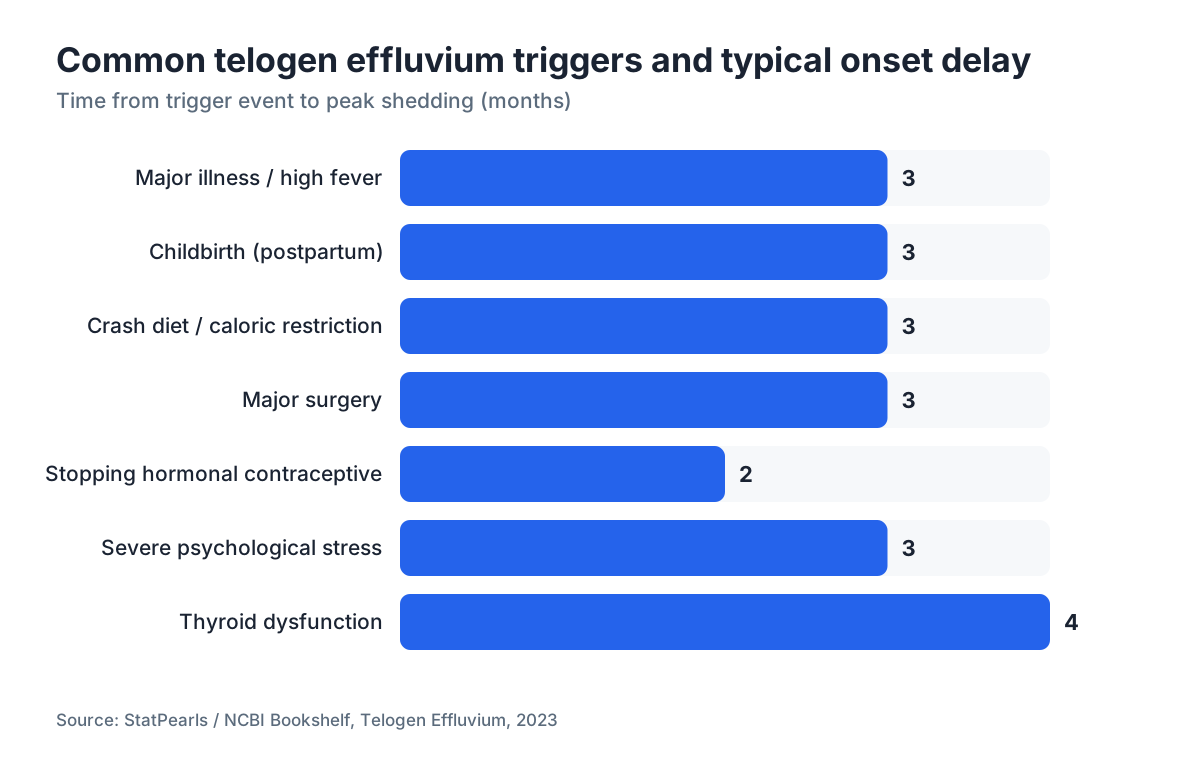
The lag between trigger and shedding is the most confusing part of TE. You rarely connect the hair loss to the cause, because shedding starts two to four months after the event, not right away [2]. By the time your hair is coming out in the shower, you have forgotten the surgery back in March or the extreme diet you started in February.
The most common triggers:
- Major illness or high fever (COVID-19 has produced large numbers of TE cases; an observational study in the Journal of the American Academy of Dermatology found hair loss in 27% of hospitalized COVID-19 patients, typically starting 50-60 days after symptom onset) [4]
- Crash dieting or sudden caloric restriction, especially diets low in protein or iron
- Childbirth (postpartum telogen effluvium is one of the most common forms, affecting up to 50% of new mothers in the months after delivery) [5]
- Thyroid dysfunction, both hypothyroidism and hyperthyroidism
- Major surgery or general anesthesia
- Severe psychological stress
- Starting or stopping certain medications, including hormonal contraceptives
- Iron deficiency anemia (ferritin below roughly 30 ng/mL is tied to more shedding, though the threshold is still debated in the literature) [6]
- Rapid weight loss after bariatric surgery
Chronic telogen effluvium, which drags on past six months, is a separate and murkier animal. It can run for years, hits women more than men, and usually ties back to ongoing nutritional deficiencies or low-grade chronic illness rather than a single acute event [7].
How is telogen effluvium different from androgenetic alopecia on the crown?
This is the question that keeps people up at night, and honestly it can be hard even for dermatologists to answer without looking at the scalp under magnification.
The practical difference is pattern, timeline, and hair diameter. Androgenetic alopecia (AGA) at the crown produces miniaturized hairs: the follicle is still there but it is making progressively finer, shorter, lighter hairs with each cycle. Under a dermatoscope, you see follicular units with clearly different shaft diameters side by side, the signature of AGA [3]. In TE, the shedding affects hairs of uniform diameter. The follicles are healthy; they just all fell asleep at the same time.
| Feature | Telogen effluvium | Androgenetic alopecia |
|---|---|---|
| Onset pattern | Sudden, after trigger | Gradual over years |
| Hair diameter | Uniform (no miniaturization) | Miniaturization visible |
| Scalp zones affected | Diffuse, all zones | Crown and top preferentially |
| Typical duration | 6-12 months, then resolves | Permanent, progressive |
| Pull test | Often positive during active phase | Negative or weakly positive |
| Regrowth | Expected without treatment | Requires ongoing treatment |
| Family history | Not necessarily relevant | Usually present |
The two conditions absolutely overlap. AGA can unmask or worsen TE, and TE can speed up the visible progression of underlying AGA. If you are a man in your 30s with early crown thinning and then you catch COVID-19 or crash diet, you may see what feels like sudden severe hair loss, but the real story is TE layered on slow AGA. That distinction matters because the treatment paths split hard. See finasteride and minoxidil for the evidence on treating AGA while TE is resolving.
Can a telogen effluvium scalp be itchy, and what does that mean?
Yes, a telogen effluvium scalp can be itchy. It is not the most common symptom, and severe itching or scaling usually means another condition is in play, but mild tenderness and itch show up in a meaningful share of TE patients.
The itchy scalp link probably has a few explanations. During active shedding, the physical displacement of hairs leaving the follicle can set off a passing inflammatory response around the follicular opening. There is also evidence that psychological stress (a common TE trigger) raises scalp sebum and disrupts the skin barrier, opening the door to seborrheic dermatitis or folliculitis on top of the shedding [8].
If your itch is mild and diffuse, and it started around the same time as the heavy shedding, it is reasonable to blame TE and not panic. If your scalp is visibly red, scaly, has pustules, or the itch is severe and localized, see a dermatologist. Those signs point to something else, like scalp psoriasis, lichen planopilaris, or a secondary infection, that needs its own treatment.
For mild TE-related itch, zinc pyrithione shampoos (the active ingredient in Head and Shoulders) are a low-risk first step. They cut Malassezia yeast counts, which drive the inflammatory side of seborrheic dermatitis, and they will not hurt anything even if dandruff is not the problem.
How do you properly diagnose TE on the top of the scalp?
Self-diagnosis is a fine starting point, but a few steps actually give you useful information.
The hair pull test at home: Grip 40-60 hairs between your thumb and index finger, hold near the scalp, and pull with gentle but firm traction. More than 6 hairs coming out during active TE counts as positive [3]. This is a rough guide, not a definitive test. Timing matters. It reads most accurately on hair that has not been washed for 24 hours.
Scalp photography: Take consistent top-down photos in the same lighting once a month. The top-of-scalp view (looking straight down at the part line) is the most useful angle. Over three to four months, this tells you whether you are improving, holding steady, or still worsening. Fear distorts your perception. Photos do not.
Blood tests your doctor should order: A full metabolic panel, complete blood count, thyroid panel (TSH at minimum), serum ferritin (better than hemoglobin, since iron stores empty before anemia shows up), vitamin D, and zinc. The American Academy of Dermatology recommends ferritin testing as part of the workup for diffuse hair loss [6].
Dermatologist evaluation: Trichoscopy (dermoscopy of the scalp) shows follicular units directly and catches miniaturization, empty follicles, or perifollicular inflammation that blood tests miss. If the picture is still unclear, a 4mm punch biopsy with horizontal sectioning can definitively separate TE from AGA or a scarring alopecia [3].
If you want a fast, zero-cost starting point before booking an appointment, MyHairline's free AI hair scan (/scan) reads your scalp photos and helps you see whether the pattern looks more like diffuse shedding or patterned thinning, which tells you a lot about how urgent a dermatologist visit really is.
Does telogen effluvium on the crown mean permanent hair loss?
In most cases, no. Telogen effluvium does not damage or scar the follicle. The follicle is alive; it just stopped producing at the wrong time. Once the trigger clears, anagen restarts and regrowth begins. Most people see visible new growth within three to six months of the shedding peak, with full density back by 12 months [2].
Thinning turns permanent in one of three scenarios. The underlying trigger is never found or fixed, and the TE goes chronic. If iron stores stay depleted, or a thyroid problem goes unmanaged, the cycle of early telogen entry keeps repeating. Or the person also has AGA, and the TE episode sped up the permanent miniaturization that was already creeping along, so the baseline was declining and TE just made it visible faster. Or, rarely, what was diagnosed as TE is actually a diffuse form of AGA or a scarring alopecia that got missed early.
The outlook is genuinely good for a single acute TE episode in someone without underlying AGA. If you are a woman in your 20s or 30s who shed heavily after a pregnancy or illness, your odds of full recovery without treatment are high, as long as you address any nutritional gaps. If you are a man with a family history of pattern baldness noticing crown thinning alongside the shedding, the picture is messier. Get the workup done and do not assume it all comes back on its own.
What actually helps: treatments for telogen effluvium top of scalp
No drug is FDA-approved specifically for telogen effluvium. The evidence-based plan is simple: find and fix the cause, feed the follicles the nutrients they need, and consider topical minoxidil to speed regrowth if you want to be proactive.
Fix the root cause first. This is not optional. If your ferritin is 12 ng/mL, no shampoo or supplement is going to stop the shedding. Iron supplementation in iron-deficient patients with diffuse hair loss has cut shedding and supported regrowth across multiple studies [12]. Treat your thyroid if it is off. Steady your diet with enough protein (0.8g per kg body weight is the floor; many hair-focused dermatologists suggest 1.2-1.5g/kg during recovery). See hair loss supplements for a plain look at what has evidence and what does not.
Minoxidil. Topical minoxidil is FDA-approved for androgenetic alopecia [9], not TE specifically, but it works partly by shortening the telogen phase and pushing follicles back into anagen, which is directly relevant to TE. Many dermatologists use it off-label for diffuse shedding. The 2% and 5% solutions and the 5% foam are all over the counter. Minoxidil for men covers dosing and application. Heads up: minoxidil can cause an initial shedding surge for the first 2-8 weeks as it restarts growth cycles, which is alarming if you do not expect it. See minoxidil side effects for the full picture.
What does not help. Expensive shampoos, biotin megadoses (unless you are actually biotin deficient, which is rare), scalp massagers, red-light laser devices (evidence is thin and inconsistent), and most "hair growth supplements" sold online. Biotin gets recommended constantly, but the evidence that it helps people with normal biotin levels is basically absent, and the FDA has warned that biotin can interfere with certain lab tests [10].
Platelet-rich plasma (PRP). PRP injections into the scalp have some small-trial evidence for AGA, but data specific to TE is limited. Cost runs $500 to $2,500 per session, with several sessions needed. It is not a first-line move for TE, but if AGA is also present, the conversation changes.
Hair transplant? Do not pursue a hair transplant until your shedding has been stable for at least 12 months. Transplanting into an actively shedding scalp wastes donor follicles and makes the result impossible to predict.
How long does recovery from telogen effluvium on the scalp top take?
Acute TE follows a fairly predictable arc. Shedding usually peaks around month three after the trigger, then slows over the next two to three months. New anagen hairs start pushing through roughly three to four months after shedding begins, so by months four to six you are typically seeing short regrowth even while older hairs are still dropping [2].
Full density recovery, meaning the scalp top looks as full as before the episode, usually takes nine to twelve months from the trigger event. For some people, especially those with longer hair, it stretches longer simply because new hairs need time to reach visible length. Scalp hair grows about half an inch (1.25 cm) per month on average [1].
Chronic TE, past six months, follows a different track. It can swing for years, flaring under new stressors and easing during calmer stretches. Women are hit disproportionately, and the mechanism likely involves a persistently lowered threshold for follicles to enter telogen early. Finding and managing every contributing factor, which often means working with both a dermatologist and a dietitian, is the most effective long-term strategy.
One practical note: the scalp top is often the last place to look fully recovered, even after the rest of the scalp normalizes, because that zone had more hairs to replace and all the new hairs started growing at the same time.
When should you see a dermatologist about scalp shedding?
See a dermatologist promptly if any of these apply.
You are losing hair in patches rather than diffusely. Patchy loss points to alopecia areata, tinea capitis, or a scarring alopecia, none of which resolve on their own the way TE does.
Your scalp has visible scarring, persistent redness, pustules, or pain. These suggest inflammatory or scarring conditions that can permanently destroy follicles if not treated quickly.
You have been shedding heavily for more than six months with no improvement. Chronic TE needs a thorough workup. Waiting it out without identifying the cause is not a sound plan.
You are a man and the thinning is concentrated at the crown and temples with a receding hairline rather than diffuse loss. That is more consistent with AGA, and the window for saving follicles is time-sensitive. Finasteride stops AGA progression in the majority of men who take it; burning two more years hoping it is just TE is a bad bet if AGA is the real problem. See receding hairline for the early-intervention evidence.
Hair loss comes with other symptoms: fatigue, weight changes, cold intolerance, or irregular periods. Those point to systemic conditions (thyroid disease, polycystic ovary syndrome, autoimmune disease) that need medical management, more than a topical.
You suspect a medication is the cause. Drug-induced telogen effluvium is common and often missed. FDA labels for many medications list hair loss as a known adverse effect [11]. Your prescribing physician can review alternatives.
A good dermatologist visit for suspected TE takes about 20-30 minutes if you show up with photos of your shedding over time and a list of any stressors or medication changes from the past 6 months. That prep alone sharply improves the diagnosis you walk out with.
Does telogen effluvium cause permanent thinning if it keeps coming back?
Repeated acute TE episodes do not damage follicles on their own. Each episode is reversible in principle. But chronic or recurrent TE over many years can lower your overall hair density if regrowth never catches up to the loss, and it is thought to speed the expression of underlying AGA in genetically susceptible people [7].
The practical risk of repeated TE is not follicle destruction so much as cumulative density loss. If you keep losing 300 hairs a day for three-month stretches every year from repeated crash diets, chronic low iron, or back-to-back illnesses, your resting density at any moment will sit lower than someone whose hair grows without interruption. The follicles are still alive and recoverable, but you never give them a long uninterrupted anagen phase to fully express.
For anyone with recurrent TE, the priority is spotting the pattern in the triggers. Keep a simple log: note any illness, major stressor, dietary change, or medication change, then track shedding onset two to three months later. The pattern usually becomes obvious within a year of careful watching, and once you can predict your triggers, you can often head off the next episode.
If you worry that recurrent shedding has permanently hurt your hairline or density, consider a DHT blocker evaluation to see whether AGA is feeding what you thought was purely episodic TE.
Sources
- American Academy of Dermatology (AAD), Hair loss: Who gets and causes
- StatPearls (NCBI Bookshelf), Telogen Effluvium, Alopecia
- American Academy of Dermatology (AAD), Diagnosing and treating hair loss
- Journal of the American Academy of Dermatology, Hair loss as a COVID-19 sequela (Rizzetto et al., 2021)
- StatPearls (NCBI Bookshelf), Postpartum Hair Loss
- American Academy of Dermatology (AAD), Hair loss: Diagnosis and treatment
- Clinical, Cosmetic and Investigational Dermatology, Chronic Telogen Effluvium (Vujovic & Del Marmol, 2014)
- Skin Appendage Disorders, Seborrheic Dermatitis and Hair Loss (Ranganathan & Mukhopadhyay, 2010)
- FDA, Drug Label: Minoxidil Topical Solution (DailyMed)
- FDA, Biotin (Vitamin B7) Safety Communication
- FDA, Drug Labeling (MedlinePlus / DailyMed)
- Journal of Investigative Dermatology, Iron and Diffuse Hair Loss (Trost et al., 2006)