TL;DR: A few foods and plant extracts, mainly pumpkin seed oil, green tea's EGCG, and saw palmetto, have shown statistically significant DHT or hair-count effects in controlled trials. The effects are modest, roughly 10 to 40 percent, against 65 to 70 percent for finasteride. They will not reverse serious hair loss on their own. They are also not pure placebo.
What is DHT and why does it cause hair loss?
Dihydrotestosterone is a hormone your body makes when the enzyme 5-alpha reductase converts testosterone. It binds androgen receptors in hair follicles with roughly five times the affinity of testosterone itself. In genetically susceptible follicles that binding starts a slow miniaturization: thick terminal hairs shrink into fine vellus hairs, then the follicle stops producing visible hair at all [1].
That is androgenetic alopecia, the mechanism behind almost every case of male-pattern and female-pattern loss. The full picture is at what causes hair loss.
The scalp carries a disproportionate share of 5-alpha reductase activity compared with most other tissue, which is why the head gets hit even when blood DHT reads perfectly normal. The real variable is usually how sensitive your receptors are, not some sky-high DHT number.
Blockers work by inhibiting 5-alpha reductase. Finasteride does this hard and specifically. The question here is whether ordinary dietary compounds can do the same thing at doses people actually consume.
How do researchers measure whether a food actually lowers DHT?
Two very different kinds of study get called "DHT blocking," and confusing them is where most bad advice starts.
The first is an in vitro assay. You add a compound to isolated 5-alpha reductase enzyme in a test tube and check whether activity drops. Plenty of compounds pass, including ones your liver destroys before they ever reach a follicle. In vitro data is a lead, not proof.
The second is a randomized controlled trial in humans, with serum or scalp DHT measured before and after. That is what counts. An honest claim needs a statistically significant drop in measured DHT or a documented slowing of hair loss, with a p-value and a real control group.
Many supplement brands print in vitro citations on the label and skip the part where human results come out far weaker. So when you meet any "DHT blocker food," ask one question first: was this tested in living humans, and did serum DHT actually move? [2]
Which foods and plant extracts have real human trial evidence?
The honest list is shorter than the internet suggests. These are the compounds with at least one reasonably controlled human trial showing measurable DHT or hair-count change.
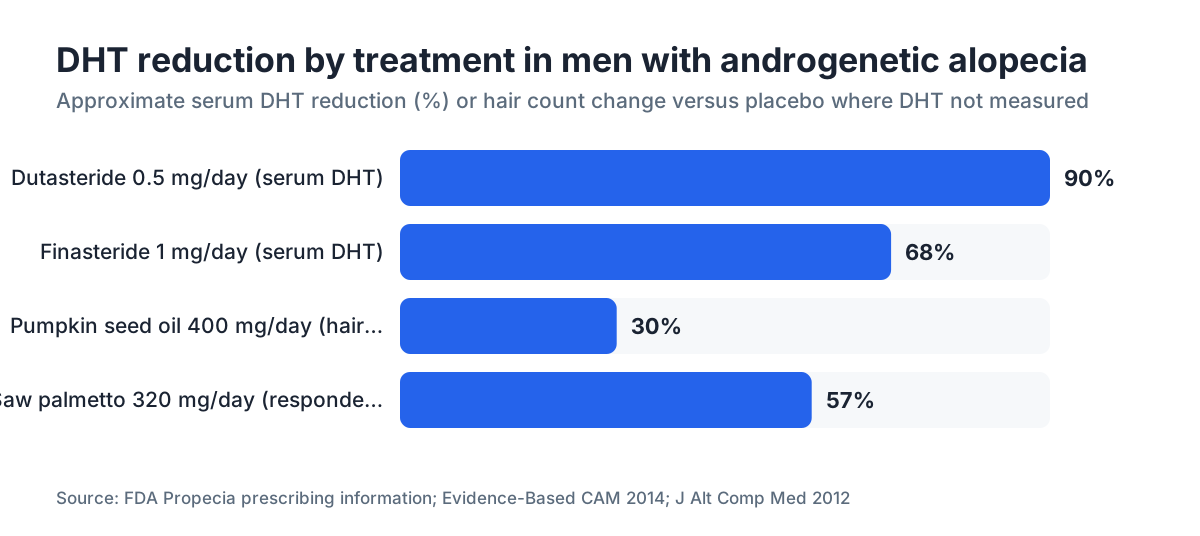
Pumpkin seed oil is the strongest case. A 2014 double-blind RCT in Evidence-Based Complementary and Alternative Medicine randomized 76 men with androgenetic alopecia to 400 mg/day pumpkin seed oil or placebo for 24 weeks. The oil group finished with a 40 percent increase in mean hair count versus 10 percent for placebo [3]. The proposed mechanism is phytosterol inhibition of 5-alpha reductase, though the trial never measured serum DHT directly, so the actual hormone change stays unknown.
Saw palmetto (Serenoa repens) has several trials. A 2012 study in the Journal of Alternative and Complementary Medicine compared 320 mg/day saw palmetto extract against 1 mg/day finasteride in men with androgenetic alopecia over 24 months. Finasteride won (66 percent of patients improved versus 38 percent on saw palmetto), but saw palmetto beat doing nothing [4]. Its active fraction, particularly beta-sitosterol, partly inhibits both type 1 and type 2 5-alpha reductase.
Green tea (EGCG, epigallocatechin gallate) has convincing in vitro data and some animal data on 5-alpha reductase inhibition. The human hair-loss trials are thin. A small topical EGCG study showed some follicle-stimulating effect, but oral EGCG trials with meaningful serum DHT reduction in humans are not yet published in a form that supports strong claims [5].
Lycopene (from tomatoes, more so cooked) and isoflavones (soy, red clover) have in vitro 5-alpha reductase inhibition data. Human work sits mostly in prostate research, where a few studies show modest drops in DHT-related markers. Stretching that to scalp DHT and hair density is a guess.
Spearmint tea gets cited constantly for lowering androgens, but the handful of small trials looked at testosterone in women with PCOS, not DHT, and none tracked hair density.
For how these stack against drugs, see dht blocker.
How do DHT blocker foods compare to finasteride and other treatments?
Here are the honest numbers.
| Treatment | Serum DHT reduction | Evidence level | Main use |
|---|---|---|---|
| Finasteride 1 mg/day | ~65-70% [6] | Multiple large RCTs | Male AGA |
| Dutasteride 0.5 mg/day | ~90% [6] | Multiple RCTs | Male AGA (off-label in US) |
| Pumpkin seed oil 400 mg/day | Not directly measured; ~40% hair count gain vs placebo [3] | 1 small RCT | AGA |
| Saw palmetto 320 mg/day | Partial inhibition; far smaller than finasteride [4] | Multiple small RCTs | AGA |
| Green tea EGCG (oral) | Unclear in humans | In vitro + animal only | Unclear |
| Dietary lycopene / soy isoflavones | Very small or not measured | Mostly prostate trials | Unclear |
Finasteride cuts serum DHT by 65 to 70 percent at the standard 1 mg dose, per the FDA-approved prescribing information [6]. Dutasteride, which blocks both isoenzymes, reaches roughly 90 percent. No food or supplement lands near those numbers in head-to-head human comparisons.
But "not as good as finasteride" is a long way from "useless." For someone who cannot tolerate finasteride, or who wants an add-on, a small real effect still beats nothing. The catch is that most people with meaningful loss need something close to finasteride-level suppression just to hold ground, never mind regrow.
For the full drug comparison, read finasteride and finasteride and minoxidil together.
Can eating more pumpkin seeds or drinking green tea actually help your hair?
Probably not through food alone, at the amounts most people eat. The 2014 pumpkin seed oil RCT used 400 mg of oil in capsule form, standardized for phytosterol content [3]. That is nothing like sprinkling seeds on a salad. A handful of pumpkin seeds (about 30 grams) gives you maybe 10 to 15 ml of oil, but the concentrated phytosterol extract in the trial capsule is not something raw seeds match.
Green tea works the same way. The EGCG amounts in mechanistic studies run far above what two or three cups of tea deliver.
This is the real weakness in the "eat your way to lower DHT" idea. Active concentration is the whole game, and food sources rarely hit the doses that showed any effect in trials. Standardized supplements are a closer proxy to what was actually studied, even though they are not medication.
Then there is absorption. Many polyphenols get chewed up in the gut before they reach circulation. EGCG bioavailability from oral green tea extract, for one, swings wildly between individuals.
So: pumpkin seed oil in capsule form at the studied dose has the most honest evidence. Diet tweaks alone are unlikely to move serum DHT in any measurable way, based on what we have now.
Are there foods that raise DHT and should be avoided?
This comes up a lot, and the honest answer is that the direct food-to-DHT-to-hair-loss pathway is mostly unproven at normal dietary amounts.
Alcohol raises aromatase activity and can shift the testosterone-to-estrogen balance, but its effect on DHT specifically is indirect and poorly quantified for hair loss [7].
Diets high in sugar and refined carbs that drive insulin resistance can raise free testosterone (by lowering sex hormone binding globulin), which in theory hands 5-alpha reductase more substrate. Translating that into measured scalp DHT, and then into hair loss outcomes in controlled studies, has not been done rigorously.
Creatine became a popular worry after a 2009 rugby study showed a rise in the DHT-to-testosterone ratio with loading doses. Total DHT was never directly measured and the study was small [8]. If you have read the debate about does creatine cause hair loss, you already know the data is weaker than the headlines.
So obsessing over specific foods to avoid is probably the wrong move. How sensitive your follicles are to whatever DHT you have matters far more than the dietary margin.
What about saw palmetto supplements specifically, are they safe?
Saw palmetto has a generally good safety record in short-to-medium-term trials. The main issues are mild gastrointestinal upset and, rarely, sexual side effects, though these show up far less consistently than with finasteride [4].
The National Institutes of Health's National Center for Complementary and Integrative Health states that saw palmetto "appears to be well tolerated," while noting the evidence for any specific condition is limited and largely from small studies [9].
One real interaction matters: saw palmetto can affect anticoagulants such as warfarin, and high-dose aspirin, because it has mild antiplatelet effects. Anyone on blood thinners should talk to a doctor before adding it.
It is not FDA-approved for any hair loss indication. You are buying an unregulated supplement with limited but genuine supporting data, and dose standardization between brands varies a lot. That is not a reason to never use it. It is a reason to be clear-eyed about what you are actually getting.
Do DHT blocker foods work differently for women versus men?
Female-pattern hair loss involves DHT and androgen sensitivity too, but the picture is messier. Many women with hair loss have completely normal androgen levels, and the sensitivity question is even harder to untangle than in men. Some women have PCOS or other androgen excess, where cutting androgens is more directly relevant [10].
The pumpkin seed oil and saw palmetto hair-loss trials ran predominantly or entirely in men. There is genuinely little data on whether these compounds do the same thing in women.
Spearmint tea lowering testosterone in women with PCOS has some trial support, but lowering testosterone is not lowering DHT, and hair density was not the primary endpoint anyway.
For a woman with significant hair loss, the evidence for any DHT-focused dietary move is thinner than it already is for men. General nutrition, ferritin and iron, thyroid status, and whether the loss is actually telogen effluvium rather than androgenetic alopecia are all more productive things to check first.
Can DHT blocker foods be combined with minoxidil or finasteride?
No pharmacological reason says pumpkin seed oil or saw palmetto would clash with minoxidil (which acts on the follicle directly, not through DHT) or with finasteride (a much stronger 5-alpha reductase inhibitor). Stacking a modest DHT reduction on top of finasteride's strong one is, in theory, additive rather than dangerous [6].
Still, nobody has run a proper RCT pitting pumpkin seed oil plus finasteride against finasteride alone to check for any real added benefit. The marginal value of piling a supplement onto an already 65 to 70 percent DHT drop from finasteride is probably small.
Minoxidil for men runs on a completely separate mechanism (vasodilation and direct follicle signaling), so pairing it with any DHT-focused strategy makes sense on paper. See minoxidil for men for the full evidence, and check minoxidil side effects before you start.
If you are trying to figure out what combination fits your stage of loss, MyHairline's free AI hair analysis at myhairline.ai/scan gives you a baseline read on where you stand before you spend on any treatment stack.
What is a realistic expectation if you focus on DHT blocker foods?
Start by being honest about your stage. If you have a mildly receding hairline and you want to slow early progression, pumpkin seed oil at the studied dose is a reasonable low-risk move. The single published RCT shows a real effect over placebo, even if the mechanism is only partly worked out [3].
If you are at Norwood 3 or beyond and hoping green tea and pumpkin seeds will grow back a temple, you will be disappointed. The evidence does not back that. At that point the conversation is finasteride, minoxidil, or for some people a hair transplant.
There is also the "what's the harm in trying" logic, which is fair. Pumpkin seed oil at 400 mg/day is cheap with no significant documented harm. Green tea in normal amounts is fine. These are not irrational choices. They just should not stand in for proven treatments when your situation calls for proven treatments.
The honest hierarchy: meaningful genetic hair loss responds best to drugs that suppress DHT hard (finasteride, dutasteride) or work through a separate mechanism (minoxidil). Dietary interventions sit further down, not because they are fake, but because the effects are smaller and the evidence is thinner. For the wider field, hair loss supplements covers the rest of the shelf.
What does the science actually say about 5-alpha reductase inhibition from plant compounds?
The pharmacology is real. Several plant-derived compounds do inhibit 5-alpha reductase in assays, including beta-sitosterol, saw palmetto free fatty acids, EGCG, lycopene, and certain zinc compounds. The enzyme inhibition is not made up [2][5].
The gap sits between enzyme inhibition in a dish and real clinical change on the scalp, which is where most of these compounds fall apart. Oral bioavailability first: much of a polyphenol gets metabolized before it reaches circulation in active form. Then tissue concentration: even if a compound reaches the blood, scalp levels may sit far below what inhibited the enzyme in vitro. Then binding: finasteride's near-irreversible binding to 5-alpha reductase is part of why it works so well at such a tiny dose, while plant compounds tend to be competitive inhibitors that get displaced easily.
A 2020 review in the Journal of Dermatological Science put it plainly: compounds like EGCG "showed significant 5-alpha reductase inhibitory activity in vitro," but clinical evidence in androgenetic alopecia remains limited [5]. That is the honest state of play.
Nobody has good head-to-head trial data comparing, say, 400 mg pumpkin seed oil against 1 mg finasteride in the same patients with the same endpoints measured the same way. Until that exists, ranking their real-world efficacy involves genuine uncertainty.
Sources
- StatPearls (NCBI Bookshelf), National Library of Medicine – Androgenetic Alopecia
- Journal of Ethnopharmacology – 5-alpha reductase inhibition by plant extracts review
- Evidence-Based Complementary and Alternative Medicine – Pumpkin seed oil RCT, 2014
- Journal of Alternative and Complementary Medicine – Saw palmetto vs finasteride RCT, 2012
- Journal of Dermatological Science – EGCG and 5-alpha reductase inhibition review, 2020
- FDA – Propecia (finasteride 1 mg) prescribing information
- NCBI PMC – Alcohol and androgen metabolism review
- Clinical Journal of Sport Medicine – Creatine and DHT-to-testosterone ratio study, 2009
- NIH National Center for Complementary and Integrative Health – Saw Palmetto
- American Academy of Dermatology – Female pattern hair loss overview