TL;DR: A DHT blocker is any drug, supplement, or topical that reduces dihydrotestosterone (DHT), the androgen responsible for shrinking hair follicles in genetically susceptible people. The only FDA-approved oral DHT blocker for hair loss is finasteride, which lowers scalp DHT by about 70%. Natural options exist but have far weaker evidence.
What does DHT blocker mean, exactly?
DHT stands for dihydrotestosterone. It's a hormone made when an enzyme called 5-alpha reductase converts testosterone into a more potent androgen. "DHT blocker" is a loose umbrella term for anything that interferes with that conversion or with DHT's ability to bind to receptors on hair follicle cells.
The definition matters because the term gets applied to very different things. A prescription finasteride tablet that blocks 5-alpha reductase type 2 is a DHT blocker. So is a shampoo containing saw palmetto extract, though the two are not remotely equivalent in evidence or potency.
In clinical dermatology, the mechanism is called 5-alpha reductase inhibition. When you see "DHT blocker" on a product label, the first question to ask is: how much does it actually lower DHT, and in what part of the body?
For people with androgenetic alopecia (the medical name for male or female pattern hair loss), DHT is the main driver. It binds to androgen receptors in genetically predisposed follicles, triggering a process called miniaturization where each hair grows progressively shorter, thinner, and lighter until the follicle eventually stops producing a visible hair. Blocking DHT slows or stops that process. It doesn't regrow hair that's already gone from follicles that have fully shut down.
How does DHT cause hair loss in the first place?
Testosterone is made in the testes (in men) and in smaller amounts in the adrenal glands and ovaries. The enzyme 5-alpha reductase, found in high concentrations in the scalp and prostate, converts testosterone to DHT. DHT is roughly five times more potent than testosterone at binding androgen receptors [1].
In scalp follicles that carry a hereditary sensitivity to androgens, DHT binding to the androgen receptor sets off a chain of molecular signals that shortens the anagen (growth) phase of the hair cycle. Each successive hair grows for less time, so it never gets as long or as thick. The follicle itself shrinks. Over years and decades, this is what produces a receding hairline or thinning crown.
Not every follicle on the scalp is equally sensitive. Follicles at the back and sides of the head (the "donor zone" transplant surgeons use) are largely androgen-insensitive, which is why pattern baldness follows predictable maps rather than wiping out all hair equally. If you want more context on how different factors contribute, the what causes hair loss article covers it in detail.
Women have far less testosterone to begin with, but they still make DHT. Female pattern hair loss (FPHL) is less clearly androgen-driven than the male version, and the relationship is more complicated, but elevated androgen sensitivity still explains a meaningful share of cases [2].
Here's the part that trips people up: DHT is the trigger, but only in follicles genetically wired to respond to it. That's why blocking DHT works well for some people and does nothing for others whose hair loss has a different cause, like telogen effluvium or nutritional deficiency.
What are the main types of DHT blockers?
There are two main categories: pharmaceutical inhibitors and natural or topical options. They work by the same general principle but differ enormously in potency and evidence.
Pharmaceutical 5-alpha reductase inhibitors
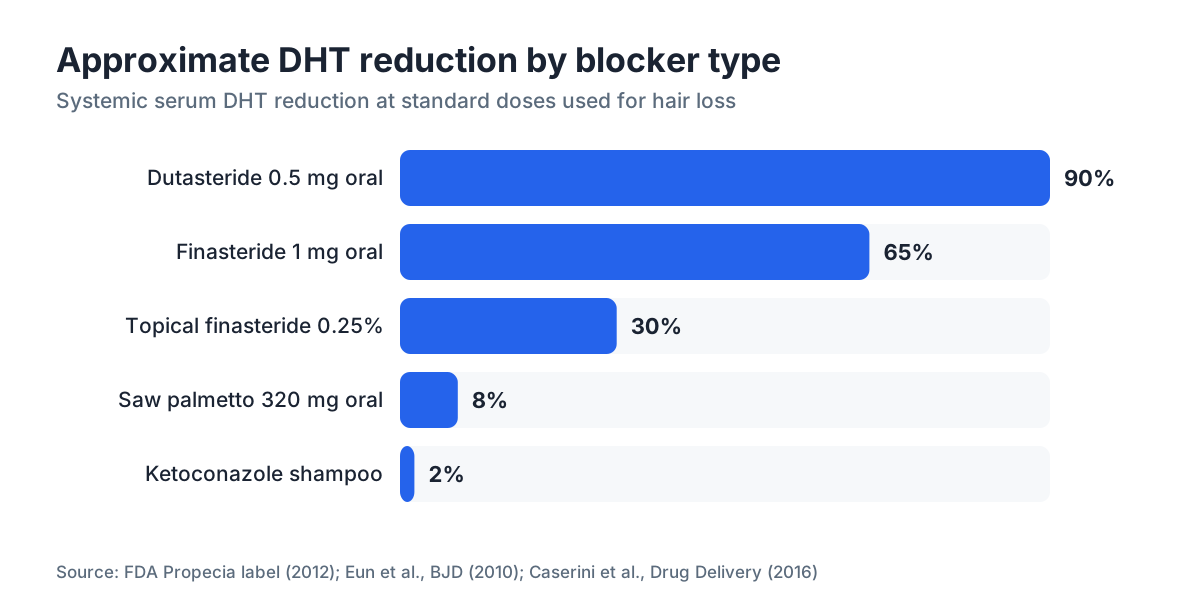
Finasteride (brand name Propecia, 1 mg oral) is the FDA-approved treatment for male pattern hair loss. It selectively blocks 5-alpha reductase type 2, the isoform dominant in the scalp and prostate. The approval trials showed it reduced scalp DHT by approximately 60-70% [3]. A separate drug, dutasteride, blocks both type 1 and type 2 isoforms and achieves roughly 90% DHT suppression; it's approved for benign prostatic hyperplasia but used off-label for hair loss in many countries and is approved for hair loss in South Korea and Japan [4]. Neither is approved for use in women who are pregnant or may become pregnant because DHT suppression during fetal development causes genital abnormalities.
Topical DHT blockers
Topical finasteride (typically 0.25% solution) delivers the drug to the scalp with lower systemic absorption than the oral version. Studies show it reduces scalp DHT meaningfully while raising serum DHT by far less than oral finasteride does, which may reduce sexual side effects [5]. It's compounded in many countries and approved in some.
Natural options
Saw palmetto (Serenoa repens) extract is the most studied natural DHT blocker. A 2021 systematic review found it improved hair density in some studies but noted the trials were small and methodologically inconsistent [6]. Pumpkin seed oil, beta-sitosterol, and green tea extract appear in supplements labeled as DHT blockers; the evidence for all of them is preliminary at best. If you want a broader look at what supplements have meaningful trial data, the hair loss supplements article is a useful starting point.
DHT-blocking shampoos
Shampoos containing ketoconazole (an antifungal) or saw palmetto are marketed as DHT blockers. Ketoconazole has some evidence for modestly improving hair density, possibly through a weak anti-androgen effect at the follicle level, but it doesn't meaningfully lower systemic or even scalp DHT the way a pill does. Contact time in the shower is short; absorption is minimal. Think of these as a weak adjunct at best, not a primary treatment.
| DHT blocker | Mechanism | DHT reduction (approximate) | FDA-approved for hair loss? |
|---|---|---|---|
| Finasteride 1 mg oral | Blocks 5-AR type 2 | 60-70% | Yes (men) |
| Dutasteride oral | Blocks 5-AR type 1 and 2 | ~90% | No (US); Yes (Korea, Japan) |
| Topical finasteride 0.25% | Local 5-AR inhibition | Moderate, lower systemic | No (compounded) |
| Saw palmetto oral | Weak 5-AR inhibition | Unknown/small | No |
| Ketoconazole shampoo | Weak local anti-androgen | Minimal systemic | No |
| Pumpkin seed oil | Weak 5-AR inhibition | Unknown | No |
How effective are DHT blockers for regrowing hair?
Effectiveness depends entirely on which DHT blocker you're talking about and what outcome you're measuring. Stopping further loss is a different bar from regrowing what's already gone.
For oral finasteride, the evidence is solid. The original FDA approval trials ran two years in men with mild to moderate pattern hair loss. At two years, 83% of finasteride users maintained or increased hair count versus 28% of placebo users [3]. Regrowth happened in a meaningful subset, mostly at the crown; the hairline was less responsive. The finasteride article goes deep on the trial data and side effect profile if you want the full picture.
For dutasteride, a randomized controlled trial in South Korea showed dutasteride 0.5 mg outperformed finasteride 1 mg on hair count at 24 weeks [4]. The tradeoff is a much longer half-life (weeks, not hours) and potentially longer-lasting hormonal effects if you stop.
Natural DHT blockers post far weaker numbers. The best saw palmetto trial found modest improvements in hair density compared to placebo, but none of these studies have sample sizes or follow-up durations that approach the pharmaceutical trials. If you're weighing supplements against drugs, the honest answer is that you're comparing a 60-70% DHT reduction with clear trial data to an unknown reduction with limited data.
One more thing, and it's the ceiling on everything above: DHT blockers work best early. Once a follicle miniaturizes completely and stops producing hair, reducing DHT won't bring it back. That's why early treatment matters and why some people who have waited too long are better candidates for a hair transplant than a DHT blocker.
What are the side effects of DHT blockers?
The side effects depend heavily on how much DHT the blocker actually suppresses systemically.
For oral finasteride, the FDA label lists sexual side effects: decreased libido, erectile dysfunction, and decreased ejaculate volume, each occurring in roughly 1.5-3.8% of men in the original trials (versus about 1-2% with placebo) [3]. Most of these resolved when men stopped the drug. Post-marketing reports describe persistent sexual side effects after discontinuation in a small subset of men, a syndrome called post-finasteride syndrome. The FDA added a label update in 2012 to reflect this. This is a real consideration, not a reason to panic, but a reason to have an honest conversation with a doctor rather than sourcing the drug from gray-market websites.
DHT is involved in prostate function, muscle maintenance, and other processes. Suppressing it by 90% with dutasteride has a wider systemic footprint than suppressing it 70% with finasteride, and dutasteride's half-life means it stays active for weeks after stopping.
For topical finasteride, systemic DHT suppression is lower. One study found topical finasteride 0.25% daily reduced serum DHT by about 30% versus about 65% for 1 mg oral [5]. Whether that translates to fewer sexual side effects is biologically plausible but not yet firmly proven in large trials.
Natural DHT blockers rarely cause meaningful side effects at typical doses, which is consistent with the fact that they rarely cause meaningful DHT reduction either.
For women, finasteride is contraindicated in pregnancy (FDA Pregnancy Category X) because DHT suppression interferes with normal male fetal genital development. Women of childbearing age who use it must use effective contraception. Postmenopausal women are sometimes prescribed finasteride off-label with monitoring [2].
If you're comparing the risk-benefit profiles of minoxidil (which doesn't block DHT but stimulates follicle activity through a different mechanism) and finasteride, read about minoxidil side effects separately, since the safety profiles are quite different.
Do natural DHT blockers actually work?
This is where a lot of people spend money without a clear answer, so let's be direct about what the evidence shows.
Saw palmetto is the most studied natural option. A 2020 randomized trial published in the Journal of Alternative and Complementary Medicine found that 320 mg/day of saw palmetto increased hair count in men with androgenetic alopecia, though the effect size was modest compared to finasteride [6]. The mechanism appears to be weak inhibition of 5-alpha reductase, similar to finasteride but many times less potent.
Pumpkin seed oil at 400 mg/day was studied in a 24-week randomized trial published in Evidence-Based Complementary and Alternative Medicine in 2014. Hair count increased 40% in the treated group versus 10% in placebo [7]. That's an interesting result, but the study had 76 participants, no DHT measurement, and hasn't been replicated at scale.
Beta-sitosterol, a plant sterol found in many DHT-blocking supplement blends, has weak 5-alpha reductase inhibition in lab studies. Human trial data is extremely thin.
Ketoconazole 2% shampoo has two small randomized trials suggesting it improves hair density and follicle size, possibly through anti-androgen effects at the scalp level, though the exact mechanism isn't fully established [8].
Here's the honest summary. Natural DHT blockers probably do something, but nobody has good data on how much DHT they actually reduce in the human scalp, and none have come close to matching finasteride in a head-to-head trial. They're reasonable as adjuncts if you can't or won't take a pharmaceutical, not as replacements.
If you're evaluating a supplement blend that claims to block DHT, look for whether the individual ingredients have human trial data, more than in-vitro (lab dish) studies. Most don't.
Can women use DHT blockers?
Women can, but the picture is more complicated than it is for men.
For premenopausal women with androgenetic alopecia, the standard first-line treatment is topical or oral minoxidil for men (yes, minoxidil is used in women too), not a DHT blocker. That's partly because the role of androgens in female pattern hair loss is less clear-cut and partly because finasteride is teratogenic.
Postmenopausal women are sometimes prescribed finasteride 1 mg or 2.5 mg off-label. A 2012 randomized trial in postmenopausal women with FPHL found finasteride did not significantly improve hair density at 12 months [2]. Spironolactone, an androgen receptor blocker (not technically a 5-alpha reductase inhibitor, but it blocks DHT's action at the receptor rather than its production), has broader use in women and is often the first anti-androgen tried in premenopausal women with hyperandrogenism-related hair loss.
For women with PCOS (polycystic ovary syndrome) and elevated androgens, treating the underlying hormonal condition often helps hair loss more than a standalone DHT blocker.
The American Academy of Dermatology's guidelines for female pattern hair loss note that minoxidil remains the only FDA-approved treatment for women, and that anti-androgens are used off-label with varying evidence [2].
How long does it take a DHT blocker to show results?
Slower than most people expect. This is one of the most common reasons people give up too early.
With oral finasteride, the hair cycle itself is the bottleneck. A full hair cycle takes roughly three to six months. When you start blocking DHT, follicles that were in a shortened anagen phase start recovering, but you won't see that in visible hair until those follicles complete a cycle and enter a new growth phase. Most clinical trials and dermatologists say to expect no meaningful visible change for three to six months, with the best results appearing at 12 to 24 months of continuous use [3].
Some people notice temporary increased shedding in the first two to three months as follicles reset. This is normal and not a sign the drug isn't working.
For natural DHT blockers, the few trials that exist show similar timelines: the pumpkin seed oil study ran 24 weeks, the saw palmetto studies ran six to twelve months.
Stop taking a DHT blocker and the protective effect reverses. DHT returns to baseline levels and the miniaturization process resumes, typically within six to twelve months after stopping finasteride. Any hair regained is usually lost within one to two years. This is a lifetime commitment if you want sustained benefit.
Using a DHT blocker alongside minoxidil (which works through a completely different pathway, promoting blood flow and extending the growth phase) tends to produce better results than either alone, which is why the combination is common in clinical practice. The finasteride and minoxidil article covers the combination evidence in detail.
Are DHT-blocking shampoos worth buying?
This question comes up constantly, and the honest answer is: probably not as a standalone treatment, though they're not worthless either.
The problem with shampoo as a drug delivery system for DHT blockers is contact time. A shampoo sits on your scalp for one to three minutes before rinsing, which is a very short window for meaningful drug absorption. Even ketoconazole, which has the best evidence among shampoo ingredients, doesn't meaningfully lower serum or scalp-tissue DHT the way an oral drug does.
Ketoconazole 2% shampoo (brand name Nizoral, also available generic) has two small randomized trials showing improvements in hair density and follicle size. The AAD lists it as a possible adjunctive treatment [8]. If you're already using finasteride or minoxidil, adding a ketoconazole shampoo two or three times per week has a reasonable (if unproven at scale) rationale and minimal downside.
Saw palmetto shampoos have even less evidence. The ingredient appears in many "hair growth" shampoos, but there's essentially no published clinical data on saw palmetto delivered as a rinse-off shampoo.
Buying a DHT-blocking shampoo as your primary hair loss treatment instead of proven options is a waste of money. As a cheap adjunct alongside a proven treatment, the downside is low.
At MyHairline, the free AI hair analysis at /scan can help you understand your pattern and stage before you decide which treatments actually match your situation.
What's the difference between a DHT blocker and minoxidil?
These two treatments work through completely separate mechanisms and are often confused or compared as if they're interchangeable. They're not.
Minoxidil was originally a blood pressure drug. It appears to work on hair primarily by opening potassium channels in follicle cells, extending the anagen (growth) phase, and possibly improving blood flow to the follicle. It does not affect DHT production or DHT receptor binding at all. It's a hair growth stimulant, not a DHT blocker.
Finasteride and other DHT blockers work upstream: they prevent DHT from being made (or from binding), which removes the trigger that's causing follicle miniaturization. Minoxidil doesn't remove that trigger; it tries to overcome it.
This is why the two drugs complement each other rather than overlap. A 2021 study in the Journal of Cosmetic Dermatology comparing combination therapy to either drug alone found the combination produced significantly better hair count outcomes than monotherapy [9].
For people who can't or won't take finasteride (due to side effect concerns or contraindications), minoxidil alone is a reasonable option. For people with early-stage pattern loss, adding finasteride to minoxidil is generally the approach most dermatologists recommend.
The minoxidil for men article breaks down dosing and formulations, and oral minoxidil covers the newer low-dose oral version, which has a different side effect profile than the topical.
If your receding hairline is the primary concern, understanding which Norwood stage you're at helps predict how much either drug is likely to help.
How do I know if I actually need a DHT blocker?
Not everyone with hair loss benefits from a DHT blocker. The drug is effective specifically for androgenetic alopecia (pattern hair loss) driven by DHT sensitivity. Using a DHT blocker for a different type of hair loss is unlikely to help and exposes you to side effects for no benefit.
The classic presentation of DHT-driven hair loss is a predictable pattern: temples receding, crown thinning, or both, following the Norwood scale in men or a diffuse thinning on the top of the scalp (Ludwig scale) in women. A dermatologist can confirm this with a scalp exam and sometimes a trichoscopy or biopsy.
Hair loss from telogen effluvium (sudden shedding triggered by stress, illness, or nutritional deficiency) is not driven by DHT and doesn't respond to DHT blockers. Hair loss from alopecia areata (an autoimmune condition) also won't respond.
Blood tests can check total testosterone, free testosterone, DHEA-S, and in women, SHBG. These don't directly measure scalp DHT, but they help paint a picture of androgen status. A scalp biopsy is the most definitive way to confirm androgenetic alopecia when the clinical picture is unclear.
If you're early in the research phase, running your photos through a tool like MyHairline's free AI scan can give you a starting point before committing to a doctor's appointment, though it doesn't replace a clinical diagnosis.
The dht blocker article covers specific product recommendations and how to evaluate them once you've confirmed the diagnosis. And if you've ever wondered whether things like creatine supplements affect DHT, the does creatine cause hair loss article addresses that specific question.
What should I ask a doctor before starting a DHT blocker?
A few questions are worth having answered before you start, and a good prescriber will cover most of them unprompted.
First, ask whether your hair loss is actually androgenetic alopecia. If the cause hasn't been confirmed, a DHT blocker might be the wrong tool entirely.
Ask about baseline labs. Finasteride and dutasteride lower PSA (prostate-specific antigen) levels by about 50%, which matters if you're over 40 and getting PSA monitoring for prostate cancer screening. Your doctor needs to know you're on a 5-alpha reductase inhibitor when interpreting PSA results [3].
Ask about sexual side effects honestly. The base rate from trials is low (1-3% for each symptom), but you should know what to watch for and know to call your doctor rather than stopping abruptly without a plan.
Ask about finasteride versus topical finasteride. If systemic side effects concern you, topical delivery reduces systemic DHT suppression substantially while still delivering drug to the scalp.
Ask how long you should try the drug before evaluating whether it's working. The answer should be at least 12 months, ideally with standardized photos at the start and at 6 and 12 months.
Finally, ask whether you should combine with minoxidil. For most people with active miniaturization, the combination is stronger than either alone, and most dermatologists experienced in hair loss will recommend it.
Sources
- Endocrine Society, Journal of Clinical Endocrinology and Metabolism – Androgen physiology review
- American Academy of Dermatology – Female pattern hair loss treatment guidelines
- FDA – Propecia (finasteride 1 mg) prescribing information
- PubMed – Randomized controlled trial of dutasteride vs finasteride in androgenetic alopecia (Eun et al., British Journal of Dermatology, 2010)
- PubMed – Topical finasteride 0.25% vs oral finasteride 1 mg DHT reduction study (Caserini et al., Drug Delivery, 2016)
- PubMed – Saw palmetto systematic review and randomized trial, Journal of Alternative and Complementary Medicine (2021)
- PubMed – Pumpkin seed oil randomized trial, Evidence-Based Complementary and Alternative Medicine (2014)
- PubMed – Ketoconazole 2% shampoo and hair density randomized trials (Piérard-Franchimont et al., Dermatology, 1998)
- PubMed – Combination finasteride plus minoxidil vs monotherapy, Journal of Cosmetic Dermatology (2021)
- FDA – Pregnancy Category X and finasteride teratogenicity guidance
- National Library of Medicine / MedlinePlus – Androgenetic alopecia overview