

TL;DR: Vaping likely contributes to hair loss through the same mechanisms as cigarette smoking: nicotine constricts blood vessels to follicles, oxidative stress disrupts the hair cycle, and DHT-related shedding may worsen. No large randomized trial has tested vaping alone, but the biology is plausible and the existing evidence on nicotine and smoking is consistent enough to take seriously.
What does the research actually say about vaping and hair loss?
Nobody has run a large, controlled trial on e-cigarette use and hair loss. That's the honest starting point. The closest evidence we have is a substantial body of research tying cigarette smoking to androgenetic alopecia, plus mechanistic studies on what nicotine and aerosol chemicals do inside a follicle. Researchers extrapolate from there to vaping. Those inferences are reasonable. They are not proven.
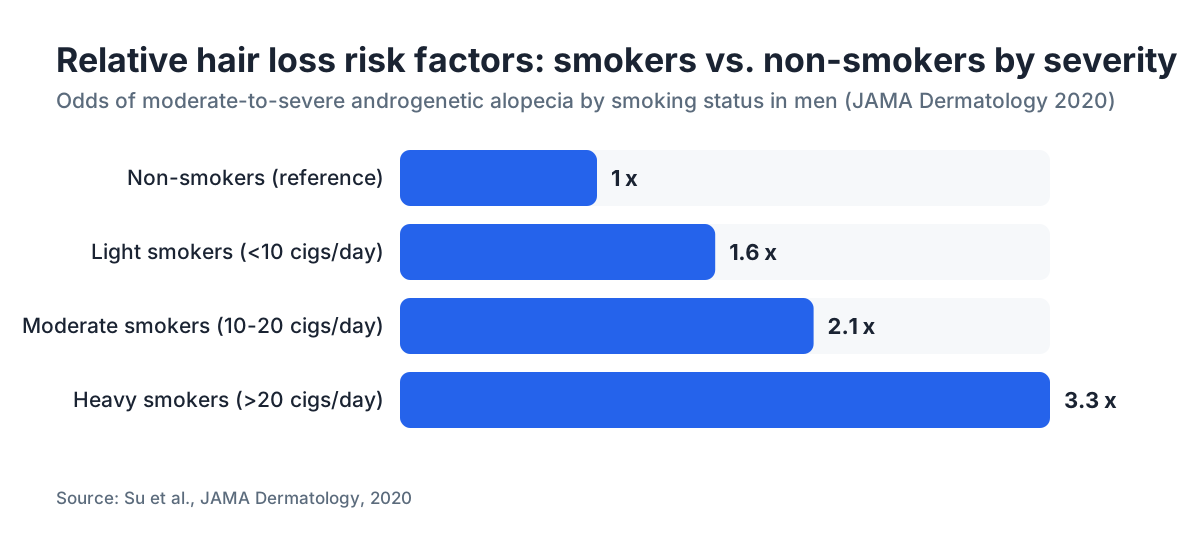
A 2020 cross-sectional study in JAMA Dermatology found male smokers were significantly more likely to have androgenetic alopecia than non-smokers, with a dose-response relationship: more cigarettes per day, more severe hair loss [1]. That study looked at conventional cigarettes, not e-cigarettes. But the mechanism it proposed was nicotine-driven vasoconstriction and oxidative stress, and both of those show up in vaping too [2].
E-cigarette aerosol contains nicotine (in most products), ultrafine particles, and varying levels of volatile organic compounds [3]. Many pod-based systems deliver 20 to 60 mg/mL of nicotine, which rivals or beats a cigarette [13]. So the claim that vaping is "hair-safe" because it skips tobacco combustion has no direct evidence behind it, and it ignores the drug both products share.
How could nicotine from vaping affect hair follicles?
Nicotine acts on nicotinic acetylcholine receptors, which are present in hair follicle cells [4]. When nicotine binds those receptors, it triggers vasoconstriction in the dermal papilla, the tiny knot of blood vessels and connective tissue that feeds a follicle. Less blood flow means less oxygen, fewer nutrients, and slower cell division in the matrix cells that build the hair shaft.
Nicotine and its main metabolite cotinine also promote oxidative stress. Free radicals from that process can damage follicle DNA and push hairs early out of the growth phase (anagen) into resting (catagen, then telogen). The result is a shorter anagen phase and more hairs sitting in telogen at once, which looks like diffuse thinning or a higher daily shed count. Clinically, that pattern is telogen effluvium.
There is a third pathway. Some data suggest nicotine indirectly raises circulating dihydrotestosterone (DHT) by increasing 5-alpha reductase activity in certain tissues [5]. If that holds up, vaping could speed up androgenetic alopecia in people who are already genetically predisposed, doing more than cause a reversible shed. The evidence here is weaker and mostly from animal studies. Treat it as a hypothesis worth watching, not settled fact.
Is vaping worse for hair than smoking cigarettes?
Probably not worse, but not meaningfully safer either.
Conventional cigarettes expose follicles to polycyclic aromatic hydrocarbons, carbon monoxide, and thousands of combustion byproducts that pile onto the nicotine damage. E-cigarettes skip most of those combustion products, which is the core of the harm-reduction case for switching smokers. But high-nicotine pods can deliver more nicotine per puff than a cigarette, and the oxidative stress from propylene glycol and flavoring compounds is real even if poorly measured [3].
The FDA Center for Tobacco Products describes e-cigarettes as containing "potentially harmful chemicals including nicotine, heavy metals like lead, volatile organic compounds, and cancer-causing agents" [3]. None of that helps a follicle.
So the honest comparison is not "vaping is safe for hair." It is closer to "vaping may be somewhat less damaging than smoking, but still worse than using no nicotine at all." If you want to keep your hair, quitting both is the obvious move.
| Factor | Cigarettes | E-cigarettes |
|---|---|---|
| Nicotine delivery | 1-2 mg absorbed per cigarette | 0.5-4+ mg per session (device-dependent) |
| Combustion byproducts | Yes (thousands) | No |
| Oxidative stress compounds | High | Moderate |
| Carbon monoxide | Yes | No |
| Evidence linking to hair loss | Direct (JAMA Dermatology 2020) [1] | Indirect (mechanistic only) |
| DHT upregulation signal | Animal data | Animal data |
What kind of hair loss does vaping cause, and is it permanent?
The most likely pattern is telogen effluvium: a diffuse, temporary shed triggered by physiological stress on the follicle [6]. In telogen effluvium, more follicles than usual sync into the resting phase, and you see heavier daily shedding, often 150 to 250 hairs per day instead of the normal 50 to 100. Here's the good part. Telogen effluvium reverses once you remove the trigger. Most people see real regrowth within 3 to 6 months of quitting.
The more serious possibility is that chronic nicotine exposure accelerates androgenetic alopecia (male or female pattern hair loss) in genetically susceptible people. That process involves miniaturization, where each hair cycle produces a finer, shorter hair until the follicle stops making visible hair at all. Miniaturized follicles can regrow with treatment, but advanced miniaturization is hard to fully reverse without a hair transplant.
If you have a family history of pattern baldness and you vape heavily, you're probably getting both effects at once: a reversible shed layered on top of an accelerated permanent process. The reversible part improves if you quit. The androgenetic part needs active treatment like finasteride or minoxidil for men to manage.
Does accutane cause hair loss?
Yes, isotretinoin (brand name Accutane) can cause hair loss, and it's listed as a known adverse effect in the drug's FDA-approved prescribing information [7]. The mechanism is different from vaping. Isotretinoin is a retinoid, a vitamin A derivative, and at high doses it appears to push anagen follicles into telogen early, triggering a telogen effluvium. It may also have a direct toxic effect on the follicle matrix at therapeutic doses in some patients.
The shedding usually starts 1 to 3 months into treatment, the same lag you see with any telogen effluvium because that's how long it takes for hairs that entered telogen early to physically fall. In most patients the loss is diffuse and temporary, clearing within a few months after the course ends. A smaller group reports more stubborn thinning. Whether that reflects prolonged effluvium, unmasking of underlying androgenetic alopecia, or a rarer direct follicle effect is not well established.
The iPLEDGE program that controls isotretinoin dispensing in the US does not list hair loss as a contraindication, and dermatologists routinely prescribe the drug for severe acne knowing some shedding is possible [8]. If hair loss already worries you before starting Accutane, tell your prescribing dermatologist. They may suggest baseline photos, watchful waiting during treatment, or in some cases temporary topical minoxidil to offset the shed.
Accutane-related and vaping-related hair loss share the telogen effluvium pathway, but they're otherwise unrelated causes. If you happen to vape while on Accutane, you're stacking two separate insults on your follicles.
How do you know if your hair loss is from vaping and not something else?
Hair loss has dozens of causes, and vaping is not at the top of the list for most people. Before you blame your vape, think about the full picture.
The causes that overlap with the vaping crowd (young adults, often under stress) include androgenetic alopecia showing up earlier than expected, iron deficiency (especially on restrictive diets), thyroid dysfunction, and stress-triggered telogen effluvium from reasons unrelated to nicotine. A dermatologist can check ferritin, run a thyroid panel, and do a pull test or trichoscopy to sort these apart.
A few patterns should raise suspicion that nicotine is contributing. Shedding that started or worsened after you began vaping, or that eases when you take a break from it, is a real signal. Diffuse thinning across the whole scalp rather than a receding hairline alone points to a systemic trigger like nicotine over pure androgenetic alopecia. And if you're a heavy vaper (multiple pods a day), your nicotine exposure is genuinely high enough to produce the vascular effects described above.
Want a quick baseline of your hairline and density before seeing a doctor? The free AI scan at MyHairline can map your pattern and give you something concrete to bring to a consultation.
For a full rundown of everything that triggers shedding, see what causes hair loss.
Can quitting vaping reverse the hair loss?
If the loss is mainly nicotine-driven telogen effluvium, yes. Removing the cause is the treatment. Most people in that category see shedding slow within 6 to 8 weeks of quitting and visible density improvements within 3 to 6 months [6].
If the loss involves genuine follicle miniaturization from androgenetic alopecia that vaping worsened, the picture gets more complicated. Quitting nicotine removes an accelerant, but it does not reverse miniaturization that already happened. You'd still need to address the underlying androgen sensitivity, usually with a DHT blocker like finasteride or with minoxidil to nudge follicle recovery.
Then there's the nicotine replacement problem. Plenty of people who quit vaping switch to nicotine gum, patches, or pouches. Those still deliver nicotine and keep some vasoconstriction going, just at a lower and steadier dose than a heavy vaping habit. Tapering off nicotine entirely does the most for your hair. In practice, any reduction beats none.
Quit timelines vary a lot. Nobody should expect overnight change. Hair grows roughly 1 cm per month, and the cycle from follicle recovery to visible new growth takes months. Patience isn't optional here.
What treatments work alongside quitting vaping?
If you've decided vaping is contributing to your hair loss and you're quitting or cutting back, adding an evidence-based treatment can speed up recovery and address any underlying androgenetic alopecia.
Minoxidil is the first thing most dermatologists reach for. It widens blood vessels around follicles and extends the anagen phase, which matters directly if nicotine-driven vasoconstriction was shortening it. Topical 5% minoxidil is FDA-approved for both men and women [9]. Oral minoxidil at low doses (0.625 to 2.5 mg daily in women, 2.5 to 5 mg in men) is increasingly used off-label and shows strong results in trials [10]. Read the full breakdown of oral minoxidil and minoxidil side effects before starting.
Finasteride 1 mg daily cuts DHT by roughly 70% and is FDA-approved for male androgenetic alopecia [11]. If vaping has sped up DHT-mediated miniaturization, finasteride hits that mechanism directly. The combination of finasteride and minoxidil has more evidence behind it than either alone in men with pattern loss.
Nutritional shortfalls compound both vaping-related and androgenetic hair loss. Iron, zinc, vitamin D, and biotin deficiencies are common in people who don't eat varied diets. Check your levels before loading up on hair loss supplements, because supplementing nutrients you aren't short on does essentially nothing for hair.
And if follicle miniaturization is advanced, a surgical consultation is worth having. A hair transplant moves permanent follicles from the back of the scalp to thinning areas, but stabilize ongoing loss first before going that route.
Does the nicotine in vaping affect hair differently for women?
The mechanisms are the same: vasoconstriction, oxidative stress, possible DHT effects. But women are less likely to have the DHT-sensitive follicle pattern that drives androgenetic alopecia, so the worsening-of-pattern-baldness pathway matters less for most women.
Women are, however, at least as prone to telogen effluvium as men, and often more so given that pregnancy, postpartum hormone shifts, and iron deficiency are already common triggers. Add chronic nicotine on top of that background and you raise the total burden on the hair cycle.
For women who vape and notice diffuse shedding, the workup should include ferritin (most dermatology standards target above 70 ng/mL, well above the lower lab normal of 12 to 15 ng/mL), thyroid-stimulating hormone, and a hormonal panel if there are signs of androgen excess like irregular periods or acne. Vaping alone is unlikely to be the whole story in most women. But it's a reasonable suspect to address while ruling out other causes.
What does the FDA say about e-cigarettes and health risks?
The FDA has no specific statement on vaping and hair loss, but its position on e-cigarette safety is useful context. The FDA Center for Tobacco Products says e-cigarettes are "not safe" and that they "can contain nicotine, heavy metals like lead, volatile organic compounds, and cancer-causing agents" [3]. The agency has authorized specific e-cigarette products for sale under the Premarket Tobacco Product Application process, but clearing a product as a less harmful option for adult smokers is not the same as a clean bill of health.
The FDA's prescribing information for nicotine replacement products (gum, patch, lozenge) lists hair loss as a rare adverse event in post-marketing surveillance, another data point linking nicotine itself, rather than tobacco combustion, to follicle disruption [12].
The American Academy of Dermatology has no specific position statement on vaping and hair loss as of this writing. Their guidance on hair loss causes covers smoking but hasn't been updated to treat e-cigarettes as a separate category, which reflects the honest gap in the direct evidence.
If you're seeing a dermatologist about hair loss, mention your vaping history the same way you'd mention smoking. Many intake forms ask about tobacco use and skip e-cigarette use entirely.
Sources
- JAMA Dermatology, Su et al. 2020, Androgenetic alopecia in male smokers
- Journal of Investigative Dermatology, Trüeb 2003, Oxidative stress and hair
- FDA Center for Tobacco Products, E-cigarettes overview
- Journal of Investigative Dermatology, nicotinic receptors in skin and follicle cells
- Dermatology (Karger), Mosley and Gibbs 1996, Nicotine and androgen metabolism
- American Academy of Dermatology, Hair loss types: telogen effluvium
- FDA, Isotretinoin (Accutane) prescribing information, adverse reactions
- FDA iPLEDGE Program, isotretinoin risk management
- FDA, Minoxidil topical solution 5% labeling
- Journal of the American Academy of Dermatology, Randolph and Tosti 2021, Oral minoxidil for hair loss
- FDA, Finasteride 1 mg (Propecia) prescribing information
- FDA, Nicotine polacrilex (nicotine gum) labeling, adverse reactions
- CDC Office on Smoking and Health, e-cigarette and youth overview