
TL;DR: The FDA has approved topical and oral minoxidil, oral finasteride, and two newer pills, baricitinib and ritlecitinib, for alopecia areata. For the common type, androgenetic alopecia, minoxidil and finasteride are the two proven drugs. Everything else is off-label, a cleared device, or a cosmetic. Nothing you buy as a supplement carries FDA approval for regrowing hair.
What does FDA approved actually mean for a hair loss treatment?
FDA approval means the agency looked at clinical trial data and decided a drug is safe and effective for one specific use at one specific dose. It does not mean the treatment works for everyone. It also does not mean unapproved treatments are junk. Plenty of effective hair loss options are used off-label, meaning the drug is FDA approved for something else and doctors prescribe it for hair loss based on published evidence.
The distinction changes three practical things: what your insurance covers, what a dermatologist can advertise, and how confident you can be that the evidence has been independently reviewed. A shampoo or supplement that calls itself 'clinically studied' is telling you nothing about regulatory status. That phrase carries no legal weight. FDA approval does.
The mechanism behind what causes hair loss varies by type, and the approval map looks completely different for androgenetic alopecia (pattern baldness) than for alopecia areata (an autoimmune condition). Figure out which one you have before any treatment conversation means much.
Which treatments are FDA approved for androgenetic alopecia (pattern baldness)?
For androgenetic alopecia, the FDA has approved exactly two drug categories with real track records: topical minoxidil and oral finasteride. That's the whole list. Everything else is off-label, a device, or a cosmetic.
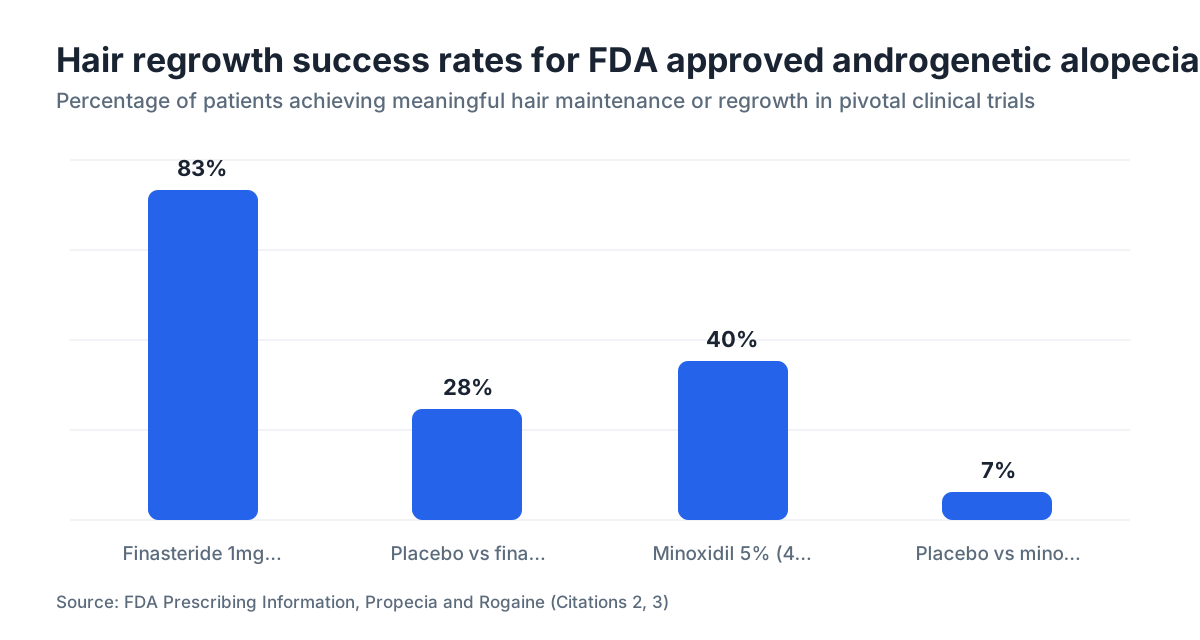
Minoxidil (topical) Topical minoxidil was the first FDA approved hair loss drug, cleared for men in 1988 and for women in 1991 [1]. The 2% solution came first; the 5% foam and solution followed. It prolongs the anagen (growth) phase of the follicle and increases blood flow to the scalp. In 48-week trials, roughly 40% of men on 5% minoxidil showed moderate to dense regrowth versus about 7% on placebo [2]. Women on 2% minoxidil showed meaningful regrowth against placebo in similar controlled studies.
You apply it twice a day. Results take 4 to 6 months to show up. Stop using it and whatever hair you gained falls back out within 3 to 6 months. It doesn't work for everyone. It works better early, and it works better on the crown than the hairline. Minoxidil for men walks through how to apply it so it actually absorbs.
Finasteride (oral, 1mg) Finasteride 1mg (brand name Propecia) got FDA approval for men with androgenetic alopecia in 1997 [3]. It blocks 5-alpha reductase type II, the enzyme that turns testosterone into dihydrotestosterone (DHT), the hormone that shrinks follicles in genetically prone men. In a two-year trial, 83% of men on finasteride kept or gained hair versus 28% on placebo [3]. It is not approved for women, and it's contraindicated in women who are or may become pregnant because of the risk of harming a male fetus.
Finasteride needs a prescription. A dermatologist or GP can write it. Generic versions run about $15 to $30 a month without insurance. Finasteride covers the sexual side effect data honestly.
A note on dutasteride Dutasteride blocks both type I and type II 5-alpha reductase, so it suppresses DHT more completely than finasteride. The FDA approved dutasteride (Avodart) for benign prostatic hyperplasia in men. South Korea approved it for androgenetic alopecia in 2009. In the US it's used off-label for hair loss in men, backed by real trial data but no FDA hair loss indication [4]. Worth raising with a dermatologist if finasteride hasn't done much for you.
| Treatment | FDA Approved for AGA | Who | Year Approved |
|---|---|---|---|
| Minoxidil 2% topical | Yes | Women | 1991 |
| Minoxidil 5% topical/foam | Yes | Men | 1997 |
| Finasteride 1mg oral | Yes | Men | 1997 |
| Dutasteride oral | No (off-label in US) | Men/Women | N/A for hair in US |
| Oral minoxidil | No (off-label) | Men/Women | N/A |
Is oral minoxidil FDA approved?
No. Oral minoxidil (Loniten) is FDA approved for severe hypertension, not hair loss [5]. Doctors prescribe it off-label for hair at far lower doses than the blood pressure use, usually 0.625mg to 2.5mg a day for women and 2.5mg to 5mg a day for men.
Even at these doses the concerns are cardiovascular: fluid retention, a faster heart rate, and rarely more serious cardiac effects. A 2022 systematic review in the Journal of the American Academy of Dermatology pulled together 17 studies on low-dose oral minoxidil and found it effective across several hair loss types with an acceptable safety profile below 5mg, while recommending baseline blood pressure and cardiac screening [6].
The evidence is real and plenty of dermatologists prescribe it. Go in with your eyes open. Oral minoxidil breaks down the dosing, the side effects, and who it suits.
What are the FDA approved treatments for alopecia areata?
Alopecia areata is an autoimmune disease where the immune system attacks hair follicles, causing patchy or total loss. The treatments that work here have nothing to do with the ones for pattern baldness. For decades there were no FDA approved options at all. That changed in 2022 and 2023 with two JAK inhibitor pills.
Baricitinib (Olumiant) In June 2022 the FDA approved baricitinib, a JAK1/JAK2 inhibitor from Eli Lilly, for severe alopecia areata in adults. It was the first FDA approval ever for the condition [7]. Across two Phase 3 trials, BRAVE-AA1 and BRAVE-AA2, 35% to 40% of patients on 4mg reached at least 80% scalp coverage at 36 weeks versus around 5% on placebo [7]. It's a once-daily pill.
The label carries a boxed warning, the FDA's most serious level, for serious infections, cancers, and blood clots, the same warnings the class carries for rheumatoid arthritis. This is not a casual treatment. It's for severe disease that hasn't responded to other things.
Ritlecitinib (Litfulo) In June 2023 the FDA approved ritlecitinib from Pfizer for severe alopecia areata in patients 12 and older, the first approval in this condition for adolescents [8]. It's a JAK3/TEC inhibitor, a slightly different target than baricitinib. In the ALLEGRO Phase 2b/3 trial, 23% of patients on 50mg daily reached at least 80% scalp coverage at 24 weeks versus 2% on placebo [8].
Ritlecitinib also carries a boxed warning for serious infections, cancers, and cardiovascular events. Both drugs need regular physician monitoring.
What about corticosteroids and older treatments? Dermatologists have injected corticosteroids into patches of alopecia areata for decades, and the AAD still lists intralesional steroids as first-line for limited disease [9]. They never went through formal FDA approval for it because they predate the modern framework and no manufacturer bothered to apply. They still work for many people with limited patches and remain the most common first move.
Topical and oral steroids, topical immunotherapy with diphencyprone (DPCP), and anthralin are also used without FDA approval for alopecia areata, leaning on decades of clinical experience and observational data.
How well does minoxidil actually work? What does the trial data say?
Honest answer: it clearly helps a meaningful minority, slows loss in a larger group, and does little for a smaller group. The FDA-reviewed studies showed 5% topical minoxidil produced at least minimal regrowth in roughly 62% of men at 48 weeks, with about 40% hitting moderate to dense regrowth [2]. The 2% numbers are lower, which is why 5% took over for men.
In women, the 2% trials showed statistically significant gains in hair weight and count over placebo, though the effect was smaller than in men. The 5% foam was approved for women in 2014 and edges out 2% in head-to-head comparisons.
Here's the catch. Minoxidil treats the symptom, not the cause. It doesn't touch DHT, the thing driving androgenetic alopecia. The day you stop, the follicles it was propping up start shrinking again. Many people shed more in the first 4 to 8 weeks, which is follicles resetting into a new growth phase, not the drug failing. Telogen effluvium explains that early shed if it rattles you.
Topical side effects are usually local: scalp irritation, dryness, flaking. Systemic absorption stays low at standard doses. Minoxidil side effects covers the rest, including the rare facial hair growth some women see.
How well does finasteride work for hair loss?
Finasteride beats minoxidil for androgenetic alopecia in men, which is why dermatologists usually put it first for men who can tolerate it. A five-year study found 90% of men on finasteride 1mg kept or gained hair count while the placebo group kept losing [3]. The drug knocks scalp DHT down by roughly 60% at 1mg [3], and that directly slows miniaturization.
It works better on the crown and mid-scalp than the hairline. For a badly receding hairline, set expectations: finasteride can slow further recession and sometimes fill a hairline in a little, but rebuilding a dramatically receded hairline with drugs alone almost never happens.
The side effect conversation is real. Sexual side effects, including lower libido, erectile dysfunction, and reduced ejaculate volume, hit roughly 1% to 4% of men in formal trials, and most resolve after stopping the drug [3]. There's ongoing debate about post-finasteride syndrome, where some men report symptoms that persist after quitting. The FDA updated the label in 2012 to note some sexual side effects may continue. That's a legitimate thing to weigh, not something to wave off.
Finasteride plus minoxidil beats either drug alone. A 2021 randomized trial found combination therapy outperformed both monotherapies at 24 weeks, covered in finasteride and minoxidil. If you want the best non-surgical odds, that combination is the standard recommendation.
Finasteride works as a DHT blocker, which is the whole reason it helps. That article maps the DHT pathway in more detail.
Are there FDA approved hair loss treatments for women?
Women have fewer FDA approved options, and that's a genuine gap in the research. Topical minoxidil 2% solution and 5% foam are approved for female pattern hair loss, and they're the main approved choices. Spironolactone, an anti-androgen, gets prescribed off-label by dermatologists for women, especially those with elevated androgens, but it has no FDA approval for hair loss [9].
Dutasteride 0.5mg is approved for female pattern hair loss in some countries. In the US it stays off-label. Finasteride is not FDA approved for women with androgenetic alopecia and is contraindicated in women who are or may become pregnant.
For alopecia areata, both baricitinib (adults) and ritlecitinib (age 12 and up) are approved regardless of sex.
Low-dose oral minoxidil is used off-label in women and has a growing evidence base, often at 0.625mg to 2.5mg a day. Many dermatologists reach for it when topical minoxidil isn't working or isn't tolerated.
What FDA cleared devices exist for hair loss?
This is where the marketing gets slippery. The FDA uses '510(k) clearance' for devices, not the 'approval' process it uses for drugs, and the bar is different. Several low-level laser therapy (LLLT) devices, including the HairMax LaserComb and some laser caps, have 510(k) clearance for promoting hair growth in androgenetic alopecia.
Cleared is not the same as proven to match drugs. The trials behind device clearance are usually smaller and shorter than what drug approval demands. A 2014 randomized trial of the HairMax LaserBand in men showed statistically significant gains in hair density versus a sham device at 26 weeks [10]. The effect is real but generally smaller than what finasteride or combination drug therapy delivers.
LLLT devices run $200 to $900 for home units, need consistent use three to four times a week, and work slowly. They can make sense as an add-on for someone who can't take medications. I wouldn't build a plan around one as the main treatment.
Platelet-rich plasma (PRP) injections have a decent pile of published evidence and get used widely, but they are not FDA approved for hair loss. No PRP system holds a hair regrowth indication. Results swing a lot by protocol, which makes it hard to judge whether it's worth your money.
What about hair supplements? Are any FDA approved?
None. No hair supplement, biotin product, or 'hair vitamin' has FDA approval for treating hair loss. Supplements are regulated as food, not drugs, under DSHEA (the Dietary Supplement Health and Education Act of 1994), so manufacturers don't have to prove they work before selling them [11].
Biotin deficiency can cause hair loss. If you're genuinely deficient (rare in people eating a normal diet), fixing it helps. But megadosing biotin when your levels are fine won't grow hair, and high-dose biotin can throw off thyroid and cardiac lab tests, which alone is reason to be careful [12].
A few ingredients like saw palmetto have thin evidence as mild DHT inhibitors, but the quality sits far below what finasteride has. Hair loss supplements is worth reading before you spend a dollar on any of them.
If you're still sorting out which type of hair loss you have, a free AI hair analysis from MyHairline can map your pattern against the Norwood scale and flag whether the approach you're eyeing actually fits your situation.
How do FDA approved hair loss treatments compare on cost and results?
Here's a straight comparison of the main options, using real price ranges from pharmacy data and results from FDA-reviewed or major peer-reviewed trials.
| Treatment | FDA Status | Monthly Cost (est.) | Regrowth Success Rate | Who It's For |
|---|---|---|---|---|
| Minoxidil 5% topical | Approved | $10-$30 (OTC) | ~40% moderate/dense (men) [2] | Men + women, AGA |
| Finasteride 1mg oral | Approved | $15-$40 (Rx) | ~83% maintain/increase (2yr) [3] | Men, AGA only |
| Finasteride + minoxidil | Off-label combo | $25-$70 | Better than either alone [fn] | Men, AGA |
| Oral minoxidil (low dose) | Off-label | $10-$25 (Rx) | Comparable to topical [6] | Men + women |
| Baricitinib 4mg | Approved | ~$2,000-$3,000 (specialty) | ~35-40% reach 80% coverage [7] | Adults, severe AA |
| Ritlecitinib 50mg | Approved | ~$2,000-$3,000 (specialty) | ~23% reach 80% coverage [8] | Age 12+, severe AA |
| LLLT devices | 510(k) cleared | $200-$900 (one-time) | Modest vs. sham [10] | AGA, adjunct |
| Hair transplant | Surgical | $4,000-$15,000 (one-time) | High for suitable candidates | AGA, advanced loss |
AGA = androgenetic alopecia, AA = alopecia areata. Cost estimates are for US patients without insurance and vary a lot. JAK inhibitors for alopecia areata may be covered with prior authorization.
For people with androgenetic alopecia who've tried the drugs and plateaued, a hair transplant is the only way to fill areas where follicles are gone. Transplants don't stop loss elsewhere, so most surgeons want you stable on medication before or alongside surgery.
What is the FDA's current pipeline for new hair loss drugs?
The JAK inhibitor class that gave us baricitinib and ritlecitinib for alopecia areata is being studied for androgenetic alopecia too, but no JAK inhibitor is approved for pattern baldness yet and the AGA trial results have been mixed.
Deuruxolitinib, another JAK1/2 inhibitor from Concert Pharmaceuticals (now part of Sun Pharmaceutical Industries), showed strong Phase 3 results in alopecia areata and went to the FDA with a New Drug Application in 2023. As of 2024 the FDA had accepted it for review. That could widen the approved menu for alopecia areata.
For androgenetic alopecia the pipeline is thinner. Clascoterone (Winlevi), an androgen receptor inhibitor that's FDA approved for acne, has been tested in small hair loss trials but no company has sought an AGA indication yet. Topical finasteride and topical dutasteride are in development partly to cut systemic side effects, and some versions sell outside the US.
The AAD's clinical guidelines note the field keeps moving and that patients should have their treatment plans reviewed periodically as new evidence lands [9].
When should you see a dermatologist instead of self-treating?
Topical minoxidil sits on the shelf over the counter, so people often start it with zero professional input. That's legal and often fine. But some situations call for a dermatologist first.
See a doctor if your loss is patchy (could be alopecia areata, which needs different treatment), if it came on over weeks instead of years, if your scalp itches, burns, or scales, or if you're a woman with significant loss (many causes need lab work to rule out thyroid disease, iron deficiency, or hormone issues before you start anything).
Starting OTC minoxidil for androgenetic alopecia while you wait for an appointment is generally safe. Starting finasteride on your own is riskier because of the side effect profile and the contraindications you need to rule out.
If you don't know what type of hair loss you have, getting it assessed before you spend money is basic triage. A free AI scan at MyHairline won't replace a dermatologist, but it can help you see where you fall on the Norwood scale and whether your pattern fits androgenetic alopecia before you book.
Sources
- FDA, Drugs section (minoxidil label history)
- FDA, Drugs@FDA database, Rogaine (minoxidil 5%) prescribing information and clinical studies
- FDA, Drugs@FDA database, Propecia (finasteride 1mg) full prescribing information
- Journal of the American Academy of Dermatology (dutasteride for androgenetic alopecia)
- FDA, Drugs@FDA database, Loniten (oral minoxidil) prescribing information
- Journal of the American Academy of Dermatology, 2022 systematic review of low-dose oral minoxidil
- FDA, Olumiant (baricitinib) approval for alopecia areata, June 2022
- FDA, Litfulo (ritlecitinib) approval for alopecia areata, June 2023
- American Academy of Dermatology, hair loss clinical guidelines
- Lasers in Surgery and Medicine, 2014 HairMax LaserBand randomized trial
- FDA, Dietary Supplements section (DSHEA)
- FDA, Medical Devices safety communication on biotin interference with lab tests