
TL;DR: Minoxidil is not a DHT blocker. It works as a potassium-channel opener that widens blood vessels around follicles and extends the anagen (growth) phase. It does not lower DHT levels or block the androgen receptor. If DHT-driven hair loss is your problem, minoxidil alone will not stop the cause, only manage the symptoms.
What does minoxidil actually do to hair follicles?
Minoxidil is a vasodilator. That is the core of what it does. Researchers developed it in the 1970s as an oral drug for high blood pressure, then noticed a consistent side effect: patients grew more hair. That observation became Rogaine, the first FDA-approved topical hair loss treatment, cleared for men in 1988 and women in 1991 [1].
The mechanism, as best science understands it, works two ways. First, minoxidil opens ATP-sensitive potassium channels in vascular smooth muscle cells. That widens the small blood vessels (arterioles) around hair follicles, improving blood flow and oxygen delivery to the dermal papilla, the cluster of cells at the base of a follicle that controls hair growth. Second, and probably more important, minoxidil extends the anagen phase of the hair cycle. Anagen is the active growth phase. A longer anagen means more time for the hair shaft to grow before it sheds [2].
Minoxidil also opens potassium channels in the outer root sheath cells of the follicle itself, which may stimulate those cells to multiply and convert follicles from a resting (telogen) state back into active growth. This is why some people see a short-term shed in the first 4 to 8 weeks of use: dormant follicles get pushed into anagen, and the old telogen hairs fall out to make room. That shed is normal and usually stops [3].
None of this involves testosterone, DHT, or the androgen receptor. Minoxidil does not block any hormone. It does not lower serum DHT. It does not compete with DHT at the receptor. It works on a completely separate pathway from the hormonal cascade that causes androgenetic alopecia (male and female pattern baldness).
What is DHT and why does it cause hair loss?
DHT stands for dihydrotestosterone. It is an androgen hormone produced when the enzyme 5-alpha reductase converts testosterone. DHT binds to the androgen receptor about three to five times more strongly than testosterone itself [4].
In the scalp, androgen-sensitive follicles (mostly along the top and crown) carry androgen receptors. When DHT binds to those receptors, it shortens the anagen phase over successive cycles. Each hair grows back a little thinner and shorter than the one before. Over years, the follicle miniaturizes until it either produces a barely visible vellus hair or stops producing hair at all. That process is androgenetic alopecia, the most common cause of hair loss in both men and women [12].
Genetics decides which follicles are sensitive to DHT and how sensitive they are. That is why some men run high DHT and keep a full head of hair, while others start thinning in their twenties with entirely normal hormone levels. The follicle's sensitivity, more than the hormone level, drives the loss.
DHT does not cause telogen effluvium, traction alopecia, alopecia areata, or nutritional deficiency hair loss. Those run through different mechanisms entirely. If you are unsure what is driving your hair loss, that context matters a lot before you pick a treatment. See our overview of what causes hair loss for a fuller breakdown.
Why minoxidil is not a DHT blocker
This question comes up constantly, and the confusion makes sense. Both minoxidil and DHT blockers like finasteride treat the same condition: androgenetic alopecia. But they work on entirely different parts of the problem.
A true DHT blocker intervenes in the hormonal cascade. Finasteride inhibits the 5-alpha reductase enzyme, which cuts the body's production of DHT by roughly 70% in serum and even more in the scalp [6]. No DHT produced means no DHT available to bind to follicle receptors and trigger miniaturization. The drug treats a root cause of androgenetic alopecia.
Minoxidil does not touch that cascade at all. It has no affinity for the androgen receptor. It does not inhibit 5-alpha reductase. It does not lower serum or scalp DHT. Zero. The FDA label for minoxidil topical solution describes it as a "direct-acting peripheral vasodilator" and makes no mention of hormonal activity [1]. Research in the British Journal of Dermatology concluded that minoxidil's action on hair growth is independent of androgenic pathways [2].
What minoxidil does is create better growing conditions for whatever follicle capacity remains. It is a downstream, supportive treatment. DHT keeps damaging the follicle; minoxidil tries to keep the follicle productive despite the damage. Think of treating a fire versus buying a better smoke alarm. The fire is still burning.
This is not a knock on minoxidil. It maintains and sometimes regrows hair, and the evidence behind it is strong. But calling it a DHT blocker is flatly wrong. If someone is selling you a "DHT-blocking minoxidil" product, that claim is coming from whatever other ingredient they added, not from the minoxidil.
How effective is minoxidil compared to actual DHT blockers?
Comparing these two head-to-head is tricky, because the studies use different endpoints and different populations. But the evidence is solid enough to draw real conclusions.
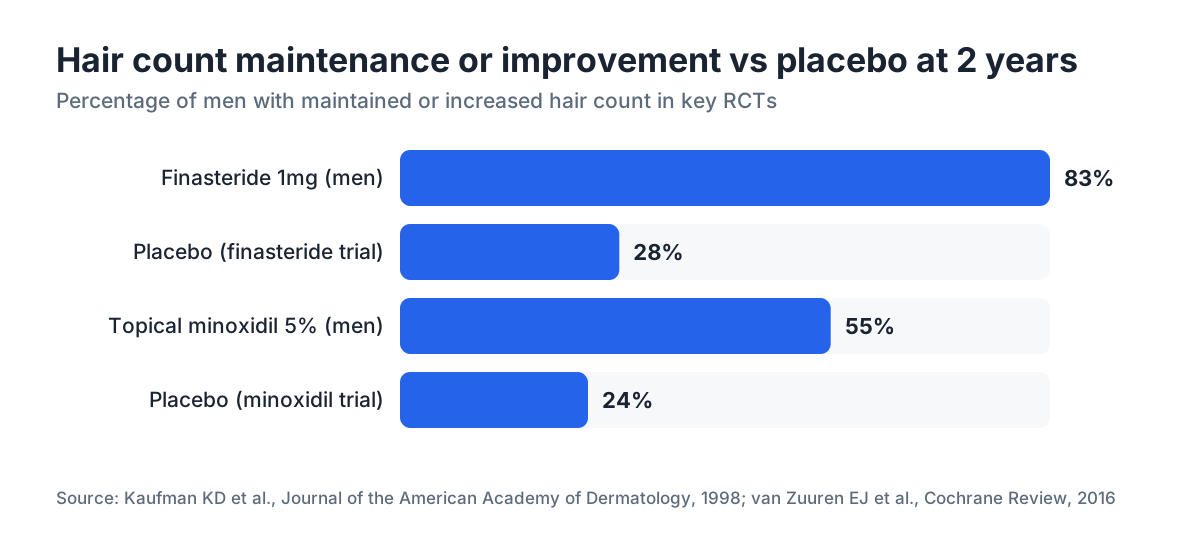
For minoxidil, the FDA registration trial for 5% foam showed that 40% of men rated their hair regrowth as moderate to dense after 16 weeks [1]. A Cochrane systematic review found topical minoxidil significantly more effective than placebo for hair counts and self-assessment in both men and women across multiple trials [3].
For finasteride 1mg, a two-year randomized controlled trial in the Journal of the American Academy of Dermatology found that 83% of men taking finasteride maintained or increased hair count, versus 28% in the placebo group [6]. A separate five-year analysis showed continued efficacy, with around 66% of finasteride users seeing visible regrowth.
Here is what that comparison looks like in practice:
| Treatment | Mechanism | DHT reduction | Hair count vs placebo (2 yr) | Who can use it |
|---|---|---|---|---|
| Topical minoxidil 5% | Vasodilator, anagen extension | None | ~+10-15% [3] | Men and women |
| Finasteride 1mg oral | 5-alpha reductase inhibitor | ~70% serum DHT [6] | +83% maintained or improved [6] | Men (not for women of childbearing potential) |
| Combined (both) | Both mechanisms | ~70% serum DHT [7] | Additive benefit [7] | Men |
The honest read: finasteride has stronger evidence for stopping androgenetic alopecia progression in men. Minoxidil has stronger evidence for stimulating regrowth across both sexes, and it is the only topical option for women. Together, the finasteride and minoxidil combination outperforms either alone.
What are real DHT blockers and how do they work?
A real DHT blocker either inhibits 5-alpha reductase (reducing DHT production) or directly blocks the androgen receptor. The two FDA-approved options in the first category are finasteride and dutasteride.
Finasteride 1mg (sold as Propecia) inhibits type 2 5-alpha reductase, the isoform most active in scalp follicles. It cuts serum DHT by roughly 70% and scalp DHT by around 60 to 70% [6]. The FDA approved it for male pattern baldness in 1997. It is not approved for women of childbearing potential, because DHT suppression during pregnancy can cause fetal abnormalities.
Dutasteride inhibits both type 1 and type 2 5-alpha reductase, cutting serum DHT by around 90 to 95% [8]. It is FDA-approved for benign prostatic hyperplasia but widely prescribed off-label for hair loss. Comparative studies suggest it beats finasteride on hair counts, with one randomized trial showing dutasteride 0.5mg produced significantly higher hair counts than finasteride 1mg at 24 weeks [8].
Some natural compounds, like saw palmetto, show weak 5-alpha reductase inhibition in vitro. The clinical evidence for meaningful DHT reduction in humans is limited and inconsistent. Saw palmetto might be worth trying as an adjunct, but it is not a substitute for finasteride if you need real DHT control. See our article on hair loss supplements for a longer look at the evidence.
For a full breakdown of the DHT-blocking category, including dosing, side effects, and who the drugs suit, see dht blocker.
Can you use minoxidil and a DHT blocker together?
Yes, and for most men with androgenetic alopecia, the combination is the standard of care. The American Academy of Dermatology recognizes both minoxidil and finasteride as first-line treatments, and using them together is explicitly supported [5].
The logic is straightforward. Finasteride attacks the hormonal cause of follicle miniaturization. Minoxidil supports the follicle's ability to grow. They are not redundant. They are complementary. A 2015 randomized controlled trial in Dermatology and Therapy found that men on combination therapy had significantly higher hair counts at 12 months than men on either drug alone [7]. The combination group also scored better on photographic assessment and patient self-evaluation.
For men, the most evidence-backed non-surgical approach is finasteride 1mg daily plus topical minoxidil for men once or twice daily. Add oral minoxidil if the topical doesn't absorb well or irritates your scalp. For women, topical minoxidil is first-line, and a dermatologist may consider spironolactone (an anti-androgen) or low-dose oral minoxidil depending on the clinical picture.
One thing to watch: more treatments means more potential side effects. Minoxidil's main ones are scalp irritation, initial shedding, and in rare cases unwanted facial hair. Finasteride carries a risk of sexual side effects in a minority of men. Know what you are signing up for. Our breakdown of minoxidil side effects covers the topical risks in detail.
Does minoxidil stop working if DHT keeps damaging follicles?
This is one of the most honest and underappreciated questions about minoxidil. Short answer: yes, for most people, minoxidil alone will eventually lose ground to androgenetic alopecia if DHT is the underlying driver.
Minoxidil does not stop follicle miniaturization. It improves the growth environment. But if DHT keeps shortening the anagen phase and shrinking follicle size cycle by cycle, there comes a point where the follicle is too miniaturized to respond to minoxidil's vasodilatory signal. The drug needs a functioning follicle to work with. Once the follicle is gone or dormant beyond recovery, topical treatments cannot bring it back.
This is why early treatment matters. Studies consistently show better outcomes when treatment starts before significant miniaturization has set in. Using minoxidil on a Norwood 2 or 3 is a different game from trying it on a Norwood 6 with decades of miniaturization. See receding hairline for how to figure out where you are in the process.
The practical takeaway: if you are using minoxidil and still losing ground, that is not necessarily a sign minoxidil has failed. It may mean minoxidil cannot compensate for ongoing DHT activity and you need to add a DHT blocker. Stopping minoxidil, for the record, generally causes shedding within 3 to 4 months as follicles return to their pre-treatment state. There is no evidence that minoxidil use permanently resets the hair cycle.
Are there any minoxidil products that also block DHT?
Some products combine minoxidil with other ingredients marketed as DHT-reducing compounds. Common additions include ketoconazole, saw palmetto, caffeine, and biotin.
Ketoconazole is the most interesting one. It is an antifungal with weak anti-androgenic activity. A small but frequently cited 1998 study in the journal Dermatology found that 2% ketoconazole shampoo produced hair density improvements similar to 2% minoxidil solution over 6 months in men with androgenetic alopecia [9]. The proposed mechanism involves reducing scalp DHT locally by inhibiting cytochrome P450 enzymes involved in androgen metabolism, though the evidence is not definitive and the effect is much weaker than finasteride. Ketoconazole at 2% needs a prescription in some countries.
Saw palmetto extracts show weak 5-alpha reductase inhibition in lab settings, but the human trials are small and the results are mixed. Nobody has shown in a well-powered RCT that topical saw palmetto meaningfully reduces scalp DHT levels or prevents androgenetic alopecia progression.
The honest take: if a product pairs minoxidil with something genuinely anti-androgenic (like ketoconazole), that combination may offer marginal benefit beyond minoxidil alone. But the minoxidil itself is still doing zero DHT blocking. The label matters. If a manufacturer claims the product "blocks DHT" without naming which ingredient supposedly does that, be skeptical.
For the most thorough picture of which ingredients have real evidence behind them, the dht blocker article ranks the evidence.
How do you know which treatment is right for your situation?
Choosing between minoxidil, a DHT blocker, or both starts with understanding what is actually causing your hair loss.
Androgenetic alopecia (pattern baldness) is driven by DHT and genetics. If that is your diagnosis, DHT-blocking is the more targeted move, and adding minoxidil on top makes sense. Pattern baldness follows predictable paths: the Norwood scale for men, the Ludwig scale for women.
If your hair loss is diffuse, sudden, or tied to a health event, stress, or nutritional deficiency, it is probably telogen effluvium, and neither minoxidil nor DHT blockers address the root cause. You need to fix the trigger.
A proper diagnosis before spending money on treatments is worth it. A dermatologist can do a pull test, dermoscopy, or scalp biopsy if the cause is unclear. If you want a fast, free starting point, MyHairline's AI hair scan at myhairline.ai/scan reads your hairline photos and gives you a Norwood stage estimate and personalized information about your pattern, which sets up a much more productive conversation with a doctor.
Some people get a sense of their situation from photos and Norwood charts alone, and that is fine as a first step. But a real clinical assessment is the only way to rule out less common causes and confirm the diagnosis before committing to long-term medication.
Creatine is worth a mention here too. There is some evidence it may raise DHT levels, which comes up for men who lift and notice shedding after starting a creatine protocol. The does creatine cause hair loss article covers that specific angle.
What happens if you stop minoxidil or a DHT blocker?
Both treatments require ongoing use to hold results. Neither one permanently reverses androgenetic alopecia.
Stop minoxidil, and within about 3 to 4 months you typically return to where your hair loss would have been without treatment. The hair that regrew on minoxidil sheds, because those follicles leaned on the drug's vasodilatory signal to stay in anagen. This is not rebound hair loss in a destructive sense. It is the hair returning to its baseline state.
Stop finasteride, and DHT rebounds fast. Serum DHT typically returns to pretreatment levels within about 14 days of stopping the drug. Loss resumes, and within a year or two most of the hair finasteride preserved will be gone. A systematic review in the BMJ found that discontinuation of finasteride was associated with significant hair loss within 12 months in men who had used it long-term [10].
This is the conversation often missing from drug marketing. These are maintenance treatments, not cures. The only intervention that permanently moves follicles out of DHT-sensitive scalp zones is a hair transplant, where follicles from the DHT-resistant donor area (usually the back and sides of the scalp) are relocated to thinning areas. Those transplanted follicles carry their original genetic DHT resistance with them and usually survive long-term, though any native hairs in the recipient area keep getting hit by DHT.
If you are thinking of stopping either drug because of side effects, talk to a dermatologist first. Sometimes adjusting the dose or formulation fixes the issue without giving up the hair benefit.
The bottom line on minoxidil and DHT
Minoxidil works. It has real, replicated, FDA-backed evidence for hair maintenance and regrowth. But it works through a completely different mechanism than DHT blockade, and confusing the two leads to worse treatment choices.
If you have androgenetic alopecia and you are using minoxidil alone, you are managing the downstream effects of DHT on your follicles while DHT keeps miniaturizing them. That can hold for a long time, especially if you catch it early. But for most men, adding a 5-alpha reductase inhibitor like finasteride produces better long-term outcomes, and the evidence is fairly clear.
For women, the picture is different. Finasteride and dutasteride are generally not recommended for women of childbearing age, and the hormonal drivers of hair loss in women are more complex anyway. Topical minoxidil stays the first-line recommendation from the AAD for women with androgenetic alopecia, with low-dose oral minoxidil gaining traction for those who prefer a pill [5]. See oral minoxidil for a detailed look at that newer route.
MyHairline's free AI hair scan gives you a fast starting-point read on your pattern type, which makes it easier to have an informed conversation with a dermatologist about whether you need just minoxidil, a DHT blocker, or both.
The short version: minoxidil and DHT blockers are not competing answers to the same question. They answer different parts of the same problem. Used together, they are the most effective non-surgical approach available for androgenetic alopecia.
Sources
- FDA, Rogaine (minoxidil) 5% Topical Foam label
- Messenger AG, Rundegren J. Minoxidil: mechanisms of action on hair growth. British Journal of Dermatology, 2004
- van Zuuren EJ et al. Interventions for female pattern hair loss. Cochrane Database of Systematic Reviews, 2016
- Imperato-McGinley J et al. Androgens and the evolution of male-gender identity. New England Journal of Medicine, 1979
- American Academy of Dermatology, Hair loss: diagnosis and treatment guidelines
- Kaufman KD et al. Finasteride in the treatment of men with androgenetic alopecia. Journal of the American Academy of Dermatology, 1998
- Hu R et al. Combined treatment with oral finasteride and topical minoxidil in male androgenetic alopecia: a randomized and comparative study in Chinese patients. Dermatology and Therapy, 2015
- Olsen EA et al. The importance of dual 5alpha-reductase inhibition in the treatment of male pattern hair loss: results of a randomized placebo-controlled study of dutasteride versus finasteride. Journal of the American Academy of Dermatology, 2006
- Piérard-Franchimont C et al. Ketoconazole shampoo: effect of long-term use in androgenic alopecia. Dermatology, 1998
- van Zuuren EJ et al. Treatments for androgenetic alopecia and alopecia areata: systematic review. BMJ, 2012
- Bassino E et al. Inhibitory effects of minoxidil on vascular smooth muscle cells: role of ATP-sensitive potassium channels. British Journal of Pharmacology, 2015
- van Zuuren EJ. Alopecia Areata. New England Journal of Medicine, 2012