TL;DR: Topical minoxidil 2% and 5% are FDA-approved over-the-counter treatments for androgenetic alopecia in the US. You can buy them at any pharmacy without a prescription. Oral minoxidil is a different story: it still needs a prescription. Foam and solution both work, and generic versions cost a fraction of brand-name Rogaine.
Is minoxidil available over the counter in the US?
Yes. The FDA approved topical minoxidil 2% for over-the-counter sale for women in 1992, and cleared the 5% strength for men in 1996 [1]. Both strengths have sat on pharmacy shelves ever since, no prescription needed. You walk in, pick it up, pay, leave.
The brand most people recognize is Rogaine. But the patent on minoxidil expired long ago, and dozens of generics now sell the same active ingredient at the same concentrations for far less. CVS, Walmart, Costco, and Amazon all carry house-brand versions. The active ingredient is chemically identical.
One thing worth being clear about: the OTC approval covers only the topical form at those specific strengths. The 5% foam is approved for men, the 2% solution is approved for women, and the 5% solution is labeled for men though some dermatologists recommend the 5% for women off-label. Anything past that, oral minoxidil included, sits in different regulatory territory.
Does minoxidil require a prescription for any form or strength?
Oral minoxidil does. It was originally developed as an oral blood pressure medication and the FDA never approved it specifically for hair loss. Dermatologists prescribe it off-label for androgenetic alopecia, usually at very low doses between 0.625 mg and 5 mg per day, which are far below the doses used for hypertension [2]. Because it's a prescription drug in its oral form, you need a doctor to order it.
High-concentration topical formulas also need a prescription. Some compounding pharmacies make topical minoxidil at 10% or even 15%, sometimes combined with other ingredients. Those aren't FDA-approved OTC products. A prescriber has to authorize them.
If a website sells oral minoxidil or high-concentration topical minoxidil without asking you to complete a medical intake or speak with a licensed clinician, that's a red flag. Legitimate telehealth platforms route oral prescriptions through an actual licensed physician.
The short version: topical 2% and 5% are OTC anywhere in the US. Everything else needs a prescription. If you're curious about the oral version specifically, the evidence and risk profile look meaningfully different from topical, and it's worth reading up separately on oral minoxidil before you decide.
How does the FDA classify OTC minoxidil, and what does that mean for you?
The FDA's OTC drug monograph system is what makes topical minoxidil available without a prescription. Under that system, active ingredients proven safe and effective at specific doses can be marketed by any company without individual product approval, as long as the label follows the monograph [1]. That's why hundreds of generic minoxidil products exist and they're all legal.
The FDA labeling for OTC topical minoxidil specifies it for "hereditary hair loss" (androgenetic alopecia). The label also requires specific warnings: not for use in people under 18, not for use if there's no family history of hair loss, and a recommendation to consult a doctor if hair loss is sudden, patchy, or comes with other symptoms [1].
Those label requirements exist for a reason. Minoxidil doesn't work on every type of hair loss. If you're losing hair because of telogen effluvium, a thyroid problem, or a nutritional deficiency, applying minoxidil is mostly wasted effort. The drug targets androgenetic alopecia specifically: the genetically programmed miniaturization of hair follicles.
OTC status doesn't mean the drug fits every person or every situation. It means the FDA decided the safety profile is acceptable for self-directed use at those concentrations when the person follows the label.
What does minoxidil actually do, and how well does it work?
Minoxidil is a vasodilator. The working theory is that it widens blood vessels around hair follicles, increasing blood flow and nutrient delivery, and possibly stretching the anagen (growth) phase of the hair cycle. The precise mechanism isn't fully settled, but the clinical results are real and well-documented.
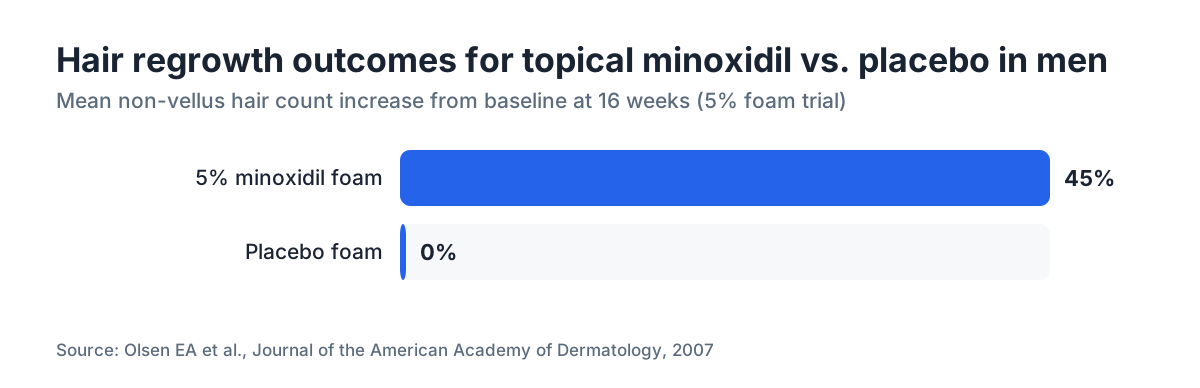
The main trial supporting the 5% foam approval found it produced 45% more hair regrowth than placebo after 16 weeks in men [3]. A separate Cochrane review of 5% solution versus placebo found statistically significant improvements in patient self-assessment and investigator-rated hair counts [4]. These aren't dramatic transformations for most people. You're looking at slowed loss, maintained coverage, and in some cases modest regrowth, mostly at the crown.
Here's the part people miss: results take time. Most clinical trials run 16 to 52 weeks before measuring outcomes, because hair cycles are slow [3]. People who quit after two months because they see nothing are almost certainly quitting too soon. Assess results at 6 to 12 months, not before.
Minoxidil also does nothing to stop the hormonal process driving androgenetic alopecia. DHT blockers like finasteride target the hormonal cause; minoxidil works around it by stimulating the follicle directly. The two mechanisms differ enough that combining them often beats either alone. There's trial evidence backing combination therapy, worth a look if you're serious about keeping your hair long-term [5]. See the section below on finasteride and minoxidil together.
What are the real costs of OTC minoxidil?
Generic topical minoxidil is cheap. A three-month supply of 5% solution usually runs $10 to $20 at major retailers. The 5% foam costs more, usually $25 to $50 for a similar supply, partly because foam formulas carry a patent premium in some products and partly because propellant-based packaging costs more to make.
Brand-name Rogaine runs about $40 to $60 for a two-month supply of foam. The active ingredient is the same as a $12 generic. You're paying for the name. If budget is tight, buy the generic.
Oral minoxidil, being prescription-only, has a different cost structure. The drug itself is cheap (minoxidil tablets have been generic for decades), but you're paying for a medical visit or telehealth consultation. Telehealth platforms that prescribe it often fold the consultation into a monthly subscription of $20 to $50, though prices vary a lot.
Insurance usually doesn't cover minoxidil for hair loss, topical or oral, because it counts as cosmetic treatment. Some FSA and HSA plans do allow the expense; check with your plan administrator.
The cost reality is this: stay on topical minoxidil for 10 years at $15 a month on generic and you've spent about $1,800 total. A hair transplant for similar coverage runs $4,000 to $15,000 upfront. Both have their place. They're not competing in the same tier.
Minoxidil solution vs. foam: which OTC version is better?
Both work. The clinical evidence doesn't show one clearly beating the other when the same concentration goes head-to-head, though most of the long-term data was built on the solution because it came first.
The practical differences matter more for most people. Solution contains propylene glycol, which some scalps find irritating. It can leave a residue and takes longer to dry. Foam skips the propylene glycol, dries faster, and is easier to apply without dripping. If you've tried solution and the scalp irritation drove you nuts, foam is the obvious next move.
Solution is cheaper, though, and its generic supply tends to be more consistent. If cost is your priority and your scalp handles it fine, solution is perfectly reasonable.
One practical tip gets overlooked: foam works best on a slightly damp scalp, pressed in with fingertips rather than rubbed hard. Solution goes on a dry scalp using the applicator that comes with the bottle. Neither method wins outright as long as the product reaches the scalp skin, more than the hair shafts.
Who should and shouldn't use OTC minoxidil?
The FDA label says OTC topical minoxidil is for adults 18 and older with a hereditary pattern of hair loss. If your hair loss fits that (gradual thinning at the crown or recession at the temples that matches a parent or grandparent), OTC minoxidil is a reasonable starting point.
It works less reliably on a receding hairline than on the crown. The hairline and temples respond more slowly and less completely in most people, which is frustrating if a receding hairline is your main concern. Crown thinning is where minoxidil shows its best results consistently.
You probably shouldn't lean on OTC minoxidil alone if your hair loss is rapid, asymmetric, patchy, or comes with itching, scaling, or pain. Those patterns point to something other than androgenetic alopecia and deserve a dermatologist visit before you start self-treating.
Pregnant women should not use minoxidil. Animal studies show teratogenic effects, and while systemic absorption from topical use is low, the label is clear it's not safe during pregnancy [1].
People with heart conditions, especially those on blood pressure medications, should check with their doctor before using even the topical form. Systemic absorption from topical minoxidil is real (estimated at roughly 1-2% of the applied dose) [6], and in people with cardiovascular sensitivity that small systemic effect can matter. For nearly everyone else, topical minoxidil at OTC strengths has a solid safety record over decades of use.
What are the most common side effects of OTC minoxidil?
The side effect people hit most often is scalp irritation: dryness, itching, and flaking. This happens more with solution than foam, often thanks to the propylene glycol in the solution formula. Switching to foam clears it up for many people.
About 5-7% of users see initial shedding in the first 4 to 8 weeks after starting [7]. This is called telogen effluvium and it isn't a sign the product is hurting you; it's the hair cycle resetting, with resting hairs shedding to make room for new growth. It almost always resolves on its own. The trouble is it makes many people quit right before the treatment would have started working.
Unwanted facial hair growth is a real side effect, especially in women using 5% concentrations. Minoxidil doesn't distinguish between the scalp and any other skin the solution touches during application; if product runs down the face or forehead and sits there, some facial hair can result. Careful application and washing your hands right after use keeps this to a minimum.
Serious cardiovascular side effects are rare with topical application at OTC strengths, but they exist in theory because of systemic absorption. Fast heartbeat, chest pain, or sudden unexplained weight gain from fluid retention should prompt a call to a doctor. For a full breakdown of what to watch for, the minoxidil side effects guide covers each one in detail.
Can women use OTC minoxidil, and which strength?
Yes. The 2% solution is FDA-approved specifically for women and the 5% foam carries OTC approval for women too [1]. The 5% solution is labeled for men, but dermatologists frequently recommend 5% formulas for women off-label, especially those with more advanced androgenetic alopecia.
The evidence that 5% beats 2% for women is real. A randomized trial in the Journal of the American Academy of Dermatology found women using 5% solution had significantly greater hair regrowth than those on 2%, though with a higher rate of facial hair as a side effect [8]. The American Academy of Dermatology lists both topical minoxidil concentrations as a recommended treatment for female pattern hair loss [9].
If you're a woman starting for the first time, beginning with the 2% or the 5% foam is reasonable. The foam tends to cause less facial hair because it dries faster and is less likely to run. If you don't see enough by 6 months, the move to 5% is worth discussing with a dermatologist.
Women curious about how to use minoxidil and what to expect can find the evidence-based breakdown in the minoxidil for men article (which covers both sexes despite the title).
What happens if you stop using minoxidil?
The hair you kept with minoxidil will shed. This is the single most important thing to understand before you start.
Minoxidil doesn't cure androgenetic alopecia. It manages it. When you stop, the follicles the drug was propping up drift back toward their pre-treatment miniaturization. Most people see noticeable shedding within 2 to 4 months of stopping, and within a year the scalp generally lands back where it would have been without treatment [4].
This isn't a flaw. Every maintenance medication works this way. You don't get to keep the benefit once you stop. Start minoxidil and you're signing up for ongoing use, probably indefinitely, if you want to hold the results. Factor that into the decision before you start, not after.
Some people find this unacceptable and prefer a more definitive option like a hair transplant. Others are fine with the trade-off. Both are reasonable. The practical middle ground for people who want to cut their medication burden is combining low-dose finasteride (which hits the hormonal cause more directly) with minoxidil, then potentially scaling back the minoxidil if the finasteride holds the line. Talk to a dermatologist before making that call.
If you're wondering whether your hair loss pattern has gotten worse and want a baseline before starting or stopping treatment, MyHairline's free AI scan can give you a Norwood stage estimate and flag how your hairline has changed over time.
Where can you buy OTC minoxidil and what should you look for on the label?
You can buy OTC topical minoxidil at any major pharmacy (CVS, Walgreens, Rite Aid), big-box retailers (Walmart, Target, Costco), and online (Amazon, and direct from retailers). No pharmacist consultation required; it sits on the shelf like any other OTC product.
When you grab it, here's what to confirm on the label. The active ingredient should read "minoxidil 5%" (or 2% if you're buying the lower strength). The Drug Facts panel should follow the OTC Drug Facts format, which the FDA requires for all OTC drug products [1]. No Drug Facts panel means it isn't properly labeled as an OTC drug, and you should skip it.
Watch out for products marketed as "hair growth serums" or "regrowth treatments" that bury minoxidil in an ingredient list packed with botanicals. Sometimes these are fine, sometimes the minoxidil concentration is too low to do anything, and sometimes the claimed benefits come from the minoxidil while the rest is filler. If the Drug Facts panel clearly shows minoxidil at 5% or 2% as the only active ingredient, you're good. If it's listed as an inactive ingredient or at some unlisted concentration, walk away.
Generic is fine. The FDA requires bioequivalence for generic drugs, meaning the active ingredient must reach the same concentration at the same rate as the reference product [10]. A $10 Walmart generic is held to the same standard as $50 Rogaine.
Is OTC minoxidil enough, or do you need something stronger?
For early-stage androgenetic alopecia (Norwood 1-3 in men, Ludwig 1-2 in women), OTC topical minoxidil is a reasonable starting point that evidence supports. Low cost, low risk, well-studied.
For people further along, or anyone who's tried OTC minoxidil for 12 months with no meaningful response, the honest answer is that topical minoxidil alone probably won't cut it. At that point the options widen: adding finasteride to hit the hormonal driver, switching to or adding oral minoxidil for potentially greater systemic effect, or asking a dermatologist whether a hair transplant fits your situation.
Combining finasteride and topical minoxidil has the most evidence behind it for men with androgenetic alopecia. A randomized trial in Dermatologic Therapy found combination therapy produced significantly greater hair density than either drug alone [5]. Mechanically that's no surprise: they work differently, so their effects stack. The combination isn't for everyone, particularly men worried about finasteride's sexual side effects, but the efficacy data is real.
People sometimes ask about hair loss supplements as an alternative or add-on. The evidence for most supplements is far weaker than for minoxidil. Biotin, saw palmetto, and similar products have limited clinical data for androgenetic alopecia, and none are FDA-approved for hair loss. Minoxidil is the evidence-based standard for OTC treatment.
If you're uncertain where you fall on the hair loss spectrum, a structured look at your own pattern helps. The AI hair analysis at MyHairline is free and takes about two minutes.
Sources
- FDA, Over-the-Counter (OTC) Monographs (Hair Growth Drug Products for OTC Human Use)
- American Academy of Dermatology, Hair Loss: Diagnosis and Treatment
- Olsen EA et al., "A multicenter, randomized, placebo-controlled, double-blind clinical trial of a novel formulation of 5% minoxidil topical foam versus placebo in the treatment of androgenetic alopecia in men," Journal of the American Academy of Dermatology, 2007
- Minoxidil for androgenetic alopecia, Cochrane Database of Systematic Reviews
- Hu R et al., "Combined treatment with oral finasteride and topical minoxidil in male androgenetic alopecia: a randomized and comparative study," Dermatologic Therapy, 2015
- DailyMed (US National Library of Medicine), Minoxidil Topical Solution Drug Label
- Rossi A et al., "Minoxidil use in dermatology, side effects and recent patents," Recent Patents on Inflammation & Allergy Drug Discovery, 2012
- Olsen EA et al., "5% minoxidil versus 2% minoxidil and placebo in the treatment of female androgenetic alopecia," Journal of the American Academy of Dermatology, 2002
- American Academy of Dermatology, Hair Loss in Women
- FDA, Generic Drugs Overview