
TL;DR: Minoxidil can slow a receding hairline and produce visible regrowth for roughly 40 to 60% of men who use it consistently. It works best on early recession and poorly on long-dead bald zones. You have to use it forever: any hair you gain sheds within months of stopping. And it never blocks DHT, the hormone driving most male pattern loss.
Does a receding hairline mean you're going bald?
Not automatically. But usually yes, if the recession is pattern-related.
A hairline can recede for several reasons: androgenetic alopecia (male or female pattern hair loss), traction from tight styles, a thyroid problem, or a bout of telogen effluvium triggered by illness or crash dieting. The job is figuring out which one you're looking at.
Male pattern hair loss, driven by dihydrotestosterone (DHT) binding to follicle receptors on the scalp, is by far the most common cause in men. The American Academy of Dermatology estimates it affects roughly 50 million men in the United States [1]. If your recession follows the classic M-shape, or if it runs in your family, odds are high it's androgenetic alopecia. And without treatment, it will almost certainly keep progressing.
A receding hairline still doesn't mean your whole scalp goes bare. Androgenetic alopecia is graded on the Norwood scale from I (no recession) to VII (only a horseshoe fringe remains). Plenty of men stabilize at Norwood II or III for decades. Genetics decide roughly where you'll land, but the timeline is anyone's guess. Here's the practical part: if recession is new or actively getting worse, see a dermatologist to confirm the cause before you spend money on treatment. See what causes hair loss for a fuller breakdown of the possible triggers.
How does minoxidil work on hair follicles?
Minoxidil started life as an oral drug for high blood pressure. Patients on it grew unexpected hair, researchers worked out why, and a topical version reached shelves in 1988 as the first FDA-approved treatment for androgenetic alopecia [8].
The drug is a potassium-channel opener. It widens blood vessels in the scalp, which improves blood flow and nutrient delivery to follicles. It also appears to prolong the anagen (active growth) phase and shorten the resting phase, so more follicles are growing at any given moment [9]. What it does not do is block DHT. The hormone shrinking your follicles keeps working while minoxidil partially counteracts one downstream effect.
That distinction matters enormously for receding hairlines. DHT-sensitive follicles at the temples and frontal scalp keep miniaturizing while you're on minoxidil alone. You may slow the visible loss and regrow some fine hairs, but the cause is still running in the background. That's why many dermatologists pair minoxidil with a DHT blocker like finasteride for pattern-related recession, a combination covered in more detail in the finasteride and minoxidil article.
What does the evidence say about minoxidil for frontal baldness and a receding hairline?
Here's where honesty matters: minoxidil has a noticeably stronger evidence base for the vertex (crown) than for the frontal scalp and temples.
The original FDA-approval trials focused on vertex hair counts, and most later studies followed the same convention. A 2002 randomized controlled trial in the Journal of the American Academy of Dermatology found 5% topical minoxidil significantly outperformed 2% and placebo on vertex hair count, but frontal data were secondary endpoints with more variance [3]. The FDA label for 5% foam states that "hair regrowth has not been demonstrated in patients who have had no hair for long periods" and that the product is "not intended for frontal baldness or a receding hairline" [8].
That language comes from the original indication and the original approval population, not from any proof of absence. Real-world practice has moved past it. Multiple observational studies and off-label use data show meaningful response in the frontal region, especially when recession is recent and follicles are still miniaturized rather than fully gone. A 2020 review in Dermatology and Therapy concluded that minoxidil produces "clinically meaningful improvements" in frontal hair density in both men and women with androgenetic alopecia, though response rates at the temples run lower than at the vertex [4].
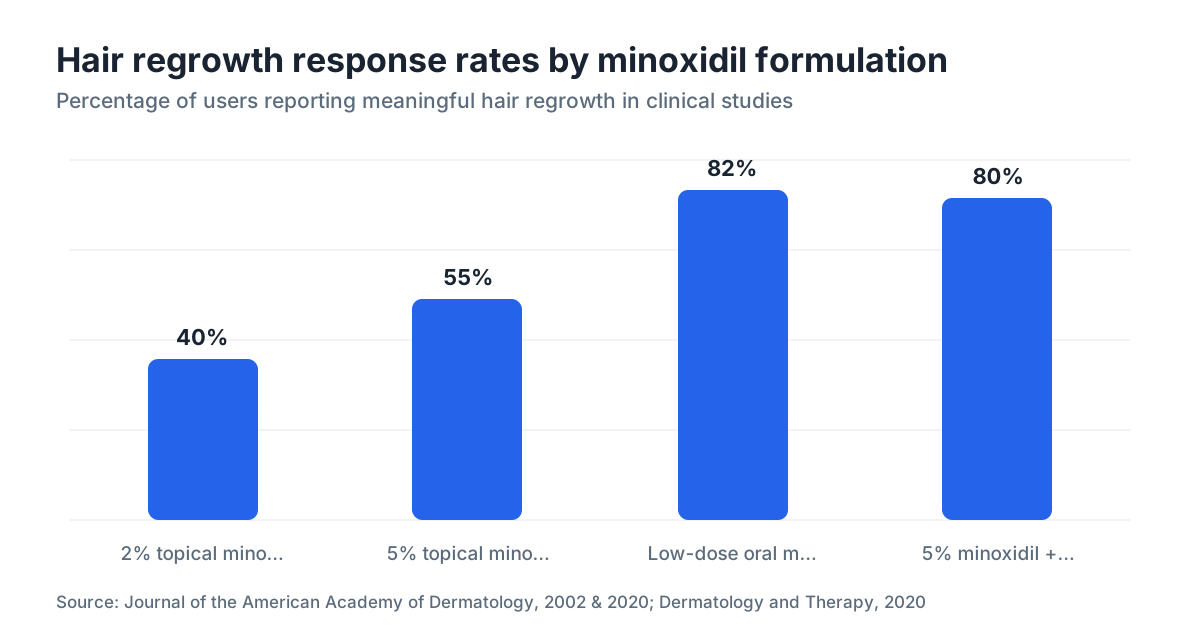
The honest number: roughly 40 to 60% of users see meaningful regrowth with consistent use, across all scalp zones. Results are better in men who start early (Norwood II, III) and worse in men whose hairline recession has been sitting there for years [1][4].
For how topical minoxidil compares to the oral version, see oral minoxidil. The oral form is gaining ground precisely because it delivers minoxidil systemically, including to the frontal scalp, at lower doses than the old hypertension pills.
Which minoxidil formulation is best for a receding hairline?
You have three real options: 2% topical solution, 5% topical solution or foam, and low-dose oral minoxidil.
The 5% formulation beats 2% on hair count in head-to-head trials [3]. For men, 5% foam or solution is the standard starting point. The FDA has approved 5% topical minoxidil for men and 2% for women, though dermatologists routinely prescribe 5% off-label for women with pattern loss too [8].
Topical foam absorbs faster and has less propylene glycol, the ingredient most often blamed for scalp irritation and contact dermatitis with solutions. If the solution has burned or itched, try the foam.
Oral minoxidil, at doses of 0.25 to 2.5 mg per day for hair loss (far below the 10 to 40 mg used for hypertension), is increasingly used off-label and is the subject of a growing pile of trials. A 2020 retrospective study in the Journal of the American Academy of Dermatology found that low-dose oral minoxidil (0.25 to 5 mg daily) produced hair regrowth in 82% of patients, with the frontal scalp responding alongside the vertex [5]. It isn't FDA-approved for hair loss in oral form, which means cost and prescriber access vary widely.
For the full breakdown of topical and oral options, see minoxidil for men.
| Formulation | Approved dose (men) | Frontal evidence | Key downside |
|---|---|---|---|
| 2% topical solution | OTC, FDA-approved | Weaker than 5% | Less effective |
| 5% topical solution | OTC, FDA-approved | Moderate, better than 2% | Propylene glycol irritation |
| 5% topical foam | OTC, FDA-approved | Comparable to solution | Slightly higher cost |
| Oral minoxidil (0.25 to 2.5 mg) | Off-label, Rx only | Emerging evidence, promising | Requires prescription, systemic effects |
How do you apply minoxidil to a receding hairline correctly?
Application technique gets skipped constantly, and it matters more than people think.
For topical 5% solution, the standard dose is 1 mL twice daily on a dry scalp. Not on the hair. On the scalp. Part your hair to expose the receding zones, use the dropper or applicator to place the liquid on the skin, then spread it lightly with your fingertips. Wash your hands right after. The FDA label says the scalp must be completely dry before application and you should wait at least four hours before getting it wet [8].
For 5% foam, the dose is half a capful twice daily. Dispense it onto your fingers (not straight from the can onto your head) and work it into the receding areas.
The frontal hairline and temples need deliberate attention. These zones are thinner-skinned and the part is less obvious than at the crown. Many people find it easier to apply to the frontal region with a fingertip, pressing gently to push the product to the scalp instead of leaving it sitting on the hair shaft.
Twice daily is the studied regimen. Once daily works for many people, and some dermatologists suggest starting there to build the habit, but the trials used twice-daily dosing. Consistency beats perfect timing. Missing the odd dose won't ruin your results. Missing weeks at a stretch will.
When will you see results, and what does early shedding mean?
This is where people quit early and waste the money they've already spent.
In the first two to eight weeks, many users shed more, not less. It's called the telogen effluvium response to minoxidil, and it happens because the drug pulls resting hairs into an active phase, forcing older telogen hairs out to make room for new anagen growth. It looks alarming. It isn't a sign the drug is hurting you. It's a sign it's working. The shed usually peaks around six weeks and settles by three to four months [4].
Visible regrowth begins, on average, at around three to four months of consistent use. Meaningful density improvements take six months to a year. The AAD recommends giving any hair loss treatment at least a full year before you judge it [1].
For a receding hairline specifically, set expectations carefully. You might see fine vellus hairs in previously bare zones, some thickening of miniaturized hairs, and slower recession. Full restoration of a badly receded hairline is not realistic on minoxidil alone. If early shedding or other reactions worry you, minoxidil side effects has the full breakdown.
What happens if you stop using minoxidil?
Any hair you kept or regrew with minoxidil sheds within two to four months of stopping.
This isn't a flaw in the drug. It's just how it works. Minoxidil doesn't repair or permanently rescue follicles. It creates conditions where follicles perform better. Remove those conditions and the follicles snap back to their DHT-driven trajectory. The FDA label is blunt about it: "Continuous use is required to maintain hair regrowth" [8].
For men with androgenetic alopecia, that effectively means treatment for life if you want to keep the benefit. It's a real commitment of time and money, roughly $20 to $50 a month for over-the-counter topical products, so it's worth thinking through before you start rather than after you've regrown hair you then watch fall out.
People who decide the indefinite commitment isn't for them, or whose recession is already deep, often look at hair transplant options as a different kind of answer.
Does minoxidil work better with finasteride for a receding hairline?
The combination is meaningfully more effective than either drug alone.
A randomized controlled trial in Dermatologic Therapy compared minoxidil alone, finasteride alone, and the two together in men with androgenetic alopecia. The combination group had statistically significantly greater increases in hair count and diameter than either monotherapy [6]. The logic is clean: finasteride blocks DHT production (cutting the cause), while minoxidil improves the follicular environment (blunting one effect).
For a receding hairline, finasteride has better frontal scalp evidence than minoxidil alone. Finasteride's FDA approval includes both vertex and anterior scalp data, and the drug reduces scalp DHT by roughly 60 to 70%, which is the dominant driver of temple and hairline recession in androgenetic alopecia [10].
Finasteride carries its own side effect profile, including sexual side effects in a subset of men, and it isn't appropriate for women of childbearing potential because of teratogenicity risk. Read finasteride for the full picture before you decide.
If you're trying to work out where you sit on the Norwood scale and whether your recession justifies a second drug, a free AI hair analysis at MyHairline gives you a baseline read before your dermatologist appointment.
Who is minoxidil least likely to help with hairline recession?
Minoxidil works on living, miniaturized follicles. It does not revive follicles that have been gone long enough to be replaced by scar tissue.
The FDA label cautions that the product is "not for use in persons with no hair or predominant frontal hair loss" [8]. In plain terms: if your temples have been fully bare for several years, with no visible hair shadow or fine vellus regrowth under a magnifying glass, the follicle may be past saving.
Other factors that predict a weaker response: starting at Norwood V or above, being older than 60 (though age alone doesn't rule you out), heavy inflammation or scarring from conditions like lichen planopilaris, or non-androgenetic hair loss that minoxidil was never built to address.
Nobody has perfectly clean data on exact age or recession-duration cutoffs. The closest we get is the trial literature, which consistently shows better response in younger men with earlier-stage loss [4][5]. If you're unsure whether your hairline recession has gone too far for minoxidil to matter, a dermatologist can run dermoscopy and trichoscopy to check follicle viability directly.
Are there alternatives or additions worth considering?
Minoxidil and finasteride carry the strongest evidence, but they aren't the only options worth knowing.
Low-level laser therapy (LLLT) has some trial support as an add-on, though effect sizes are modest and the devices are expensive. Platelet-rich plasma (PRP) injections get used by some dermatologists for hairline recession, with a few small RCTs showing benefit, but the evidence isn't strong enough yet for a firm recommendation. Ketoconazole shampoo has weak but real evidence as a minoxidil adjunct, and it's cheap.
Hair loss supplements like biotin are popular and poorly supported unless you have a documented deficiency. Saw palmetto has minor DHT-blocking properties but far weaker data than finasteride.
For men at Norwood III and above whose hairline has been stable on medication for at least a year, hair transplant surgery is a one-time structural fix rather than an ongoing maintenance drug. Surgery plus continued medication (to protect the follicles you didn't transplant) is how most good surgeons approach it.
If stress or a specific physical event set off your shedding rather than a slow progressive pattern, the cause might be telogen effluvium, which usually reverses on its own within six to nine months without treatment.
What's the honest bottom line on minoxidil for a receding hairline?
Minoxidil is a legitimate, FDA-approved, low-risk tool for slowing a receding hairline and regrowing some hair in a meaningful share of users. It isn't a cure. It doesn't touch the root cause. And its track record at the temples is less impressive than at the crown.
If your recession is recent, you're in an early Norwood stage, and you'll commit to daily use indefinitely, minoxidil is a reasonable first step. If your recession has been progressing for years, or you want the strongest evidence-based regimen, adding finasteride (if you're eligible) makes the treatment significantly more effective.
The most common mistake is quitting in month two or three because the early shed looks worse. The second most common is expecting a badly receded hairline to fully restore. Minoxidil is maintenance and modest regrowth, not a reset button.
If you want to track your hairline over time against a consistent reference point, the free AI scan at MyHairline maps your current hairline and shows you whether treatment is actually moving things in the right direction.
Sources
- American Academy of Dermatology, Hair loss: Who gets and causes
- Olsen EA et al., Journal of the American Academy of Dermatology, 2002
- Badri T et al., Dermatology and Therapy, 2020, review of minoxidil in androgenetic alopecia
- Panchaprateep R & Lueangarun S, Journal of the American Academy of Dermatology, 2020, low-dose oral minoxidil retrospective study
- Hu R et al., Dermatologic Therapy, 2015, combination minoxidil and finasteride RCT
- MedlinePlus, National Library of Medicine, Finasteride
- U.S. Food and Drug Administration, Drug Safety and Availability
- National Library of Medicine, StatPearls: Minoxidil
- American Academy of Dermatology, Hair loss: Diagnosis and treatment