

TL;DR: Norwood scale 1 is the baseline: a full, juvenile hairline with no visible recession at the temples or crown. Most men under 30 start here. It does not mean you'll stay here. Early tracking is the only way to catch loss before it gets obvious and expensive to reverse. That's the whole reason the stage matters.
What is Norwood scale 1?
Norwood scale 1 is a hairline with no recession at all. The temples are full, the frontal line runs straight or curves gently, and the crown shows no thinning. It's the hairline you were born with.
Dr. James Hamilton first published the scale in 1951. Dr. O'Tar Norwood revised and expanded it in 1975. [1] Stage 1 is the anchor of the whole system, the zero-loss point every other stage gets measured against.
A Norwood 1 hairline does not mean you're immune. It means you haven't lost anything yet, or at least not enough to register on the scale. The scale describes what you see, not what's coming.
One detail worth knowing: the scale was designed and validated on men. Women lose hair differently, usually diffuse thinning across the crown rather than a receding front, and the Ludwig scale fits them better. [2]
What does Norwood 1 actually look like?
Picture a hairline that looks completely normal on a 20-year-old. The corners of the forehead are covered. No visible scalp at the temples when you look straight ahead or even at a 45-degree angle. No widening part at the crown. The line may run straight across, or it may carry a slight natural widow's peak. Both count as stage 1.
Photographically, the giveaway is the temporal recession angle, which sits at roughly 0 to 10 degrees off a horizontal baseline. Once that angle opens up noticeably, you've crossed into stage 2. [1]
Plenty of men confuse a high forehead with a receding hairline. They're different things. If your hairline has always sat high and the temples are still full, that's your anatomy, not recession. The Norwood scale measures change against your own starting point, or against where you sit relative to a typical young adult.
What is Norwood scale 1.5 and how is it different?
Norwood 1.5 isn't part of Norwood's original 1975 classification. Dermatologists and transplant surgeons use it informally to describe a hairline caught between classic stage 1 and stage 2: barely perceptible temporal recession, maybe a slight deepening at the corners, subtle enough that you could talk yourself out of it. [1]
Standing in the bathroom under bright light, unsure if you're a 1 or a 2? You're probably a 1.5. That moment matters. Stage 1.5 is where the follicles along the temples start to miniaturize. The hair shaft thins and shortens in response to dihydrotestosterone (DHT), even before the recession looks dramatic.
Here's the clinical point. If you're 1.5, you still have time. The follicles haven't been destroyed. Early intervention with a DHT blocker like finasteride has the strongest evidence at this stage, because you're protecting follicles that are still alive and producing. Wait until you're a 3 or 4 and you're trying to recover ground instead of holding it.
A practical test for telling 1 from 1.5: shave your head or wet your hair flat. If the temples look hollow next to the rest of your scalp, you're probably 1.5 or early 2, not 1.
How common is androgenetic alopecia and who progresses past Norwood 1?
Androgenetic alopecia (AGA), the genetic pattern loss the Norwood scale tracks, affects roughly 50% of men by age 50. [3] About 80% of Caucasian men experience some degree of it over their lifetime, though rates vary by ethnicity, with lower prevalence in Asian and African populations. [4]
Not everyone moves past Norwood 1. Some men are genetically protected, with follicles that shrug off DHT no matter how much is around. But a single snapshot won't tell you which group you're in. The only reliable signal is trajectory: is your hairline changing year over year?
Genetics drives the whole thing. If your father and your maternal grandfather (both lines matter; the maternal-only idea is a myth) had significant loss by their 30s, your risk climbs. [5] DHT sensitivity is the mechanism underneath: follicles in the frontal and crown regions carry more androgen receptors, and in susceptible men, DHT shrinks them over years until they stop producing visible hair.
Age of onset matters too. Men who notice any recession before 25 are more likely to reach higher Norwood stages than men whose hairlines hold steady into their 30s. [4]
How do dermatologists diagnose Norwood 1 vs. early thinning you can't see yet?
Staging Norwood is mostly visual, done in a well-lit room with the hair dry and unstyled. A dermatologist checks hairline position, temple shape, crown density, and the transition zone between hairline and forehead skin.
For subtle cases, two tools add objectivity:
Dermoscopy (trichoscopy): A handheld magnifier lets the clinician see individual shafts and their diameter. Miniaturized hairs (thinner, shorter) are the earliest sign of AGA, showing up before any recession does. A 2006 study in the Journal of the American Academy of Dermatology found that hair diameter variability above 20% is a reliable marker of AGA. [6]
Global photography: Standardized photos at consistent angles every 6 to 12 months beat any single exam. Change over time is the real data.
At-home tools have gotten better too. If you want a structured starting point before booking an appointment, the free AI scan at MyHairline compares your hairline to the Norwood stages from a photo and flags early temple recession. It won't replace a clinical exam. It's a reasonable first move before you spend money on consultations.
Blood work (ferritin, thyroid, zinc) is sometimes useful to rule out telogen effluvium, a diffuse shed that mimics thinning but isn't AGA. Treating the wrong thing wastes your money.
Should you start treatment if you're still Norwood 1?
This one is genuinely contested. Anyone who hands you a clean yes or no is oversimplifying.
The case for starting early: finasteride cuts DHT by roughly 70% at the standard 1 mg/day dose. [7] The original Phase III trials show it's far better at keeping existing hair than at regrowing lost hair. If you're Norwood 1 with a family history, you sit at the top of the risk-benefit curve. You have everything to protect.
The case for waiting: finasteride carries real side effects for a minority, including sexual dysfunction in roughly 1.4 to 3.8% of men in clinical trials. [7] Starting a lifetime daily drug at Norwood 1 means the longest possible exposure. If you turn out to be one of the protected men who never would have lost hair, you've taken on risk for nothing.
The honest middle ground: track your hairline with photos for 12 to 24 months. Measurable change is your signal. Stable means keep watching. If you have a strong family history and you're under 30, a talk with a dermatologist about prophylactic finasteride is entirely reasonable. Don't make the call from an article alone.
Minoxidil for men sometimes gets used alongside or instead of finasteride early, though it works differently (a vasodilator that extends the growth phase rather than blocking DHT). The finasteride and minoxidil combination has stronger evidence for holding density than either alone.
At Norwood 1 specifically, there's no FDA-approved reason to treat, because you have no diagnosed loss yet. [8] Any treatment here is prophylactic and off-label in spirit. Worth knowing going in.
Can lifestyle choices affect whether you stay at Norwood 1?
Lifestyle matters less than genetics here. It's not irrelevant.
Chronic stress triggers telogen effluvium, a temporary shed that makes the AGA timeline look faster even when it isn't AGA. Managing cortisol won't cure hair loss, but it removes a confounding accelerant.
Nutrition gaps, specifically ferritin below 70 ng/mL and vitamin D below 30 ng/mL, are linked to increased shedding. [9] A basic blood panel catches them, and fixing them is cheap.
Scalp health matters at the margins. Seborrheic dermatitis (dandruff at scale) inflames the tissue around the follicle, and there's modest evidence that chronic follicular inflammation speeds up miniaturization. [4] A ketoconazole shampoo a few times a week handles it.
Crash dieting or very low protein intake causes telogen effluvium reliably. The mechanism is simple: hair is protein, and the body deprioritizes it in a caloric deficit. [9]
Some men ask whether supplements protect against AGA. The data on hair loss supplements like saw palmetto, biotin, or pumpkin seed oil is thin. Saw palmetto may inhibit DHT mildly, but the effect is small next to finasteride. Biotin helps only if you're actually deficient. No supplement matches finasteride's evidence for AGA prevention.
On whether specific habits worsen loss, one topic comes up constantly: does creatine cause hair loss? One small study tied creatine to a higher DHT/testosterone ratio in rugby players, but the evidence for actual hair loss is weak, and nobody has replicated it at scale.
What do Norwood stages 2 through 7 look like compared to stage 1?
Seeing the whole progression clarifies what you're trying to avoid.
| Stage | What you see | Treatment options still effective |
|---|---|---|
| 1 | Full hairline, no recession | Finasteride, tracking, lifestyle |
| 2 | Slight temporal recession, corners deepening | Finasteride, minoxidil, combination |
| 3 | Deeper temples, may see early frontal recession | Finasteride + minoxidil, early transplant consideration |
| 3 vertex | Temple loss plus crown thinning begins | Finasteride + minoxidil |
| 4 | Significant frontal loss, crown thinning, bridge of hair remains | Finasteride + minoxidil, transplant |
| 5 | Bridge narrows, frontal and crown zones connecting | Transplant is primary option |
| 6 | Bridge gone, large area of loss | Transplant, scalp micropigmentation |
| 7 | Only a horseshoe of hair remains | Limited donor hair for transplant |
Medication works best in the top half of that table. By stage 5 or 6, a hair transplant becomes the primary option, though donor supply caps how much you can do. Intervene early and you're preserving what you have rather than rebuilding what's gone.
A receding hairline usually first becomes visible at stage 2 to 2.5. That's exactly why catching yourself at 1 to 1.5 and starting to track pays off.
What causes hair loss to start in the first place?
The short answer is genetics plus hormones, specifically how sensitive your follicles are to DHT. The full picture has more moving parts.
DHT is a metabolite of testosterone, made when the enzyme 5-alpha reductase converts testosterone inside the follicle and surrounding tissue. In susceptible follicles, DHT binds to androgen receptors and sets off a cascade that shortens the growth cycle and miniaturizes the follicle over years. [7] Finasteride blocks 5-alpha reductase. That's why it works.
DHT alone doesn't explain everything. Two men with identical DHT levels can end up very different depending on receptor sensitivity, which is coded in the genes. Prostaglandins matter too, especially PGD2, which runs high in balding scalp tissue and appears to suppress hair growth. So do the local scalp microbiome and follicular microinflammation. [4]
For the wider mechanics, the what causes hair loss article covers the full range, including AGA, autoimmune causes, and nutritional factors, in more depth.
How do you track whether your hairline is changing at Norwood 1?
Tracking is the most underrated tool at this stage. Your memory lies. Confirmation bias makes you see what you want. Photos don't.
Here's a system that works:
-
Take photos every 3 to 6 months under identical conditions: same lighting (natural light, not direct sun), same camera angle, hair dry and unstyled. The three angles that matter are front-facing, top-down, and each temple at 45 degrees.
-
Keep a short note of what you see: any change in the hairline corners, any widening of your part, any drop in crown density.
-
Compare photo sets at 12 months, not 3. Three months is too short to separate real structural change from daily swings in styling, hydration, or shedding.
Want a faster baseline read? The MyHairline AI scan (/scan) stages your hairline against the Norwood scale from a phone photo and flags temple recession that's easy to miss on your own.
The professional version is a phototrichogram or trichoscopy-assisted mapping, what hair clinics use to measure follicle density per cm² over time. [6] If you can find a dermatologist who offers it, that's the most objective data available.
One last note: lighting changes how a hairline reads more than almost anything else. Harsh overhead light makes any hairline look thinner. Consistent conditions matter more than any single photo.
Is there anything that can actually prevent progression from Norwood 1?
No treatment guarantees you'll stay at Norwood 1. Anyone claiming otherwise is selling something.
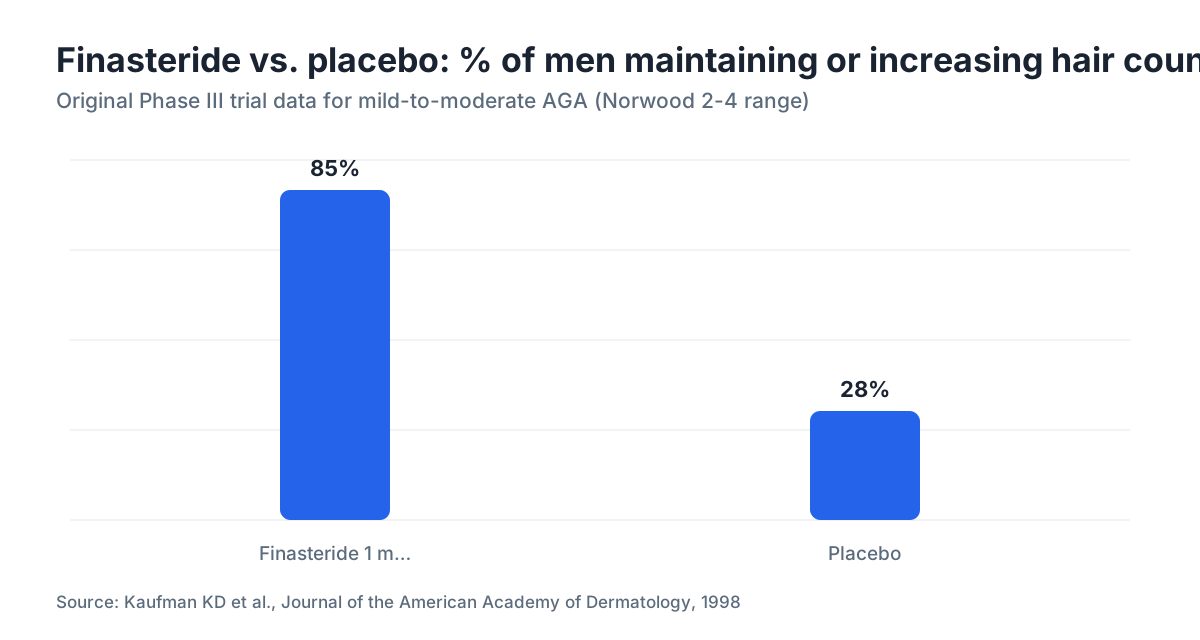
That said, finasteride has the strongest evidence for slowing or stopping AGA. The FDA-approval trials for men with mild to moderate loss (Norwood 2 to 4) found finasteride 1 mg/day maintained or increased hair count in roughly 83 to 87% of men over two years, against 28% on placebo. [7] Extension data out to 10 years showed sustained efficacy in most men who kept taking it. [8]
Minoxidil 5% topical, used once or twice daily, works through a different pathway (extending the anagen phase, improving blood supply to the follicle) and has FDA approval for male-pattern loss. [8] Its preventive effect at Norwood 1 is less studied than finasteride's, but the two combined beat either alone.
The honest framing: these drugs work best started early and taken consistently. Stop finasteride and the protected hair sheds within 6 to 12 months as DHT climbs back to baseline. It's not a cure. It's ongoing management. That trade-off at Norwood 1 comes down to your family history, your risk tolerance, and how you weigh the side effects.
For the full finasteride evidence, the finasteride article covers mechanism, dosing, and side-effect data. If side effects from topical or oral minoxidil worry you, the minoxidil side effects page separates what's documented from what's anecdotal.
Sources
- Norwood OT. Male pattern baldness: classification and incidence. Southern Medical Journal, 1975.
- American Academy of Dermatology (AAD) - Hair Loss
- Vary JC. Selected Disorders of Skin Appendages. Medical Clinics of North America, 2015.
- Sinclair R et al. Androgenetic alopecia. New England Journal of Medicine, 1998.
- Heilmann-Heimbach S et al. Genetic causes of androgenetic alopecia. Lancet, 2017.
- Rakowska A et al. Dermoscopy shows follicular miniaturization in androgenetic alopecia. Journal of the American Academy of Dermatology, 2006.
- Kaufman KD et al. Finasteride in the treatment of men with androgenetic alopecia. Journal of the American Academy of Dermatology, 1998.
- FDA - Propecia (finasteride) labeling and Rogaine (minoxidil) approval
- Guo EL, Katta R. Diet and hair loss: effects of nutrient deficiency and supplement use. Dermatology Practical & Conceptual, 2017.