
TL;DR: Kirkland Signature minoxidil is a generic version of Rogaine sold at Costco. It contains the same active ingredient at the same concentration (2% or 5%), costs roughly 60-70% less than brand-name Rogaine, and is FDA-approved for androgenetic alopecia. Clinical evidence shows no meaningful difference in efficacy between generic and brand minoxidil.
What is Kirkland minoxidil and how does it differ from Rogaine?
Kirkland Signature minoxidil is a store-brand hair loss treatment made for Costco. The active ingredient is minoxidil, the same molecule that made Rogaine the first FDA-approved over-the-counter hair regrowth product for men in 1996, and for women in 1992 at a lower concentration. [1]
The difference between Kirkland and Rogaine is price, not chemistry. Both the 5% solution and the 5% foam use the same active ingredient at the same strength. The FDA requires generic drugs to be bioequivalent to their brand-name reference, meaning the same dose reaches the same tissue at the same rate. [2] What changes between brands is the inactive ingredients, the vehicle (the liquid or foam carrier), and the label.
For the 5% topical solution, Kirkland's inactive ingredients include alcohol, propylene glycol, and water. Some people find propylene glycol irritating to the scalp. Rogaine's foam skips propylene glycol, which is part of why the foam became popular among people who reacted to the liquid. Kirkland makes a foam version too, and it also avoids propylene glycol, but formulations can vary slightly by production batch, so check the current label.
One practical note: Kirkland minoxidil is sold as a 6-bottle pack (each bottle is 60 mL) at Costco and on Costco's website. That's a 6-month supply for one application site at once-daily use, or about 3 months if you apply twice daily as the solution label directs. You buy in bulk, and that's where most of the savings come from.
Is Kirkland minoxidil FDA-approved?
Yes. Minoxidil 5% topical solution is FDA-approved for men, and minoxidil 2% topical solution is FDA-approved for women. The approval covers androgenetic alopecia, the pattern hair loss driven by genetics and androgens. [1]
Kirkland's product is an FDA-approved generic. It goes through the same approval pathway as any other generic drug, which requires showing that the product is pharmaceutically equivalent and bioequivalent to the reference listed drug. The FDA's Orange Book lists approved generic versions of minoxidil, and Kirkland's manufacturer appears on that list. [10]
What FDA approval does not mean: it does not mean minoxidil is approved for every type of hair loss. Alopecia areata, telogen effluvium, traction alopecia, and scalp conditions that cause scarring are separate problems. If you're not sure what's causing your shedding, reading about what causes hair loss before spending money makes sense. The label also does not claim minoxidil will regrow a full head of hair or stop loss entirely. It says minoxidil "can help regrow hair" and that individual results vary, which is an honest summary of the clinical picture.
Does Kirkland minoxidil actually work for hair loss?
The evidence here is for minoxidil broadly, not Kirkland specifically, because no independent trial has enrolled subjects to test Kirkland against Rogaine head-to-head. What we do have is strong clinical data for 5% topical minoxidil versus placebo, plus good reason to expect a bioequivalent generic to behave the same way.
The main efficacy trial was a 48-week randomized double-blind study of 5% topical minoxidil versus 2% versus placebo in men. Men using 5% minoxidil grew a mean of 45% more hair than placebo at 48 weeks and responded faster than the 2% group. [3] A separate review in the Journal of the American Academy of Dermatology found roughly 40% of men using minoxidil reported moderate regrowth. [4] That's real but modest. Nobody should expect Rogaine, Kirkland, or any minoxidil brand to undo years of heavy loss.
Women benefit too. The American Academy of Dermatology recommends minoxidil 2% as a first-line treatment for female pattern hair loss. [4] Some dermatologists use 5% off-label for women, especially for more advanced loss, though the FDA-approved concentration for women is still 2%.
For more on the evidence behind minoxidil, see does minoxidil work. If you're thinking about pairing it with finasteride, finasteride and minoxidil covers how the two drugs interact and whether the combination beats either one alone.
The honest caveat: minoxidil works best for people who are still losing hair, not those who have been bald for years. The crown responds better than the hairline in most studies. And if you stop, whatever hair you gained tends to shed within a few months. It's a maintenance medication, not a one-time fix.
How much does Kirkland minoxidil cost compared to other options?
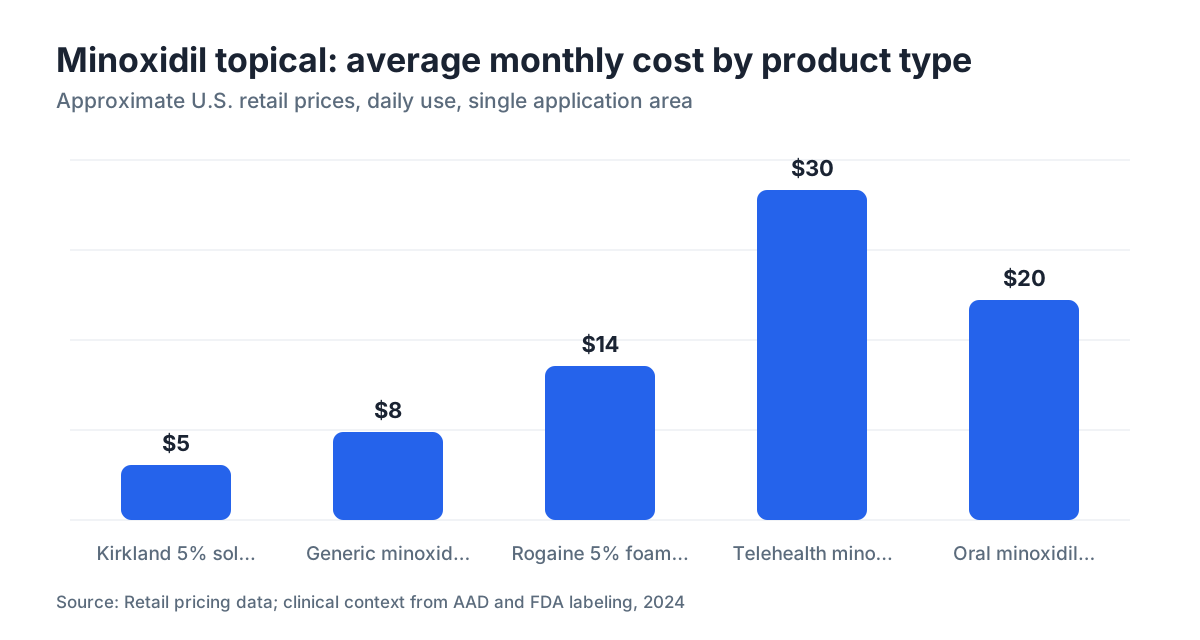
This is where Kirkland earns its reputation. A 6-pack of Kirkland 5% minoxidil solution (six 60 mL bottles) runs roughly $25 to $35 at Costco, though prices shift and members may see slightly different rates than non-members. That works out to about $4 to $6 per month, or $50 to $70 per year for daily use.
Rogaine's 5% foam, the brand-name equivalent, typically runs $35 to $50 for a 3-month supply at major retailers, which is around $120 to $200 per year. Generic minoxidil from other brands (Equate, Hims, Keeps) lands somewhere in between, often $15 to $30 for a 3-month supply.
Prescription oral minoxidil is a separate category. Doses used for hair loss (0.625 mg to 5 mg daily) sit far below the cardiovascular doses that originally put minoxidil on the market, and monthly costs through pharmacies range from roughly $10 to $40 depending on your dose and whether you use GoodRx or a telehealth subscription. [5] See oral minoxidil if you're curious whether the pill might suit you better than topical.
| Product | Approximate monthly cost | Formulation | Prescription? |
|---|---|---|---|
| Kirkland 5% solution (Costco) | $4-6 | Topical liquid | No |
| Rogaine 5% foam | $10-17 | Topical foam | No |
| Generic minoxidil (Equate, etc.) | $5-10 | Topical liquid | No |
| Oral minoxidil (generic tablet) | $10-40 | Pill | Yes |
| Telehealth minoxidil (Hims/Keeps) | $20-40 | Varies | Bundled |
For someone who needs to take minoxidil indefinitely, that $100-plus annual gap adds up fast. Over 10 years, you're looking at $1,000 or more saved compared to name-brand Rogaine, with no evidence you'd get a different clinical result.
What's the difference between Kirkland minoxidil solution and foam?
The solution is a liquid you apply with a dropper. The foam is a mousse-like product you dispense straight onto the scalp. Both deliver 5% minoxidil, but the vehicles (the carriers that move minoxidil to your scalp) differ in a way that matters for some people.
The liquid contains propylene glycol, a common cosmetic solvent that helps minoxidil penetrate the skin. It's effective but can cause dryness, flaking, and irritation in some users. It also leaves hair feeling greasy or stiff, which a lot of people find annoying. The foam has no propylene glycol, which is why it took off after its launch.
Kirkland minoxidil foam follows the same logic: no propylene glycol, lighter feel, faster drying, easier to apply without wrecking your styling. The tradeoff is that foam is harder to apply precisely through thick hair. The dropper on the liquid lets you part the hair and target the scalp directly.
On efficacy, a small randomized trial in the Journal of the American Academy of Dermatology found once-daily 5% foam produced similar hair count increases to twice-daily 2% solution at 24 weeks, which suggests the foam vehicle works at least as well despite its once-daily schedule. [6]
Which should you pick? If you have a sensitive scalp or hate the greasy feel, go foam. If you want the cheapest option and your scalp tolerates it, the liquid is slightly less expensive per month. If you have a receding hairline, the liquid's precision applicator makes it easier to reach the hairline rather than the crown.
How do you use Kirkland minoxidil correctly?
The dosing on the Kirkland label mirrors the FDA-approved labeling for minoxidil 5% solution: apply 1 mL twice daily to the dry scalp in the affected area. The foam label says half a capful (roughly 1 gram) once daily. [1]
For the liquid: part your hair to expose the scalp, draw 1 mL into the dropper (the bottle has a marked dropper), apply directly to the scalp (not the hair), then spread gently with your fingertips. Let it dry at least 4 hours before washing your hair or going to bed. Wash your hands well afterward, because minoxidil absorbed through the hands can grow hair where you don't want it.
For the foam: hold the can upside down, dispense half a capful onto your fingers, apply directly to the dry scalp, and massage in gently. Foam is once daily.
A few things people get wrong:
Applying to wet hair. The scalp needs to be dry so the product absorbs instead of running off.
Expecting fast results. Minoxidil usually triggers initial shedding around weeks 2 to 8 as follicles switch between growth phases. This is normal and temporary, but it scares a lot of first-timers into quitting too soon. Real regrowth usually isn't visible until 4 to 6 months in, and full assessment comes around 12 months. [4]
Using more than directed. More minoxidil does not mean more regrowth. The dose is set to saturate scalp receptors. Extra just raises side effect risk.
Stopping and restarting. Hair gained on minoxidil depends on staying on it. A few weeks off starts a shedding cycle. If you're thinking about adding other approaches, minoxidil for men walks through how to build a routine you'll actually stick to.
What side effects should you watch for with Kirkland minoxidil?
Most side effects with topical minoxidil are local and manageable. Scalp irritation, dryness, and flaking are the most common. They happen more often with the liquid because of propylene glycol, and switching to the foam often fixes them.
Unwanted facial or body hair is a real but usually mild effect. Minoxidil gets absorbed into the bloodstream in small amounts, and that systemic exposure can wake up follicles elsewhere. For women especially, facial hair growth is worth watching. Keeping application on the scalp and washing your hands right away helps limit it.
The more serious side effects, including chest pain, rapid heart rate, sudden weight gain from fluid retention, and dizziness, are on the label because minoxidil was first developed as an oral blood pressure drug. [1] These are rare with topical use at these doses, but they're not theoretical. Anyone with a history of heart disease should talk to a doctor before starting.
Initial shedding, as noted above, isn't exactly a side effect, but it's the thing that drives the most panicked Google searches around weeks 3 to 6. It happens because minoxidil pushes resting follicles into an active growth phase, which first requires shedding the old hair. Holding on through this phase is the single most important behavior in whether minoxidil ends up working for you.
For a full breakdown, minoxidil side effects covers the evidence on each reported adverse event and how common they actually are in clinical data.
Who should not use Kirkland minoxidil?
The FDA label is specific about who should stay away. Do not use minoxidil if you are under 18. Do not use it if your hair loss is sudden, patchy (as in alopecia areata), or comes with scalp redness, itching, or pain without a medical evaluation first. Do not use it if you're pregnant or nursing, because the safety data in pregnancy is thin. [1]
People with heart disease, high blood pressure, or who already take prescription medications should get a physician's sign-off before using topical minoxidil. Systemic absorption is low but not zero.
Kirkland's 5% solution is labeled for men. Women who want to try 5% minoxidil are using it off-label. Many dermatologists do recommend it for women with significant androgenetic alopecia, but the FDA-approved women's label covers 2%, not 5%. That's a real distinction, not a marketing one.
If your hair loss has an obvious trigger (a recent major illness, a crash diet, a new medication, heavy stress) you may be dealing with telogen effluvium rather than genetic pattern loss. Minoxidil may still help, but it won't fix the trigger, and the shed hair often regrows on its own once the trigger clears.
Where can you buy Kirkland minoxidil and are there fakes to watch out for?
The most reliable place to buy Kirkland minoxidil is directly from Costco, in-store or on costco.com. Costco sells the 6-pack in most warehouses and ships it online. You don't need a Costco membership to buy through the website, though members get standard member pricing.
The product also shows up on Amazon from third-party sellers. That's where the fake or tampered product risk enters. Amazon's marketplace lets third-party sellers list products, and the FDA has warned more broadly about counterfeit topical minoxidil circulating online. [7] Buying from the official Costco site or a Costco warehouse nearly eliminates this risk. If you're buying on Amazon, confirm the seller is Costco itself or a highly rated seller with verified inventory, and inspect the packaging when it arrives.
There's no evidence of widespread Kirkland-specific counterfeiting as of this writing, but the general risk of online gray-market health products is real enough to mention. A product with a damaged seal, an odd smell, or inconsistent labeling is worth returning.
Some people use a free AI hair analysis tool, like the one at MyHairline (/scan), to track whether their scalp is actually responding before committing to a 6-month Costco pack. Having a baseline helps no matter which brand you choose.
How does Kirkland minoxidil compare to finasteride or a hair transplant?
These are different tools for different stages of hair loss, and they're not mutually exclusive.
Finasteride blocks DHT (dihydrotestosterone), the androgen that miniaturizes follicles in androgenetic alopecia. A 5-year randomized trial found finasteride significantly increased hair count and slowed progression in men with male pattern baldness. [8] Minoxidil works differently, likely widening blood vessels in the scalp and directly lengthening the anagen (growth) phase of the hair cycle. Because the mechanisms differ, many dermatologists use both together. The finasteride and minoxidil article goes through the combination evidence in detail.
For women, finasteride is generally avoided because of the risk to a developing fetus and weaker efficacy data in female pattern loss. Minoxidil stays the primary drug option, sometimes paired with spironolactone or another anti-androgen.
A hair transplant is surgery that physically moves DHT-resistant follicles from the back and sides of the scalp to thinning areas. Transplants can produce permanent results in the right candidate, but they're expensive ($4,000 to $15,000 or more depending on graft count and clinic), take recovery time, and don't stop ongoing loss in non-transplanted areas. Most surgeons want patients on medical therapy like minoxidil before and after surgery to protect native hair. hair transplant expenses breaks down the costs if you want to compare what you'd spend over decades on Kirkland minoxidil versus saving for surgery.
Put plainly: if you're in early-to-mid pattern hair loss, minoxidil and finasteride together are the most evidence-backed starting point. Kirkland minoxidil is a perfectly good, cheap way to get your minoxidil. Surgery is an option once medical therapy has plateaued and you have realistic expectations.
How long does it take to see results from Kirkland minoxidil?
Four to six months before you see real regrowth. That's the honest answer backed by the trial data, and it's longer than most people expect when they start.
Here's the typical timeline:
Weeks 1 to 8: You may see increased shedding. This is the minoxidil-induced phase transition. Some people see nothing at all. Some see new fine hairs at the very edge of loss areas.
Months 2 to 4: Shedding usually slows. Early vellus (fine, colorless) hairs may appear in thinning areas. Not visible enough to notice from across a room.
Months 4 to 6: Terminal (pigmented, thicker) hairs start coming in where the vellus growth appeared. This is where people begin to notice something is happening.
Months 6 to 12: Maximum response for most users. The 48-week trials that established minoxidil's efficacy used 12 months as their primary endpoint for a reason. [3]
After 12 months, you're in maintenance. Most users don't keep gaining hair forever; they hold what they've gained and slow further loss. If you've used minoxidil correctly for 12 months and see no change at all, the honest read is that you may be a non-responder. Somewhere around 30 to 40% of users get modest-to-no response. [4] That's not a failure of the product; it reflects how much individual follicle sensitivity to minoxidil varies.
Is Kirkland minoxidil worth it? An honest verdict
For most people with androgenetic alopecia who want to try topical minoxidil, Kirkland is the obvious money choice. Same active ingredient, same concentration, FDA-approved generic pathway, and a fraction of Rogaine's cost. If you were going to buy Rogaine anyway, buy Kirkland instead.
The caveats are real but minor. If propylene glycol irritates your scalp, pay up for the foam. If the bulk Costco commitment feels like too much before you know whether you'll respond, start with a month or two of another generic from a pharmacy to test your skin's tolerance.
Minoxidil in general (Kirkland included) is not a miracle. It works best for people who catch their loss early, apply it consistently (twice daily for the solution, once daily for the foam), and don't quit when they hit the initial shed. It's a solid first-line medication at a very low price, and that's a reasonable place for most people to begin.
If you're weighing all your options, hair loss supplements covers what the evidence says about vitamins and supplements, since a lot of people take them alongside minoxidil and the payoff varies a lot. For a wider look at what else might be hitting your hair, does creatine cause hair loss is worth a read if you're active and supplementing.
A free AI hair analysis at MyHairline (/scan) can help you figure out your Norwood stage and whether your pattern of loss is the kind minoxidil handles well, before you commit to a multi-month supply.
Sources
- FDA, Minoxidil Topical Solution 5% Drug Label (DailyMed)
- FDA, Generic Drug Facts
- Olsen EA et al. (2002). A randomized clinical trial of 5% topical minoxidil versus 2% topical minoxidil and placebo in the treatment of androgenetic alopecia in men. Journal of the American Academy of Dermatology, 47(3), 377-385.
- American Academy of Dermatology, Hair Loss: Diagnosis and Treatment
- Randolph M, Tosti A. (2021). Oral minoxidil treatment for hair loss: A review of efficacy and safety. Journal of the American Academy of Dermatology, 84(3), 737-746.
- Blume-Peytavi U et al. (2011). A randomized double-blind placebo-controlled pilot study to assess the efficacy of a 24-week topical treatment by minoxidil 5% foam on the frontal temporal region of the scalp. Skin Pharmacology and Physiology, 24(4), 196-204.
- FDA, Counterfeit Medicine
- Kaufman KD et al. (1998). Finasteride in the treatment of men with androgenetic alopecia. Journal of the American Academy of Dermatology, 39(4), 578-589.
- NIH MedlinePlus, Minoxidil Topical
- FDA, Orange Book: Approved Drug Products with Therapeutic Equivalence Evaluations