
TL;DR: Topical minoxidil (2% or 5%) is the only FDA-approved treatment for female hair loss. Spironolactone and finasteride are prescribed off-label with solid evidence behind them. The right treatment depends entirely on the diagnosis: androgenetic alopecia, telogen effluvium, and alopecia areata each need a different drug, so getting the diagnosis right comes before spending a dollar.
What is women's alopecia and why does the type matter so much?
Alopecia just means hair loss. That's it. It isn't a single disease. The word covers at least a dozen conditions with different causes, different biology, and treatments that don't overlap. A woman who tries minoxidil for alopecia areata while assuming she has androgenetic alopecia can burn six months and get nowhere.
Four types cover most women. Female pattern hair loss (FPHL, also called androgenetic alopecia), telogen effluvium, alopecia areata, and scarring alopecias like frontal fibrosing alopecia. FPHL is the most common, affecting roughly 40% of women by age 50 according to the American Academy of Dermatology [1]. Telogen effluvium, the diffuse shedding that follows stress, illness, childbirth, or crash dieting, is the second most common reason women see a dermatologist for hair loss [2].
The distinction matters because the treatments are unrelated. FPHL is driven by androgen sensitivity at the follicle, so anti-androgen drugs help. Telogen effluvium is a temporary disruption of the hair cycle, so the job is finding and fixing the trigger. Alopecia areata is autoimmune, so the drugs that work suppress the immune response. Treat one like another and you waste money and time.
A dermatologist can usually spot FPHL from a physical exam and a pull test, but bloodwork is nearly always worth running. Thyroid trouble, iron deficiency, and low ferritin all cause diffuse shedding that mimics FPHL but isn't. The Cleveland Clinic recommends checking TSH, free T4, ferritin, serum iron, TIBC, CBC, and androgens (total and free testosterone, DHEAS) in any woman with diffuse hair loss [2].
What is the FDA-approved treatment for female hair loss?
Topical minoxidil is the only drug the FDA has approved specifically for female pattern hair loss [3]. The 2% formulation was approved for women in 1991. The 5% foam followed in 2014. That's the entire approved list for FPHL in women.
Minoxidil works by prolonging the anagen (growth) phase of the hair cycle and increasing blood flow to the follicle. It doesn't block androgens, which is why it helps regardless of whether hormones are the driver. The FDA label for the 5% foam has women apply it once daily. The 2% solution is typically twice daily [3].
In clinical trials, 5% minoxidil foam applied once daily produced significantly greater increases in hair count than placebo at 24 weeks [4]. Earlier trials of the 2% solution found that about 19% of women rated their regrowth as moderate to dense, versus 7% on placebo, after 32 weeks. The results are real and modest. Most women see less shedding within 8 weeks and visible regrowth by 4 to 6 months, if they're going to respond at all.
Here's the catch you can't work around: you have to keep using it. Stop minoxidil and whatever came back is gone within 3 to 4 months, because you were only changing the hair cycle, not fixing the cause.
If you want the side effect picture before starting, the minoxidil side effects article covers hypertrichosis, scalp irritation, and the initial shedding phase that rattles almost everyone in the first 6 weeks.
How effective is minoxidil for women compared to other options?
Minoxidil is a solid first-line treatment and rarely a complete fix on its own for women with significant androgenetic alopecia. It slows loss and produces partial regrowth in most users. It doesn't wake up follicles that have already gone dormant.
The table below pulls from the major trials and AAD guidelines.
| Treatment | Evidence level | Typical regrowth | Time to see results | FDA-approved for women? |
|---|---|---|---|---|
| Topical minoxidil 5% | Level I (RCTs) | Modest to moderate | 4-6 months | Yes |
| Topical minoxidil 2% | Level I (RCTs) | Modest | 4-6 months | Yes |
| Oral minoxidil (0.25-2.5 mg) | Level II (open-label trials) | Moderate | 3-6 months | Off-label |
| Spironolactone (100-200 mg) | Level II | Moderate | 6-12 months | Off-label |
| Finasteride (1-2.5 mg) | Level II | Moderate | 6-12 months | Off-label |
| Platelet-rich plasma (PRP) | Level III | Variable | 3-6 months | Not approved |
| Low-level laser therapy | Level II | Modest | 4-6 months | FDA-cleared (device) |
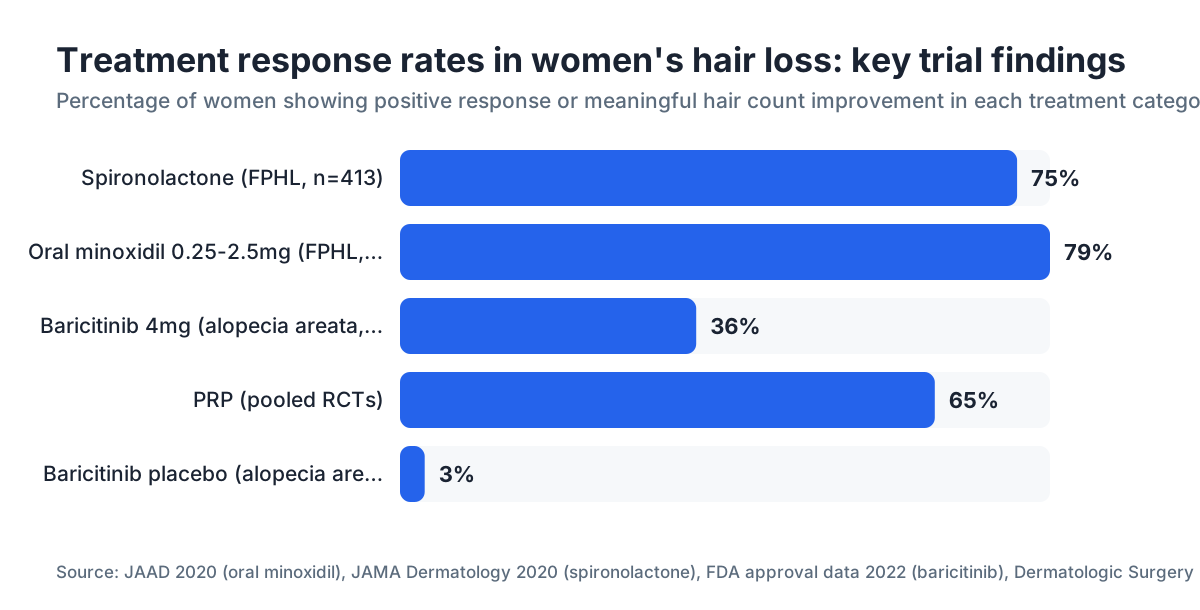
Oral minoxidil has picked up real momentum. A 2020 retrospective review in the Journal of the American Academy of Dermatology found that low-dose oral minoxidil (0.25 mg to 2.5 mg daily) improved hair density in 79 of 100 female patients with pattern hair loss [5]. The lower doses cut the cardiovascular and fluid retention problems that made higher doses impractical. Many dermatologists now treat it as a better bet than topical for women who can't tolerate the scalp application or hate the cosmetic residue.
For how minoxidil behaves differently in women versus men, see the minoxidil for men article, which covers the androgen-related differences in how follicles respond.
Does spironolactone work for female hair loss?
Spironolactone is probably the most prescribed off-label treatment for FPHL in women in the United States. It's an aldosterone antagonist first developed for blood pressure that also blocks androgen receptors and cuts DHT binding at the follicle. For women whose hair loss runs on androgens, it can work well.
A 2020 retrospective cohort study in JAMA Dermatology found that 74.6% of women with FPHL treated with spironolactone had a positive response on global photographic assessment over a median of 2 years [6]. That isn't a randomized controlled trial, but it's a large real-world sample (n = 413), and the response rate matches what clinicians report in practice.
Typical doses run from 100 mg to 200 mg daily. At 100 mg, most women tolerate it fine. Higher doses raise the risk of menstrual irregularities, breast tenderness, and hyperkalemia (high potassium), especially in women with kidney disease. Spironolactone is a potent teratogen, so it's off the table during pregnancy or for women trying to conceive.
One more thing worth knowing. Spironolactone is slow. Don't judge it before 6 months. Most dermatologists run a 12-month trial before calling it a failure. Combining it with topical minoxidil is standard practice and makes biological sense, since the two hit different mechanisms.
Can women take finasteride for hair loss?
Yes, though it's messier than in men. Finasteride is FDA-approved only for men, but it's prescribed off-label for postmenopausal women with FPHL fairly often. In premenopausal women the math changes.
Finasteride blocks 5-alpha reductase type II, the enzyme that converts testosterone to DHT. DHT is the androgen mainly responsible for follicle miniaturization in androgenetic alopecia. In men, 1 mg daily drops scalp DHT by roughly 60%. Women usually need a higher dose to get the same suppression, because women have less type II 5-alpha reductase and more type I. Studies in postmenopausal women have used 1 mg to 5 mg daily, with some researchers reporting better results at 2.5 mg [7].
For premenopausal women, the concern is fetal exposure. Finasteride causes genital malformations in male fetuses at even low doses, which means any woman who might become pregnant should not take it without reliable contraception. The FDA label is categorical on this.
A 2000 randomized controlled trial in postmenopausal women with FPHL found that 1 mg finasteride daily produced no statistically significant improvement over placebo [8]. Higher doses and women with elevated androgens may respond better. If a woman's DHEAS or free testosterone is high, an anti-androgen approach makes more mechanistic sense than if her hormones sit in the normal range. For the mechanism, the finasteride and DHT blocker articles go deeper on the androgen pathway.
The finasteride-plus-minoxidil combination gets its own treatment in the finasteride and minoxidil article, which covers what stacking both does to DHT levels and hair count.
What treatments work for alopecia areata in women?
Alopecia areata is autoimmune. T-cells attack the follicles. It's a different disease from FPHL and the treatments reflect that. Minoxidil can help regrowth cosmetically but does nothing about the immune attack itself.
For mild to moderate alopecia areata (less than 50% scalp involvement), intralesional corticosteroid injections are first-line. The AAD's clinical guidelines recommend triamcinolone acetonide injected into bald patches every 4 to 8 weeks, typically at 5 to 10 mg/mL [1]. Most dermatologists consider this the most reliable option for patchy disease. Regrowth at the injection site usually shows up within 4 weeks.
Severe or stubborn cases changed in 2022, when the FDA approved baricitinib (Olumiant), a JAK1/JAK2 inhibitor, for severe alopecia areata in adults. It was the first FDA-approved systemic treatment for the condition [9]. A second JAK inhibitor, ritlecitinib (Litfulo), got FDA approval in 2023. In the BRAVE-AA2 trial, 36% of patients on baricitinib 4 mg reached a SALT score of 20 or less (80% or more scalp coverage) at 36 weeks, versus 3% on placebo [9].
JAK inhibitors work, but they're expensive, they carry black box warnings for serious infections, cancer, and cardiovascular events, and they're usually held back for patients who've failed other approaches. Topical JAK inhibitors for alopecia areata are still in trials as of mid-2025.
For women with extensive alopecia areata who don't respond to injections or can't tolerate systemic drugs, oral minoxidil can at least help overall density while the immune condition gets managed separately.
Is hair transplant an option for women with alopecia?
Hair transplant works for some women with FPHL, but who qualifies is far narrower than in men. The requirement is a stable donor area with healthy follicles that future loss won't touch. In men with predictable male pattern baldness, the sides and back are usually safe. In women with diffuse FPHL, the thinning often reaches the donor area too, which can sink a transplant over time.
The best candidates have pattern loss confined to the front and crown, a dense and unaffected donor area, and hair loss that's held stable for at least 1 to 2 years. Women with traction alopecia (from tight hairstyles) and those with hairline recession from FPHL who've plateaued on medical treatment can also do well.
Women with alopecia areata are generally not candidates, because the immune attack that caused the original loss can turn on the transplanted follicles too.
The hair transplant article covers the full process, FUE versus FUT, and realistic costs if you want to weigh that route. Procedure costs in the US run from $4,000 to $15,000 depending on graft count and clinic.
One practical note. Most surgeons want a woman on stable medical therapy (usually minoxidil) for at least 6 to 12 months before a transplant evaluation, because transplanting onto an actively thinning scalp only compounds the problem.
What about PRP, LLLT, and other newer treatments?
Platelet-rich plasma (PRP) has built a reasonable body of evidence over the past decade, though no regulator has formally approved it for hair loss. The provider draws a small amount of blood, spins it to concentrate the growth factors in platelets, and injects it into the scalp. Those growth factors (PDGF, VEGF, and IGF-1) push follicle activity and new blood vessel growth.
A 2019 meta-analysis in Dermatologic Surgery pooled 11 randomized controlled trials and found statistically significant improvements in hair count and thickness with PRP versus controls [10]. Effect sizes were moderate. The practical catches: protocols vary wildly between providers (spin speed, platelet concentration, and injection technique all move the result), insurance won't cover it, and a course of 3 to 4 initial sessions runs $1,500 to $4,000 in the US.
Low-level laser therapy (LLLT) devices, including laser helmets and combs, hold FDA clearance as medical devices for hair growth, which is a lower regulatory bar than drug approval. The mechanism isn't nailed down but likely involves raising mitochondrial activity in follicle cells. A 2014 RCT in women with FPHL found significantly higher hair counts in the LLLT group versus a sham device at 26 weeks [11]. The gains are modest and device quality is all over the map.
Supplements like biotin get heavy marketing on thin evidence. Biotin deficiency is genuinely rare, and supplementing biotin in someone who isn't deficient has shown no benefit in controlled trials. Saw palmetto has weak evidence for mild DHT inhibition. The hair loss supplements article sorts what's worth taking from what's a waste of money.
For women worried that something external is driving the loss, the what causes hair loss article breaks down the full range including medications, autoimmune triggers, and nutritional gaps.
What does a realistic treatment plan look like?
You've just been diagnosed with FPHL and you're starting from zero. Here's how most evidence-based dermatologists build the plan.
First, confirm the diagnosis and rule out fixable causes. Low ferritin is everywhere among women and can cause shedding that looks exactly like FPHL. The target ferritin for hair growth is debated, but many hair loss specialists aim above 70 ng/mL rather than the standard lab floor of 12 to 15 ng/mL. Fix the ferritin first. It's cheap and sometimes it's the whole answer.
Second, start minoxidil. For most women the 5% foam once daily is easier and slightly more effective than the 2% solution. Give it at least 6 months before you judge. If topical minoxidil irritates your scalp or you hate the routine, low-dose oral minoxidil (0.25 to 1 mg daily for women) is a reasonable alternative your dermatologist can prescribe.
Third, consider an anti-androgen if you're premenopausal with no pregnancy plans, or postmenopausal. Spironolactone is easier to access than finasteride in most US practices. Add it to minoxidil, not instead of it.
Fourth, set expectations with real numbers. Even with optimal treatment, most women with FPHL recover 10% to 20% of lost density over the first year. The goal is to stop the loss and partially restore what's gone, not to get back to age-25 density. Treatment is indefinite. Stop the drugs and the loss picks up again.
If you're unsure what stage or pattern you're dealing with, a structured assessment helps. The free AI hair scan at MyHairline can map your current pattern before you see a dermatologist, so you walk in with baseline documentation. That's the whole point of it. It doesn't replace a diagnosis. It makes the consultation more productive.
Are there any treatments specifically for postmenopausal hair loss?
Yes, and the hormonal shift at menopause is worth understanding, because it changes which treatments make the most sense.
Estrogen extends the anagen phase of the hair cycle. When estrogen drops at menopause, the relative androgen effect on follicles rises even if androgen levels hold steady. That's why FPHL often speeds up after menopause. It isn't necessarily that androgens went up. It's that estrogen's protective effect is gone.
Hormone replacement therapy (HRT) doesn't reliably help hair loss, and the evidence is mixed. Some formulations with androgenic progestins (like levonorgestrel or norgestrel) can make FPHL worse. Progestins with anti-androgenic activity, like drospirenone or cyproterone acetate, may help. If a postmenopausal woman is already weighing HRT for other reasons, talking through progestin choice with her gynecologist in the context of hair loss is reasonable.
Finasteride fits better in postmenopausal women than premenopausal ones, because the teratogenicity risk no longer applies. Doses of 1 mg to 2.5 mg daily are used. Some data suggest postmenopausal women with elevated androgens respond to finasteride better than those with normal androgen levels [7].
Spironolactone stays a solid option. Blood pressure effects become relevant in older women, so monitoring is warranted, but for most healthy postmenopausal women the hair loss doses (75 to 200 mg daily) are well tolerated.
Topical minoxidil stays first-line at any age. If scalp absorption is a concern or topical application isn't practical, low-dose oral minoxidil works in older women as well as younger ones, with blood pressure and weight watched along the way.
What triggers or worsens hair loss in women that's often missed?
Several common contributors slip through a standard workup, and fixing them can change the whole trajectory.
Iron deficiency without anemia is the big one. Ferritin tracks iron stores, and follicles are metabolically busy enough that low ferritin can stall hair cycling well before hemoglobin drops enough to cause anemia. A ferritin below 30 ng/mL in a woman with diffuse shedding is worth treating, full stop.
Thyroid disease, both under and over, causes diffuse shedding. It usually starts 3 to 6 months after the thyroid goes out of range and resolves 6 to 12 months after it's corrected. Women on thyroid medication who develop hair loss should have their TSH rechecked. Overtreatment with levothyroxine (a suppressed TSH) also causes shedding.
Crash dieting and calorie restriction get overlooked constantly. The follicle is metabolically expensive, and the body deprioritizes it during a caloric deficit. The telogen effluvium article explains the mechanism. The shedding usually starts 2 to 4 months after the dietary trigger, which is why women rarely connect the two.
Some medications cause hair loss as a documented side effect: lithium, valproate, retinoids, beta-blockers, heparin, and certain ACE inhibitors are the usual suspects. Birth control pills with a high androgen index can worsen FPHL. If hair loss started or got worse after a medication change, that timeline matters.
Traction alopecia from tight buns, braids, and extensions damages follicles progressively in the temporal and frontal regions. Caught early, it's reversible once the hairstyle changes. Left chronic, it scars follicles permanently. It doesn't respond to minoxidil or anti-androgens. Once the follicles have scarred, hair transplant to the affected areas is the only option.
For readers curious about specific lifestyle factors, the does creatine cause hair loss article tackles a common question about supplements and androgens.
What should you expect from a dermatology appointment for hair loss?
Most first appointments for hair loss run 20 to 40 minutes. Here's what actually happens and what to push for.
A good dermatologist does a pull test (grasping 40 to 60 hairs and pulling gently, where more than 6 coming out is abnormal), examines the scalp with a dermatoscope, and takes a detailed history: timing of loss, recent stressors, medications, menstrual history, family history. They should order bloodwork including ferritin, a thyroid panel, and androgens at minimum.
If the diagnosis sits between FPHL and diffuse alopecia areata, a scalp biopsy settles it. Two 4mm punch biopsies from the affected area, processed with horizontal sectioning, give the most diagnostic information. It sounds worse than it is. Local anesthetic, the biopsy takes under 5 minutes, and the cosmetic result is basically invisible.
Come with photos. Pull-back photos taken in the same lighting and position over time are the single most useful tool for tracking progression and response. Most phone cameras do the job. If you've been documenting your hair already, bring the photos. If you haven't, start today.
A baseline assessment from the MyHairline AI scan gives you a structured pattern map to show your dermatologist, which makes the appointment more efficient and leaves you something to compare against later.
Don't leave without three things: a clear diagnosis, a treatment plan with specific drugs and doses, and a follow-up timeline. A responsible clinician sets a 3 to 6 month check-in for labs and clinical assessment. If you walk out with a sample of minoxidil and no diagnosis, you didn't get what you came for.
Sources
- American Academy of Dermatology, Hair Loss in Women guidelines
- Cleveland Clinic, Female Pattern Hair Loss overview
- FDA, Minoxidil Topical Foam 5% prescribing information
- Blume-Peytavi U et al., JAAD 2011 to 5% minoxidil foam RCT in women
- Sinclair RD et al., JAAD 2020, low-dose oral minoxidil retrospective review
- Vañó-Galván S et al., JAMA Dermatology 2020, spironolactone cohort study
- Iorizzo M et al., Archives of Dermatology, finasteride 2.5 mg in postmenopausal women with FPHL
- Price VH et al., JAAD 2000, finasteride 1 mg RCT in postmenopausal women
- FDA, Baricitinib (Olumiant) approval for alopecia areata, 2022
- Gupta AK & Renaud HJ, Dermatologic Surgery 2019, PRP meta-analysis
- Lanzafame RJ et al., Lasers in Surgery and Medicine 2014, LLLT RCT in women